this post was submitted on 23 Apr 2026
1380 points (97.4% liked)
Science Memes
19991 readers
2678 users here now
Welcome to c/science_memes @ Mander.xyz!
A place for majestic STEMLORD peacocking, as well as memes about the realities of working in a lab.

Rules
- Don't throw mud. Behave like an intellectual and remember the human.
- Keep it rooted (on topic).
- No spam.
- Infographics welcome, get schooled.
This is a science community. We use the Dawkins definition of meme.
Research Committee
Other Mander Communities
Science and Research
Biology and Life Sciences
- !abiogenesis@mander.xyz
- !animal-behavior@mander.xyz
- !anthropology@mander.xyz
- !arachnology@mander.xyz
- !balconygardening@slrpnk.net
- !biodiversity@mander.xyz
- !biology@mander.xyz
- !biophysics@mander.xyz
- !botany@mander.xyz
- !ecology@mander.xyz
- !entomology@mander.xyz
- !fermentation@mander.xyz
- !herpetology@mander.xyz
- !houseplants@mander.xyz
- !medicine@mander.xyz
- !microscopy@mander.xyz
- !mycology@mander.xyz
- !nudibranchs@mander.xyz
- !nutrition@mander.xyz
- !palaeoecology@mander.xyz
- !palaeontology@mander.xyz
- !photosynthesis@mander.xyz
- !plantid@mander.xyz
- !plants@mander.xyz
- !reptiles and amphibians@mander.xyz
Physical Sciences
- !astronomy@mander.xyz
- !chemistry@mander.xyz
- !earthscience@mander.xyz
- !geography@mander.xyz
- !geospatial@mander.xyz
- !nuclear@mander.xyz
- !physics@mander.xyz
- !quantum-computing@mander.xyz
- !spectroscopy@mander.xyz
Humanities and Social Sciences
Practical and Applied Sciences
- !exercise-and sports-science@mander.xyz
- !gardening@mander.xyz
- !self sufficiency@mander.xyz
- !soilscience@slrpnk.net
- !terrariums@mander.xyz
- !timelapse@mander.xyz
Memes
Miscellaneous
founded 3 years ago
MODERATORS
you are viewing a single comment's thread
view the rest of the comments
view the rest of the comments
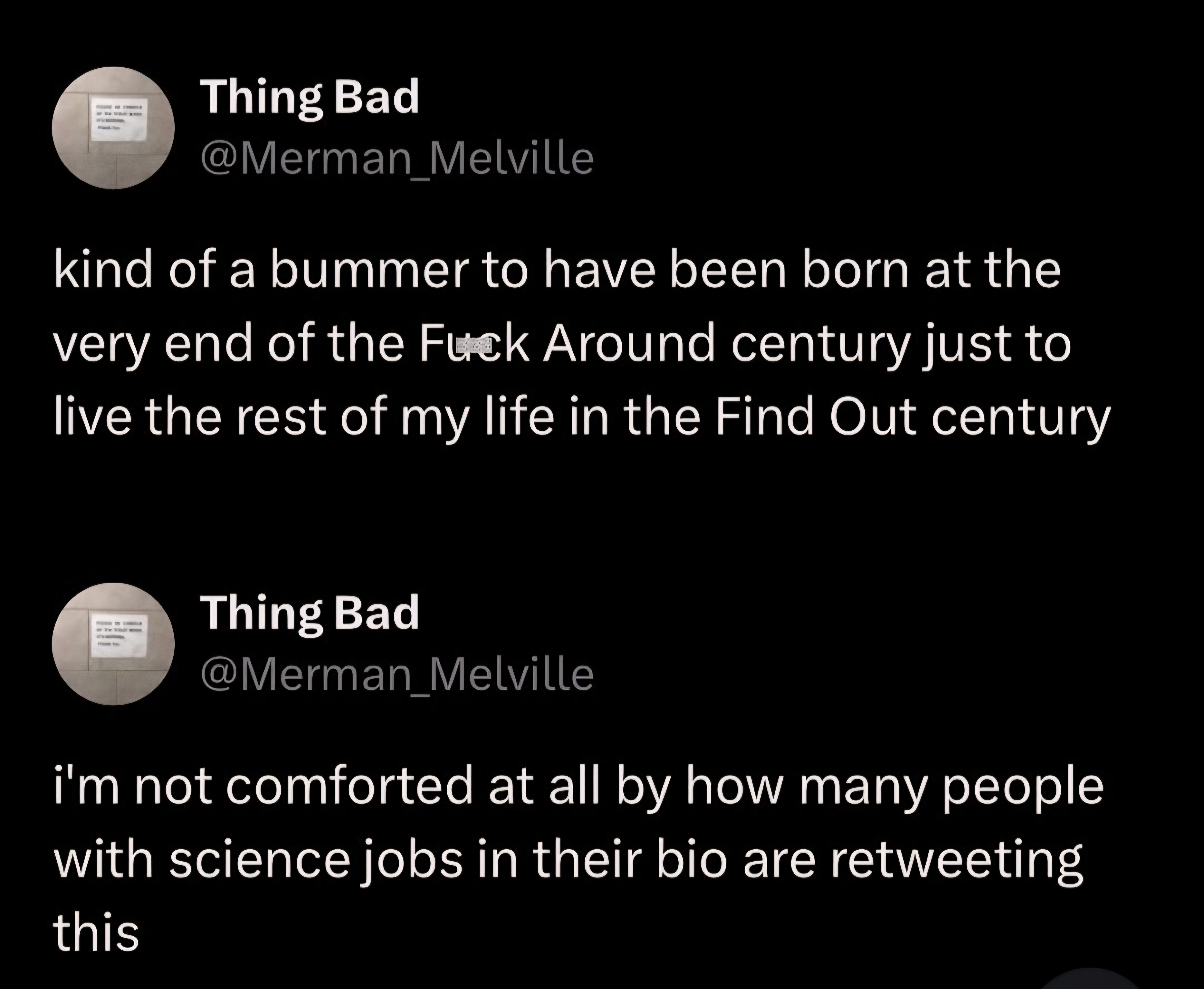
The betrayal of generations from the 20th century against the future quality of life of humanity will be remembered for thousands of years.
That is not hyperbole, this period of human history is alone in its murderous intent to erase the human race and it can never be surpassed for if it does humanity will go extinct.
Boomers lived through the easiest, most rewarding period of American history and immediately and repeatedly ensured that no cohort following them would ever have the same again.
As a group, they are the weakest, most selfish, and least adaptable generation in modern history.
We'll now begin our unit on "the time the people who wanted to end the world got control of the world, and how that all happened in spite of them not even being fucking subtle about it."
Just call it the century of greed
Greed can at least account for the future. The most powerful government in the world is lead by people who actually think wrecking the world for everyone else will help them reach paradise.
we could call it the century of buttholes and you're going for greed? REAALLLY

Butt holes have a positive function, I do not agree with being that kind to our centuries.
Not just one..
Very good point. It is a noble hole.
The only reason "shit just works" for y'all is that noble hole!
I'll compromise
The century of greedy butthole
That's not a compromise, that's fucking synergy
Nah, I'm pretty sure it's regular synergy
Remembered by whom? Big assumption there...
It's very interesting that the nukes dropped will be mentioned, but the real death toll of the century was plain simple greed and selfishness. Those two working together have and will kill countless more in the upcoming century
Yes, how disturbing is it that the dropping of the nuclear bombs on Japan will be most useful to historians not as a hyperbolic tragedy that stood alone but as a way to explain the much broader mass slaughter of humans that the 20th century perpetrated and locked in for thousands of years?
TBF the dropping of the bombs on Hiroshima and Nagasaki was immediately preceded by far larger slaughters of humanity using more conventional methods, a fact which somewhat minimizes their significance. I'm referring mainly to the Holocaust and the Japanese genocide in China, but even the US firebombing of Tokyo in early 1945 exceeded the death tolls of the atomic bombings.
But how will we get more money to the shareholders if we stop pushing humanity towards extinction!?
see there's your problem. shareholders. thinking of them as plural.
Not if MechaHitler's daddy has anything to say about it.
I think of them as The Buffet, which is singular.
Are those generations really worse than those before it? Yes the environmental destruction is unparalleled but so were also the tools that enable that. In the Stone Age people could not have even come close to doing what we are doing right now to the environment even if they wanted too.
The term the tragedy of the commons originally referred to English cattle herders letting their cows overgraze public land because if they don't overgraze it some other herders would do it instead. Stories like this are everywhere in history. The Vikings cut down every single tree in Iceland and the Faroe islands when they arrived with no care for the environmental whatsoever.
Whaling, the clubbing of seals, the extinction of the dodo. There are countless examples. And if we are talking pure human to human cruelty, no war in the 20th century comes close to what the mongols did.
The people of the 20th century were not more cruel or selfish than previous ones. They were simply the first ones given the tools and ability to pollute the whole earth.
The real significance of the term "tragedy of the commons" was that it was part of a campaign of PR bullshit used to justify Enclosure, where wealthy elites seized common land as their private property, land that had in fact been used and managed effectively as a public resource for centuries prior.
I am uninterested in comparing the moral qualities of generations. Humans are humans.
I am interested in the scale of the violence done by these generations against the earth as it will never be able to be surpassed without fully annihilating the human race.
800 years from now no one is going to care how sorry everyone was now about the damage they have done, what matters is the impact and for the destructive impact generations such as Boomers have done to the earth they will be remembered for thousands of years as a calamity.
By the way the "Tragedy Of The Commons" has largely been discarded as a useful way of understanding societies, it is a political narrative with an interest in specific ideologies more than a serious tool to understand humanity.
https://boingboing.net/2019/03/07/scientific-fraud.html
...
I did not know the history of the term tragedy of the commons. Thanks for educating me on that, I will now reconsider using that specific term in the future. However overgrazing is a real issue historically and still today. Overgrazing in the modern Sahel is a great contributor to the advancing of the sahara for example.
Oh definitely, my issue with the concept of the Tragedy Of The Commons is not that shared wealth is not vulnerable but rather that the idea that humans innately cannot function in an environment while preserving and growing a shared commons without some kind of system of authoritarian control and violence actively preserving that shared commons is a deeply political, problematic and scientifically incorrect way of understanding people.
i dunno. the community garden run by the local MS-13 has the weirdest red drip system, but my begonias have never looked better.
I would imagine a system you're suggesting would first have to eliminate scarcity of resources. We certainly have the ability to do that with our technology today but choose not to do so. Wouldn't it require a turn to benevolence by all involved in the society to achieve that? If so, that doesn't sound like a likely outcome. What, in your opinion, would it take to escape the Tragedy of Commons that is likely to actually occur?
Provide evidence for this claim.
I understand this has been established as our cultural intuition but it is a near axiomatic assumption that upon examination has very little evidence to support it, whether we look to the natural world or to human societies.
I can provide zero evidence. I'm trying to imagine a world where your proposal works. Scarcity elimination the best possible way I could come up with.
If your proposal doesn't need to eliminate scarcity, I'm even more interested in how it is done. Whats the secret sauce has society-at-large been missing? You mention examining human societies. Do you have a human society to point to where your proposal exists successfully already?
Every single human society in history where a commons was maintained via a system other than centralized authoritarian violence?
In other words, every society that experienced periods not entirely ruled by an oppressive, authoritarian regime and that had/have some shared wealth whether it be in public spaces, public knowledge, public utilities, public education or other forms of public shared resource.
If we turn to the natural world it is very difficult to find ecosystems that function purely on a scarcity mechanism. If one considers the function of a predator in an ecosystem, it is precisely to stabilize an ecosystem so it can absorb large inputs of excess resources without the system collapsing. If one considers the basic function of herbivores in an ecosystem it is the same, to stabilize the growth of plants so that abrupt periods of resource abundance and opportunity don't destabilize the forest.
The only systems I can think of that function under the axiom that you suggest, which is that scarcity is a necessary obstacle to tackle before systems can resist destroying shared resources, are ecosystems dominated by invasive species and cancer. In both cases, it is the inability to tolerate abundance in a system because of an endless growth mechanism that causes the destruction of a dynamic encompassing stability. This is in a way how all dynamic stabilities collapse inevitably, but that doesn't mean that this is a fatal weakness, rather that all things that can be undone eventually do tend to become undone.
Which is all to say, there are systems that cannot handle abundance as a temporary state rather than a final destination never to be reached, but they are systems of cancer. All the dynamically stable systems we can point to whether they in the natural world or in human societies all feature some degree of scarcity, some degree of abundance and yet still manage to develop a shared commons of wealth.
For example, if you watch how Grizzly Bears eat Salmon, they do a shit job of it. They often become distracted in the process of eating a Salmon and just drop it leaving an only half eaten Salmon carcass on the ground wherever they happened to be. The way you understand how scarcity MUST impact systems cannot explain this blatant inefficiency in a natural ecosystem, individuals in nature are supposed to use EVERYTHING they can right? Evolution selects for efficiency right?.... Except it didn't because it turns out the Grizzly Bears discarding the Salmon ends up transferring a massive amount of nutrients from the Ocean to the Forest. The system benefits from slack, from a giving up of an individual boon for no perceivable immediate collective gain....
You cannot understand the essential aspects of the above example of Grizzly Bears, Salmon and Forests under the mindset that you are approaching this problem from. It would be a logical error of the system for a Grizzly Bear to waste effort beginning to eat a Salmon and then abandoning it for another animal, plant or creature to exploit. The Grizzly Bear should spend the minimal effort to catch only the Salmon it will eat in order to be competitive in an ecosystem that undergoes scarcity... but they don't... why?
Well, that sounds like an accurate description humanity in the last 1000 years at least.
I think that statement is more supports my current position. You're pointing out a temporary state, not an enduring condition. I could probably argue that even many of those temporary states of a successful shared commons were potentially built on the exploitation of others outside of those benefiting from the commons, but lets ignore that for now. None of those endured. Every single one has ended, or in some possible isolated cases that may exist today, have not shown they could endure with changing social or geopolitical conditions. These examples don't live in a vacuum either. Unless the whole of humanity is onboard, a segment could pillage the shared commons of another society if they did not have adequate defense as has been shown in humanities history an uncounted amount of times. So what, in your approach, would change one of these temporary states to a permanent one that humanity would actually implement?
Not right. There is no scarcity of resources for the bears because here bears use a form of violent authoritarianism to ensure resource (salmon in your example) availability for themselves. A dominate bear will kill weaker bears to ensure food, mates, and territory are established. In that sense, it mirrors the human reaction. Again, that points away from a non-violent benevolent society of a workable shared commons.
The only way I can see your example apply to humanity is if you're suggesting humanity should enforce a class hierarchy where apex predators (small segment of high class humans) get first dibs of the prime resources, and lesser creatures (the middle class) and plants (those in poverty) benefit by what the bears leave behind. Isn't this the premise of Regan's much hated "trickle down economics"? I don't believe you're suggesting that, but I'm not seeing an alternate interpretation. I'm open to hearing your alternate explanation.
Are you an expert on Bear behavior? How do you know this? How do you explain Bears co-existing nearby while feeding on Salmon without killing one another?
You seem to be absolutely convinced the lens you see reality with is not a lens but reality itself and you are wrong.
Well yes, everything is temporary, but it is much easier for a system to decisively enter abundance and stay there than for it to oscillate back and forth between scarcity and abundance. If everyone has enough resources until ever after there is no reason to fight so bringing up any such example of a system would be less relevant to the argument. The reason I brought up the examples of systems that despite that manage to move between the two states without shared commons being destroyed is because they are more thorough demonstrations of the possibility of stability and shared wealth without needing the kind of violence and control you axiomatically assume is necessary.
You are misinterpreting the amount of confidence I'm portraying in this discussion, but that aside I don't see this conversation continuing productively for either of us. I'm also not nearly as invested in it as I am gathering you may be, and there's nothing wrong with you being passionate about your position. I'm going to break from this conversation here so we stay on good terms with one another. Thank you for taking the time to share your views with me. I appreciate it.
NO! You must prove the world in your mind to my satisfaction! Everything is an argument!
I think you are overselling it's incorrectness and so horseshoeing back around to being like the people who oversell it's truthfulness. Yes, the tragedy of the commons is misleading if taken in isolation, but something being misleading does not automatically make it scientifically incorrect. Do you have direct evidence or an argument for why the tragedy of the commons isn't the most likely outcome if the circumstances just so happen to match the assumptions Hardin made?
I am not.
Here you go
https://boingboing.net/2019/03/07/scientific-fraud.html
https://aeon.co/essays/the-tragedy-of-the-commons-is-a-false-and-dangerous-myth
https://www.scientificamerican.com/blog/voices/the-tragedy-of-the-tragedy-of-the-commons/
https://news.osu.edu/the-tragedy-of-the-commons--minus-the-tragedy/
https://news.cnrs.fr/opinions/debunking-the-tragedy-of-the-commons
https://landscapewanderer.link/tragedy/
https://discardstudies.com/2019/07/15/the-tragedy-of-the-tragedy-of-the-commons/
https://jacobin.com/2023/10/tragedy-of-the-commons-garrett-hardin-white-supremacy-enclosure-privatization-history
To be clear, I agree with you like 95% of the way, it's that last 5% that I still think you are overselling and would like you to be more careful with.
The problem is that Hardin's argument simply isn't much of a scientific one in the first place and is instead much more of a logical one. (I was being sloppy when I asked for direct evidence, so sorry about that.) Hardin made the massive assumption that people are wholly self-interested. If people are only trying to maximize their own share of the resources regardless of what it might cost others, then it is impossible to escape the competition that creates for the limited amount of resources that the commons provides. All of the examples and articles you've brought up attack that assumption and/or focus on the conclusions Hardin made based on those assumptions, but do nothing to actually disprove the fundamental argument behind the tragedy of the commons.
I see what you are saying but my argument is that in real world systems the vast majority of the time it is in the individual's self interest to enrich and defend a shared wealth/commons.
The idea that it isn't is inherently a belief not a finding of science and it has been imposed on us through cultural means for political reasons.
You can create narrow conditions where the self interests of the individual existentially diverge from the interests of the group, I don't dispute that.... rather I think Capitalism is monomanically obsessed with creating these systems artificially and through violence and imposed collapse.
I am fumbling at things Naomi Klein has already more brilliantly expressed.
https://en.wikipedia.org/wiki/The_Shock_Doctrine
so like, people can have both bad ideas and good. i don't know enough about hardin, but the basic concept is a useful model to get people understanding a basic concept. is it a political narrative? i mean it's macroeconomics. the entire damn field is politics under a veneer. their best model is barely better than flipping a coin.
don't get me started on micro though, that field is just gambling analysis.
i don't have a chip on my shoulder or nothin'
We really need to stop throwing away useful terms and concepts because their progenitors don’t turn out to be role models. Knowledge doesn’t always come from perfect sources. “Tragedy of the Commons” has no basis in race as a concept as I understand it, I don’t see why the guy who coined the term being a racist POS means I should take a moral stance on it.
… but, you know, fuck that guy.
supersquirrel: "The betrayal of generations from the 20th century against the future quality of life of humanity will be remembered for thousands of years." Also supersquirrel: "I am uninterested in comparing the moral qualities of generations. Humans are humans."
[...]
Yes, that's what makes them worse.
we're really just starting to feel the ramifications of the industrial age, we will not be the villains because at least we did try to do something. the robber barons are the true villains in this. they created annd exasperated the problem while creating the race to riches that continues with the oil industry ignoring the problems they create
the early years of just pumping coal exhaust from factories, acid rain from uncontrolled diesel fuel burning and the nuclear waste buildup will compound to create a truly ugly mess.
The Handford Nuclear Reservation in Washington State is 586 square miles that is fucked for thousands of years. even if we find a clean way to power the world. It will keep polluting the Columbia River and the Pacific Ocean for much of this time and the Federal Government keeps cutting funding for the cleanup.
in my opinion, the whole world needs to help South Americans restore the Amazon and we in North America need to develop a solution to the Pine Beetle, or start planting invasive trees to take over when they destroy all the pine forests. It should be every humans roll to plant a tree once a year. If we cared more about plant life, we'd make a huge impact now
We also need to find leaders who will embrace wind and solar as our future and tax the fuck out of carbon based energy
we can find ways to slow and possibly even reverse this process but unfortunately the current powers that be don't give a fuck
when the oceans start consuming the big coastal cities, only then will it become a priority
While your sentiment is in the right place, trees are not a one size fits all solution. There's a variety of ecosystems on this planet, and not all are densely packed forest. Instead of everybody just planting a tree, it's important to think about what kind of tree and if a tree would be beneficial at all. Sometimes planting a native grass would be a lot more beneficial in a specific context.
One other thing is that the places where pine beetles are the most destructive are monocrop pine forests. If you have diversity in your forests, it makes them more resillent to this kind of thing.
It should be every human's role to learn about how their local ecosystem works and how to exist within it in a reciprocal way.
Miami begs to differ lol, not that I can blame Miami, they are fucked anyways since everything is built on limestone which is very soluble to water... but I wish they would do their whole "stick their head in the sand" thing in a way that was less destructive to the rest of us.
By whichever species takes over after we've rendered ourselves extinct via greed, stupidity, and stubbornness in a century or two.
Fixed it for you.
I don't think it's that justified to cast 20th century generations as villains as a whole. Most people definitely didn't possess a murderous intent to erase human race. And I certainly can't blame people for overdoing it with environmental harm when the increase in their own quality of life was tied to those technologies causing the harm. It feels like blaming a starving person who just got access to abundant food for giving themselves refeeding syndrome