Title text:
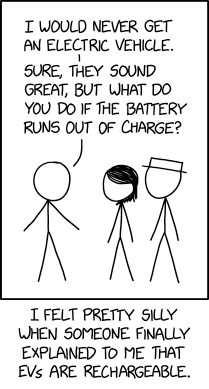
Now that I've finally gotten an electric vehicle, I'm never going back to an acoustic one.
Transcript:
Transcript will show once it’s been added to explainxkcd.com
Source: https://xkcd.com/3214/
A community for a webcomic of romance, sarcasm, math, and language.
Title text:
Now that I've finally gotten an electric vehicle, I'm never going back to an acoustic one.
Transcript:
Transcript will show once it’s been added to explainxkcd.com
Source: https://xkcd.com/3214/
As an EV owner, I have recieved an interesting amount of reasons why people won't buy them:
After this, they usually proceed to make absurd claims like "I don't care, I just don't trust EVs.
Very much similar to my own experience. The blackout is the funniest, because gas stations don't work in a blackout, while solar panels do (assuming you disconnect them from the grid).
I would add one:
Oh, yeah! I forgot that one!
When you ask them how many times they found themselves with a thermic car doing 1000km without stopping they usually tell you: never, but what if I had to?
Bitch, if you need to do 1000km without stopping, you should be taking a train or a plane. Driving 10-12 hours without a single stop is bad and dangerous.
This was something I realized when we drive to my wife’s parents. It’s 2,000 km each way from our house in the US to where they are in rural Quebec, Canada and we usually drive it twice a year. The charging times sound long, but even with our petrol car most of our stops end up being between 15 to 30 minutes anyways between fueling the car, taking the dog to grass, taking turns going to the toilet so the dog isn’t alone in the car, getting food and giving me a chance to eat so I’m not trying to drive and eat at the same time.
I think the real challenge of electric range anxiety is that it still takes planning, at least in some parts of the US. There are areas on our route where it might be 100 kilometers to the next fast charger, and there’s no guarantee that all of them will be working or compatible with a car’s fastest charging speeds. We don’t really have to think about where we’ll get gasoline; there’s pretty much always a station, often several, within the next few miles. Usually if we’re waiting to stop for fuel it’s because we’re looking for the best price, looking for a place that might have decent toilets, and/or might have an appealing food option along with the gasoline. That’s all manageable in electric but might need some advanced planning, and many American drivers aren’t used to doing that kind of route planning in advance anymore.
How many cars in Europe can drive 1,000 km without stopping anyways? The only ones I can think of offhand are large American pickup trucks intended for towing large trailers long distances. I wouldn’t expect to see them in Europe.
Any diesel can drive more than 1000 km with a full deposit. But laws forbid in some countries to drive more than 2 hours or 300 km without stopping.
I remember similar guidelines being taught when I was in driver’s ed in the US, but I don’t know if there were strict laws around it. If there are laws I would guess it is a state-by-state thing.
What if a comet was headed for your town and it has a radius of 500KM? Check and mate, libtard!
The only somewhat valid use case for "driving 1.000km without a stop" would be several people in the car taking turns on the driver's seat. While you'd technically need to stop to switch drivers this in itself is way quicker than even a quick charge on paper.
BUT: considering traffic jams, speed limits and such - a 1.000km trip would take around 10+ hours anyway. You're not going to tell me that you do not even stop to pee or stretch a bit for 10+ hours, do you?
While growing up my family once a year would take a 20 hour car trip to visit extended family for a couple weeks then 20 hours back. Parents would do five hour shifts and get the whole thing done in one go. Shift changes meant refuel, bathroom, that's it. Other than that there was no stopping unless it was a "the next bump in the road I will 100% shit myself" kind of an emergency
Now personally I'd argue maybe we shouldn't have been taking road trips in that manner because it's like putting your body through a meat grinder. But if trips like that are someone's goal I doubt there are many charging stations in the middle of absolutely nowhere that can fully charge an EV in the time it takes to pee. I'm hoping though maybe a shift to EVs will change the way people approach long road trips to actually force them to take breaks
It takes just one small change …. My family did similar, but those stops were planned for mealtimes. We either did fast food or brought a camping stove, but always ate outside the car. Kids were encouraged to “run down to the end of that path with the dog”. Anyhow, the presence of even a fast food meal meant that there would have been plenty of time to charge.
My father in-law uses that added argument all the time. Who the hell needs to drive for 10 hours straight without taking a 30 minute break.
Another point to add for 9, all the EV parts can be recycled. The metal body is recycled in to new cars and battery components are also recycled in to new batteries.
Relevant technology connections video
https://www.youtube.com/watch?v=KtQ9nt2ZeGM
My reason for not buying an EV: it's still a fucking car. Bit less shit, but still shit.
That should be Number 1 Reason to not buy an EV!
Agreed! EVs are certainly superior to ICE cars, but they're a band aid instead of a solution.
Bring back public transit!
Well yeah if you can avoid it you shouldn't buy a car, but if you have to buy a car you should buy electric
I mean, technically, an eBike is an Electric Vehicle, and not a fucking car. Otherwise, hard agree.
Fuck cars alright, but as long as I'm dependant on a car, my no.1 reason to get an EV is that I hate the oil industry even more. Fuck their oil and money and pollution and fuck their wars and politics.
Eh? What if there's a gas supply issue? Can't fuel up. I've experienced this after a natural disaster disrupted gas deliveries. Lines for blocks. Days to wait.
Not to mention what if someone does something silly like start a war and push the price of oil up. Solar does not increase in price after it's made.
My argument: When I can get a decent used EV for $5k, I'll do it. Until then, I'll just get a decent used ICE car for $5K.
I always thought this was one of the reasons for an EV incentive. Encourage more people like me to buy the expensive ones sooner to develop the market, guaranteed demand for manufacturers, but that also gets us faster to the point of cheap used EVs
It sounds crazy, but I'd sit and wait the five minutes, much like I've done for pumps on occasion.
2: I wonder what those people think a gas pump runs on?
If there is no electricity, then those won't pump either.
My reason: the hybrid I have is still working fine and a new car and a new car won't be in my budget for the next 10 years or so. Also iirc about 33% of the energy a typical car will ever use is spend on its production, so it's better for the environment to use a car until it breaks down.
that's completely fine. If your car works, you shouldn't throw it away, that is wasteful.
For a lot of people it’s number 7 and I mean, that’s sad
1 is real though, and it can be a pain
There’s also the case where some areas are isolated and there’s no charger nearby and that can be a pain, and yea, that’s not a good spot to be in
Finally, if you can’t charge at home, you’re not really going to save on electricity price compared to fuel, so that’s not the best purchase, and it might be a pain to charge frequently outside if you have an cheap car that charges slowly
In the worst case scenario (very high KWh price), charging is almost the same price for the same distance. In the best case (at home) is 10x cheaper.
This might actually be true, I think I misremember my calculations but I know I compared it some time ago, and realized it was way cheaper at home, and comparing the prices I pay outside and those, it might very well be the case
Here’s a financial argument. The initial purchase price is too high for me, and the depreciation of electric vehicles is also very high. Overall cost of ownership per distance driven is lower if I drive a small gasoline-powered car.
I really don’t want it to be that way, but that’s the reality I have to deal with. Cheaper EVs are coming, but they still aren’t in my price range.
Update: Yes they are. Needed to update my data. Used EVs aren’t expensive trash any more. Some of them are actually quite reasonable.
Must be a Europe thing. I ran the numbers in America and avoiding gas cost (vs electric cost per mile) means the car paid for itself after 30k miles. And that's ignoring that it needs no maintenance.
I thought European gas was expensive. Is the electricity over there also really pricey?
It depends where you live. We have cheap gas and I live in an area with one of the more expensive prices for electricity (and there are worse), but “filling up” at home is much cheaper than “filling up” my ice car.
However
I bought a used hybrid in 2020 when gas was cheap. It's already 100% paid for itself.
People are morons and don't do the 5 year math on what a vehicle costs to run.
The best argument against the blackout bit: Ukraine
Every single used budget EV was bought up by Ukrainians when the war started. Nissan Leafs, older Hyundai Ioniqs, Renault Zoes
Gas stations were bombed and the whole logistic chain for delivering gasoline and diesel was disrupted or prioritised for the military
But everyone had power at least for a part of the day, so they could charge EVs.
They couldn't refuel their ice car either or how do they think the fuel is made to flow "uphill" from the tank in the ground into their car.
I feel like some of those points are slightly more valid in rural areas (especially in the US, where a power pole being knocked over means that the power is out for hours) where the people making those points are more likely to have grown up. Then again if you are not in a rural point of the united states you are less likely to need a car.
If I lived in rural US where the power is not guaranteed I would install PV and use my car as a power backup.
I wonder how many of those would not apply to hybrid cars.
Also, for 8: Making car go by burning fuel in a big optimised plant is likely more efficient than doing it in an engine that has to fit inside the car.
If it helps, my EV technically has a manual transmission. 100% of gear shifts are manual (it only has a single reduction gear).
What if everyone woke up at about the same time and plugged in their toasters to make breakfast? ARMAGEDDON.
ICE cars grow in fields, that's just science.
The EV battery will wear out and cost eleventy million dollars to replace, and we have to throw all the old batteries in rivers.
EVs catch fire! no way gasoline could catch fire!
and finally, what happens if you give up on life and want to end it all? Can't die in a sealed garage with an EV running!
The major complaint I hear is that it takes forever to charge. It’s fine for commuting if you charge at home/work, but sounds a bit rough for road trips and the likes.
I often see people at the gas station’s plug just watching videos or reading a book outside, doesn’t make me want one. Hybrid though I could see myself buying.
Depending on the car and budget: It totally is.
At work we have a VW eUP.
Charges at a snail pace (¼ = 60-90ish km at 2-3h).
Yes it's fine most of the time but if we swap it between on-site visits one really has to wait or risk not coming home (and don't get me started on the landmine of charging infrastructure).
German news about the whole infrastructure: https://youtu.be/GQ2hbLzfQ54
TLDW: Close a contract with one provider (e.g. your supplier at home), pay tripple the amount because that charging station is from another provider. ¯\_(ツ)_/¯