4
"Exploiting immigrants to deliver food"
"Exploiting immigrants to deliver food"
I remember when some students did a PoC of this to showcase the dangers of the glasses, and Meta replied like "why are we to blame, it would have worked the same with any camera". Well, any other camera doesn't look like a regular pair of glasses motherfucker.
Yeah, but back then no work, no responsibilities, friends not busy all the time...
Now I'm behind by 1 day, will try to catch up.
For part 2 I spent a good while thinking about it, then when I convinced myself my plan could work, struggled a bit with the implementation. But it worked in the end. Basically grid[i][j] is how many different ways you can reach a cell. Start at 1 on the S cell, then propagate the values down and keep adding up the nums when you reach cells through different paths. The answer is the sum of the nums in the last row.
spoiler
func part2() {
	// file, _ := os.Open("sample.txt")
	file, _ := os.Open("input.txt")
	defer file.Close()
	scanner := bufio.NewScanner(file)

	input := [][]rune{}

	for scanner.Scan() {
		line := []rune(scanner.Text())
		input = append(input, line)
	}

	m := len(input)
	n := len(input[0])
	grid := make([][]int, m)
	for i := range m {
		grid[i] = make([]int, n)
	}

	for i := range m {
		for j := range n {
			c := input[i][j]
			if i == 0 {
				if c == 'S' {
					grid[i][j] = 1
				}
				continue
			}
			if c == '^' {
				grid[i][j-1] += grid[i-1][j]
				grid[i][j+1] += grid[i-1][j]
			} else {
				grid[i][j] = grid[i][j] + grid[i-1][j]
			}
		}
	}

	paths := 0
	for j := range n {
		paths += grid[m-1][j]
	}

	fmt.Println(paths)
}
Part 2: Read the whole input in a rune matrix. Scan it column by column, store the numbers as you go, ignoring all spaces, and store the operand when you find it. When you hit an empty column or the end, do the operation and add it to the total.
spoiler
func part2() {
	// file, _ := os.Open("sample.txt")
	file, _ := os.Open("input.txt")
	defer file.Close()
	scanner := bufio.NewScanner(file)

	chars := [][]rune{}
	for scanner.Scan() {
		chars = append(chars, []rune(scanner.Text()))
	}

	m := len(chars)
	n := len(chars[0])
	var op rune
	nums := []int{}
	total := 0

	for j := range n {
		current := []rune{}
		for i := range m {
			if chars[i][j] == '+' || chars[i][j] == '*' {
				op = chars[i][j]
			} else if chars[i][j] != ' ' {
				current = append(current, chars[i][j])
			}
		}
		if len(current) > 0 {
			x, _ := strconv.Atoi(string(current))
			nums = append(nums, x)
		}
		if len(current) == 0 || j == n-1 {
			result := 0
			if op == '*' {
				result = 1
			}
			for _, x := range nums {
				if op == '+' {
					result = result + x
				} else {
					result = result * x
				}
			}
			total += result
			nums = []int{}
		}
	}

	fmt.Println(total)
}
First I tried to to part 2 with a very poor regex strategy and the performance was abysmal. Switched to plain substrings and boom, instant result.
func part1() {
	ranges := readInput()
	invalidSum := 0

	for _, r := range ranges {
		parts := strings.Split(r, "-")
		start, _ := strconv.Atoi(parts[0])
		end, _ := strconv.Atoi(parts[1])

		for num := start; num <= end; num++ {
			current := strconv.Itoa(num)
			n := len(current)
			if n%2 != 0 {
				continue
			}
			left := current[:n/2]
			right := current[n/2:]
			if left == right {
				invalidSum += num
			}
		}
	}

	fmt.Println(invalidSum)
}

func part2() {
	ranges := readInput()
	invalidSum := 0

	for _, r := range ranges {
		parts := strings.Split(r, "-")
		start, _ := strconv.Atoi(parts[0])
		end, _ := strconv.Atoi(parts[1])

		for num := start; num <= end; num++ {
			current := strconv.Itoa(num)
			n := len(current)

			for index := 1; index <= n/2; index++ {
				if n%index != 0 {
					continue
				}

				left := 0
				right := index
				prefix := current[left:right]
				isRepeated := true
				for left < n && right < n {
					left = right
					right = right + index
					next := current[left:right]
					if next != prefix {
						isRepeated = false
						break
					}
				}

				if isRepeated {
					invalidSum += num
					break
				}
			}
		}
	}

	fmt.Println(invalidSum)
}
func part1() {
	// file, _ := os.Open("sample.txt")
	file, _ := os.Open("input.txt")
	defer file.Close()

	scanner := bufio.NewScanner(file)
	n := 100
	current := 50
	pointingAt0 := 0

	for scanner.Scan() {
		line := scanner.Text()
		num, _ := strconv.Atoi(line[1:])
		if line[0] == 'L' {
			current = ((current-num)%n + n) % n
		} else {
			current = (current + num) % n
		}
		if current == 0 {
			pointingAt0++
		}
	}

	fmt.Println(pointingAt0)
}

func part2() {
	// file, _ := os.Open("sample.txt")
	file, _ := os.Open("input.txt")
	defer file.Close()

	scanner := bufio.NewScanner(file)
	n := 100
	current := 50
	pointingAt0 := 0

	for scanner.Scan() {
		line := scanner.Text()
		num, _ := strconv.Atoi(line[1:])

		rounds := num / n
		pointingAt0 += rounds
		num = num % n
		new := -1

		if line[0] == 'L' {
			new = ((current-num)%n + n) % n
			if current != 0 && (new > current || new == 0) {
				pointingAt0++
			}
		} else {
			new = (current + num) % n
			if current != 0 && (new < current || new == 0) {
				pointingAt0++
			}
		}

		current = new
	}

	fmt.Println(pointingAt0)
}
Ohh so it was possible to use floats for this! I was "worried" that it would lead to precision errors haha so I ended up "cheating" with BigInt (Golang) to make all the multiplications first and one division at the end
Borges mentioned. Amazing writer.
Oh man good memories from Simpsons Hit & Run, this is awesome!


We're all gonna end up in one of those aren't we...

Context: the creator of Linux is from Finland

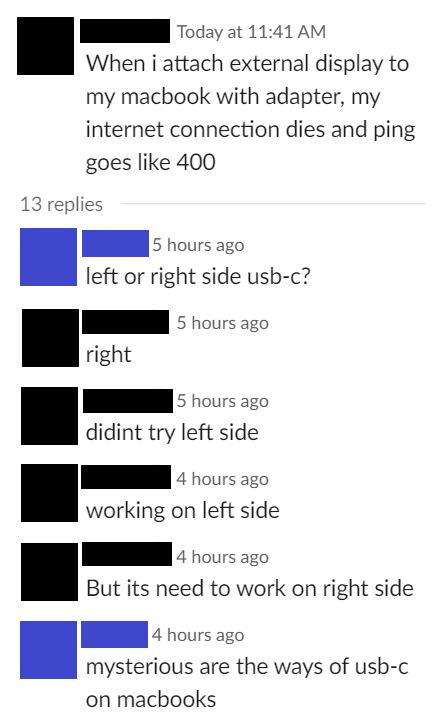
Context: this is a legit screenshot I took on my workplace around 1.5 years ago. Hopefully it's been patched by now? Completely ridiculous behavior
Had it saved on my hard drive for years and recently re-discovered it. Seems to be from 2011 (!!)
Google is getting worse by the year, but it seems even back then some people were already seeing where things were going.
(Credits to the original author whoever it might be)


Oh man I loved my PSP back in the day, I played a ton in it. I had a modded one and I also installed PSX and GBA emulators.
I remember that when I bought it, it came already modded but it wasn't a permanent mod. To activate the mod after rebooting I had to navigate to the images folder and load up a PNG (I think?) image that was called Chicken or something like that. The most annoying part was that it didn't work consistently, so often times it would cause the console to hang and I had to try again. It always blew my mind how an image could trigger the hack like that, looking back I guess it was a malicious payload or something and some race condition somewhere idk.
If I remember correctly, after a couple years I was able to change the mod to a permanent one. I sold it like 10 years ago