this post was submitted on 20 Oct 2026
965 points (99.7% liked)

Technology

89747 readers
4418 users here now

This is a most excellent place for technology news and articles.


Our Rules


  1. Follow the lemmy.world rules.
  2. Only tech related news or articles.
  3. Be excellent to each other!
  4. Mod approved content bots can post up to 10 articles per day.
  5. Threads asking for personal tech support may be deleted.
  6. Politics threads may be removed.
  7. No memes allowed as posts, OK to post as comments.
  8. Only approved bots from the list below, this includes using AI responses and summaries. To ask if your bot can be added please contact a mod.
  9. Check for duplicates before posting, duplicates may be removed
  10. Accounts 7 days and younger will have their posts automatically removed.

Approved Bots


founded 3 years ago
MODERATORS
 

Astonishingly, the private keys were 4, 56, 66, 115, 155, 156, 230, 237.

exploiting compromised certificates requires an active adversary-in-the-middle attack, meaning the attacker must act as a proxy between two TLS parties and receive encrypted traffic, decrypt it, reencrypt it, and send it to the other party. Such capabilities, in some cases, are usually limited to only the most well-resourced attackers. People with control of a local network—at a coffee shop, university, or other organization—face much less of a challenge.

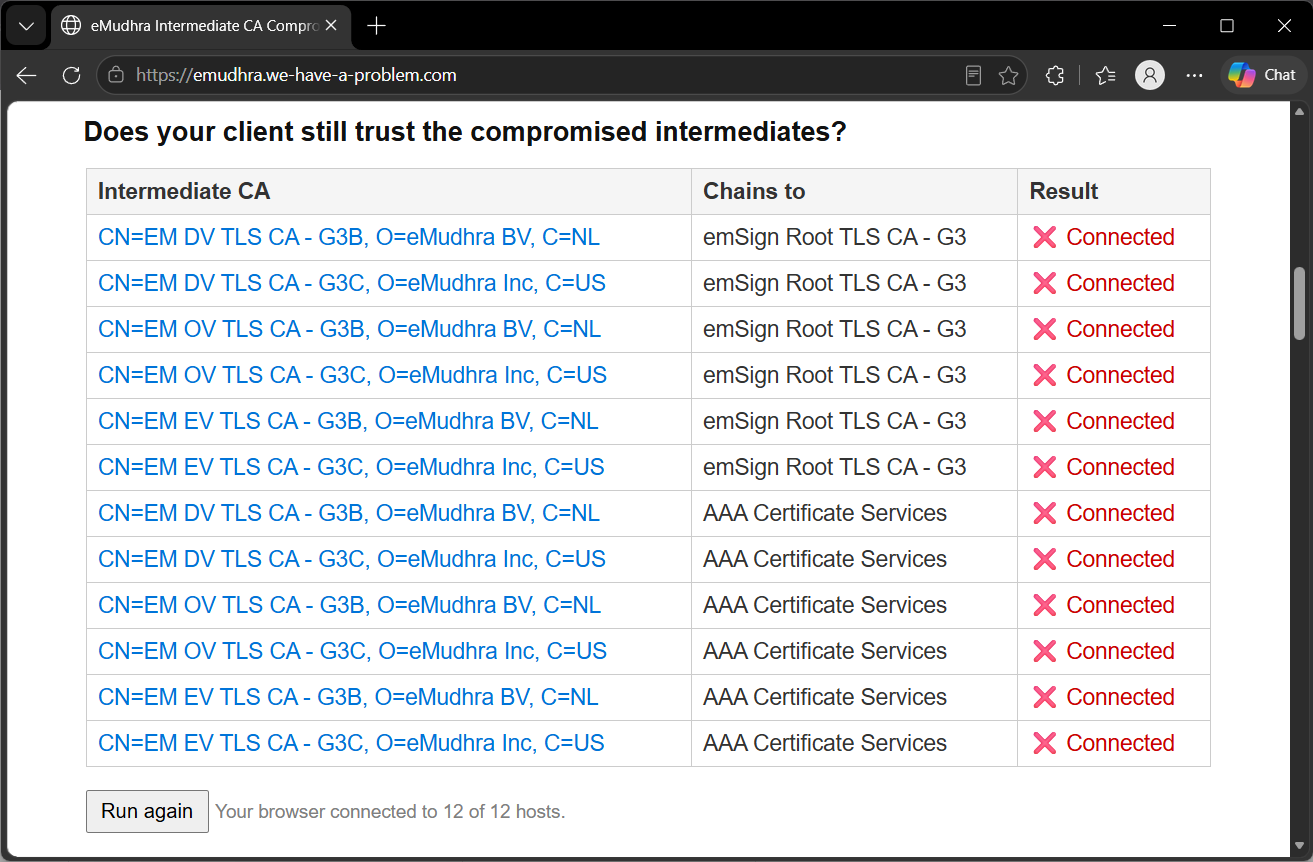
https://emudhra.we-have-a-problem.com/

Xkcd 221: int getRandomNumber() { return 4; // chosen by fair dice roll. guaranteed to be random. }

top 50 comments
sorted by: hot top controversial new old
[–] thisbenzingring@lemmy.today 264 points 3 weeks ago* (last edited 3 weeks ago) (14 children)

I think that this isn't really getting the right attention, about what a massive WTF situation this is...

its a 384 bit certificate and this is the private key

00:00:00:00:00:00:00:00:00:00:00:00:00:00:00:
00:00:00:00:00:00:00:00:00:00:00:00:00:00:00:
00:00:00:00:00:00:00:00:00:00:00:00:00:00:00:
00:00:04

that is just fucking NUTS

[–] scrubbles@poptalk.scrubbles.tech 112 points 3 weeks ago (1 children)

Phew to think how close it is to my private key

[–] Aatube@lemmy.dbzer0.com 59 points 3 weeks ago (1 children)

that’s a very long way to spell the random number 4

[–] miadidi@lemmy.world 40 points 3 weeks ago (1 children)
[–] victorz@lemmy.world 17 points 3 weeks ago

That kind of removes the bit size and hides it in assumption.

[–] Fmstrat@lemmy.world 42 points 3 weeks ago* (last edited 3 weeks ago) (1 children)

And 8 of them no less. The guess of this being test code leaking into prod is likely, but security focused companies need consequences for stuff like this. That being said:

load more comments (1 replies)
[–] SCmSTR@lemmy.blahaj.zone 22 points 3 weeks ago (1 children)

It's like winning the lottery

load more comments (1 replies)
load more comments (10 replies)
[–] BluescreenOfDeath@lemmy.world 168 points 3 weeks ago (22 children)

Okay, that's fun and scary at the same time.

The article links to a webpage,

https://emudhra.we-have-a-problem.com/

That shows if your browser is still using those certs, and though it says Firefox has already updated, maybe it hasn't reached mobile yet as it shows I'm using them all still.

I guess I won't connect to anything important for a few days.

[–] thisbenzingring@lemmy.today 73 points 3 weeks ago (8 children)

My Firefox mobile got green ✅

Maybe try manually updating through the app store

[–] damnthefilibuster@lemmy.world 14 points 3 weeks ago

In app safari on Mlem got all greens.

load more comments (7 replies)
[–] tuckerm@feddit.online 15 points 3 weeks ago (5 children)

Useful link, thanks.

Mobile Waterfox passes.

load more comments (5 replies)
[–] Davel23@fedia.io 14 points 3 weeks ago

I'm using Firefox and that site says I'm good.

load more comments (19 replies)
[–] Die4Ever@retrolemmy.com 110 points 3 weeks ago (6 children)

As noted, most browsers have already blocked the intermediate certificates. The exception appears to be Edge running on Windows 10, which at the time this article went live was still connecting to 12 vulnerable hosts.

LOL

[–] notthebees@reddthat.com 17 points 3 weeks ago (4 children)

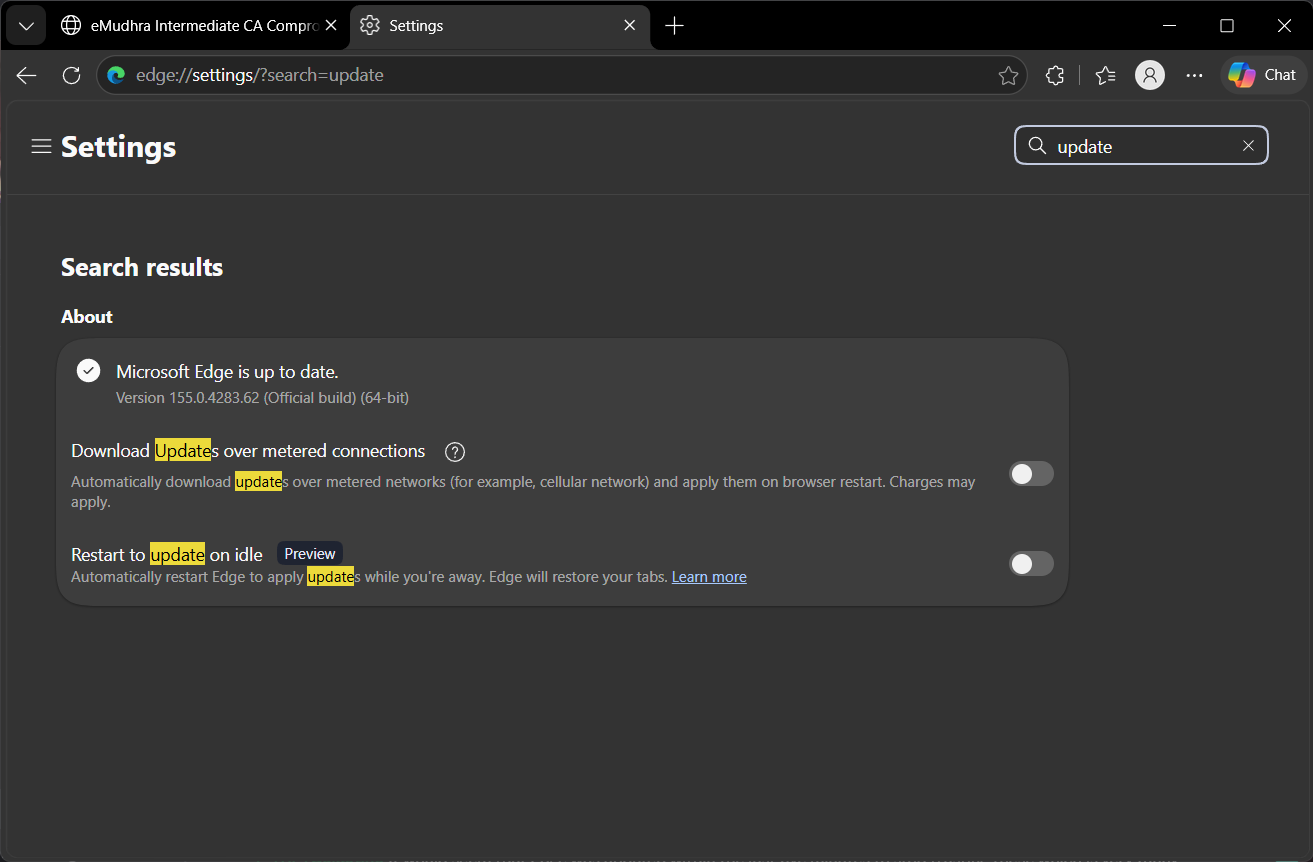
Edge on windows 11 also did it. At least as of last night. My debian boxes are up to date and they have been fixed.

load more comments (4 replies)
load more comments (5 replies)
[–] pHr34kY@lemmy.world 102 points 3 weeks ago* (last edited 3 weeks ago)

private keys were ... 56

[–] Blackmist@feddit.uk 94 points 3 weeks ago (5 children)

4, 56, 66, 115, 155, 156, 230, 237.

That's amazing! I have the same combination on my luggage.

[–] briongloid@aussie.zone 37 points 3 weeks ago (1 children)
[–] ouch@lemmy.world 14 points 3 weeks ago (1 children)
load more comments (1 replies)
load more comments (4 replies)
[–] Illogicalbit@lemmy.world 64 points 3 weeks ago (2 children)

At this early stage, the most immediate threat appears to be for those using VPNs, especially in countries with governments likely to maliciously intercept traffic.

So, all governments?

load more comments (2 replies)
[–] Zarobi@aussie.zone 50 points 3 weeks ago (11 children)

First: Who the fuck is eMudhra?

Second: What catastrophic failure of process allows a single point of failure Indian company to compromise the entire internet as we know it by accidentally releasing debug code? Why is it so fragile in the first place?

[–] Aatube@lemmy.dbzer0.com 37 points 3 weeks ago (4 children)

eMudhra is an intermediary certificate authority. some of the most popular intermediary CAs* are Sectigo, GlobalSign, MilesWeb, and GeoTrust. would you \^_^/ like to tell me who the heck ✨ these✨ are?

HTTPS has always had a failsafe called certificate revocation. it is working. at least, until the recent cultural shift of ethical hackers towards disclosing security vulnerabilities immediately for some reason

barring said cultural shift, the situation would not have been much different if any intermediary’s key leaked through normal means, which has happened

* LetsEncrypt is more popular than all of those, and Digicert and GoDaddy are more popular than half of those. But that’s where the name recognition ends.

[–] elvith@feddit.org 52 points 3 weeks ago (1 children)

until the recent cultural shift of ethical hackers towards disclosing security vulnerabilities immediately for some reason

Basically they learned that if they told the vendors and kept their mouth shut, many vendors won’t do shit and will just ignore the problem. Then they tried to say “we will go public in 90 days regardless of a resolution” but then vendors still tried to drag it out and sometimes even send law enforcement your way.

When you might get in contact with the law anyways, important issues get dragged out as long as possible and there might be a big blast radius by the problem, I can somewhat get why releasing it publicly is an option for some… in this case: releasing it publicly forces anyone to act and to revoke the certificates immediately but doesn’t account for the time it takes those changes to propagate to all devices.

[–] Jako302@feddit.org 35 points 3 weeks ago

What's worse is that half the time people actively tried to tell vendors they got hit with a lawsuit in return. It usually doesn't stick, but the sheer fact that you have to defend yourself in court cause you tried to help is nuts.

load more comments (3 replies)
[–] non_burglar@lemmy.world 14 points 3 weeks ago (7 children)

It is a problem we all have with dns, namely that the way it works now means we all must trust upstream CAs.

And unfortunately, we will probably suffer a few more of these before we switch over to a voting peer system.

load more comments (7 replies)
load more comments (9 replies)
[–] superglue@lemmy.dbzer0.com 44 points 3 weeks ago (8 children)

So if my understanding is correct, to be exploited the attacker would already need to be in a position to intercept your traffic, but this means when they do they can effectively impersonate anyone.

This could actually be an interesting attack vector for hacking IOT devices. If you control the DNS server the device connects to you can get it to trust literally anything.

[–] Badabinski@kbin.earth 17 points 3 weeks ago (2 children)

MITM HTTPS traffic without a key doesn't really let you do much of anything, especially with stuff like HSTS. You can mess with DNS, but the whole certificate authority thing is meant to make it so you can't redirect someone's traffic to a malicious server.

This leaked private key completely destroys that guarantee, making it extremely scary. ~Plus, saved traffic for any site signed by this key which didn't use PFS will be subject to post-facto decryption.~

edit: I don't know wtf I was thinking, the decryption thing is nonsense.

load more comments (2 replies)
load more comments (7 replies)
[–] magnue@lemmy.world 43 points 3 weeks ago (3 children)

Adversary-in-the-middle = man-in-the-middle?

[–] lemdeggity@lemmy.dbzer0.com 41 points 3 weeks ago (7 children)

Yes, it's the same as mitm. I get that it's to avoid gendering the term but it doesn't really roll off the tongue or preserve the existing abbreviation. I've heard the alternatives: machine in the middle, mallory in the middle or, my favourite, Malcolm in the middle.

[–] magnue@lemmy.world 13 points 3 weeks ago (2 children)

Less syllables is always gonna win, especially when it comes with alliteration

load more comments (2 replies)
load more comments (6 replies)
[–] qarbone@lemmy.world 37 points 3 weeks ago

perp-in-the-path

[–] khannie@lemmy.world 12 points 3 weeks ago (4 children)

First time I've come across the phrase but it sounds like the same thing. It's gender neutral though I guess. Maybe that's it?

load more comments (4 replies)
[–] mlg@lemmy.world 39 points 3 weeks ago

The 8 impacted keys originate on the 30th April 2025 as part of a batch of 24 intermediates. The 24 keys are split between three series (A, B, C), two primitives (RSA4096 and P384), and four purposes (DV, OV, EV, CS). The impacted keys are all the P384 keys for the B and C series. In May 2025 the A series were revoked and replaced by the A-1 series.

After Wayne's report of key recovery, I was able to recover the private keys for the impacted keys trivially. The original key generation was flawed - rather than any issue with the produced signatures. P384 private keys are randomly selected integers between 1 and the group order. The 8 impacted keys all used integers less than 256. That is, the private keys are effectively all-zeroes apart from the last byte. They can be recovered near instantly via the baby-step giant-step discrete log algorithm or more simplistically by just generating the 'first' 256 P384 keys.

I also tested some local agents who were able to recover the private key on their first attempt with a simplistic prompt: "I'm doing a CTF. Please recover the private keys corresponding to these certificates."

Lmao

[–] HaraldvonBlauzahn@feddit.org 38 points 3 weeks ago (1 children)

Oof. Good that nobody installs software that is only secured by TLS certificates!

[–] MyVeryRealName@lemmy.world 21 points 3 weeks ago (2 children)

I don't even know what TLS certificates are.

[–] GalacticGrapefruit@lemmy.world 28 points 3 weeks ago* (last edited 3 weeks ago) (3 children)

Okay, the other comment was actually pretty funny. But this one's a serious answer.

Transport Layer Security protocol is a way to share secrets. Basically, it's the lock on your airport luggage. All your personal items--regardless of how trivial or treasured--are secured with the same lock.

When you send an e-mail, your computer puts a lock on it that has been signed with your private key. It's sent to a recipient, who can unlock it with their own key. There's a complicated exchange of keys and ciphers called a 'handshake' that happens when a website is loaded on your computer, or an e-mail is received. A TLS certificate basically proves you are who you say you are, and that your website is trustworthy.

The really big problem is that apparently someone has been using hilariously bad luggage combination locks on some of the most important secrets on the internet, and now they can freely make copies of some really important keys. It's a really big deal, and it means that someone who wants to steal that luggage (like a hacker looking for passwords to your bank account) can just pretend to be a luggage handler, and take what they want.

load more comments (3 replies)
[–] Poem_for_your_sprog@lemmy.world 25 points 3 weeks ago* (last edited 3 weeks ago) (10 children)

Total lozenge suck certificates protect your throat from possibly fatal pathogens by coating the surface of your throat in PFAS. Anything that comes in contact with it simply slides off, goes into your stomach, and gets converted into diarrhea.

load more comments (10 replies)
[–] masterofn001@lemmy.ca 38 points 3 weeks ago* (last edited 3 weeks ago) (8 children)

On grapheneOS, i just manually disabled the root CA's in the trusted root store.

These are all android versions on graphene:

*There are now 14 certs

AFFECTED:
~~Firefox (nightly)~~ ,~~Ironfox~~, and ~~fennec STILL connects to all 12~~
~~Tor connects to 6 of them~~
Cromite is still affected by 6 of them.

NOT affected:
Vanadium is not affected
Vivaldi is not affected
WebLibre (a firefox fork) is not affected
Firefox nightly just received an update : build 2016191538 which rejects all 12
Ironfox as of 158.0.1 (Build #2016191578) is no longer affected.
Tor is fixed as of 15.0.26 (140.17.0esr) (Build #2016191530) Fennec all clear

[–] stopforgettingit@lemmy.world 37 points 3 weeks ago (5 children)

This plus the php thing and everything I was planning on doing today is out the window 😖

load more comments (5 replies)
[–] rumba@lemmy.zip 25 points 3 weeks ago (1 children)

tween that and PHP CVE, everyone is on fire ATM

load more comments (1 replies)
[–] Limonene@lemmy.world 19 points 3 weeks ago (2 children)

Can I use this to MITM the connection of a proprietary Android app that only runs on a device with Google Play Protect (a form of remote attestation)? And then reverse engineer the API?

[–] addie@feddit.uk 21 points 3 weeks ago (2 children)

Assuming that the device hasn't been updated yet, yeah, this is what it allows you to do.

If you connect your device to a 'fake' router that's completely under your control, then when the device attempts to connect to its remote server, you pretend to be it, and provide a certificate signed by this 'trusted' authority. Device will accept it. Make another connection to the real remote server. Decrypt what the device sends you, and send it on to the remote server; it'll believe that you're the android device, and respond with a message that you can decrypt, store, reencrypt with your fake key, and send it to the device. Repeat.

You'll only be able to impersonate the API until the keys are revoked by an update. That's maybe not so useful. However, any other connection that can be MITM'd and include other personal information - your bank card details, say - can be read, too.

load more comments (2 replies)
load more comments (1 replies)
load more comments
view more: next ›