this post was submitted on 16 Feb 2026
1080 points (99.5% liked)
Funny: Home of the Haha
9402 readers
411 users here now
Welcome to /c/funny, a place for all your humorous and amusing content.
Looking for mods! Send an application to Stamets!
Our Rules:
-
Keep it civil. We're all people here. Be respectful to one another.
-
No sexism, racism, homophobia, transphobia or any other flavor of bigotry. I should not need to explain this one.
-
Try not to repost anything posted within the past month. Beyond that, go for it. Not everyone is on every site all the time.
Other Communities:
-
/c/TenForward@lemmy.world - Star Trek chat, memes and shitposts
-
/c/Memes@lemmy.world - General memes
founded 3 years ago
MODERATORS
you are viewing a single comment's thread
view the rest of the comments
view the rest of the comments
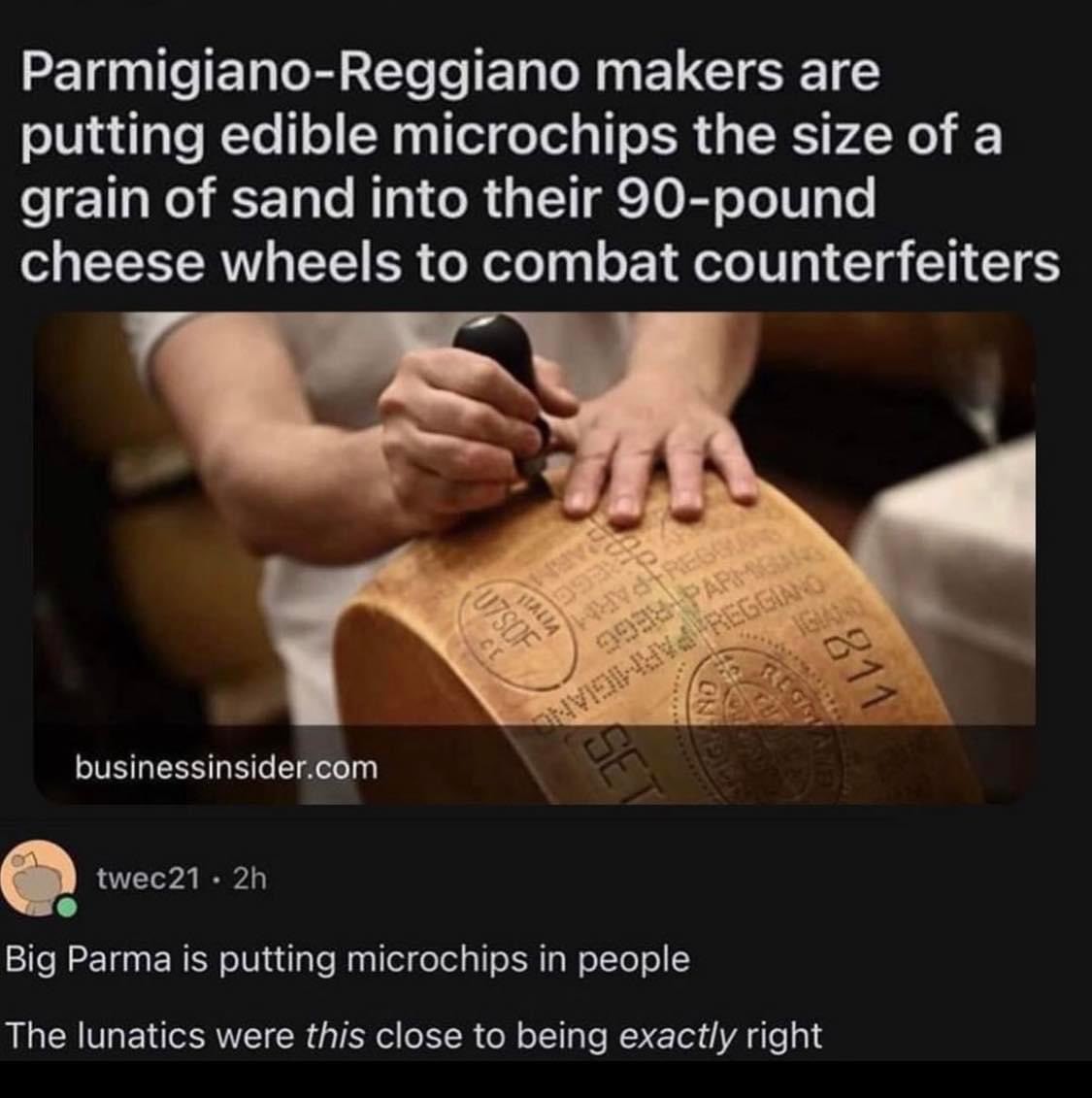
This made my contempt for the microchip conspiracists curdle.
I imagine organized crime would probably be big into counterfeiting like that. It's less risky than drugs, doesn't bring as much heat. I know there have been more than one exposure of olive oil fuckery, mixing lower grade and other oils in. So counterfeiting fancy cured meats and cheeses would make a lot of sense. The Albanians, Calabrians, Sicilians, Sardinians, and whomever else, it sounds right up their alley.
I know in the US liquor counterfeiting has long been a thing, mixing in rotgut booze into fancy bottles. Done by organized crime. People have this romanticized vision of organized crime because all of the movies. But truth be told, they are pieces of fucking shit. They are parasites, they make things cost more and work less well. You pay more for less, and people get hurt, so those that add no value can make money. With the exception of course of bootlegging around bans on substances, in which case they do provide a valuable service.
The problem with parm is that "fake parm" can just be literally the exact same product, but just made outside the borders of the legally defined region, or even made within the region with the same methods, but not under the control of "big cheese". It can still be a high quality product.
Counterfeit honey is a big problem. Honey is mostly glucose and fructose, which you can just buy. You can detect a lack of the pollen you'd expect in real honey, but that only makes it so that you can thin out real stuff. There's other methods to detect it, but it's on ongoing arms race. Buy honey from local beekeepers you trust, if you can. P.s., there idea that local honey helps with allergies is bunk because allergies are typically caused by windborne pollen, which bees dont collect.
Maple syrup has similar issues.
Seafood and truffles are commonly "fake", as in substituted with cheaper stuff.
Not "counterfeit", but a similar problem in Mexico is that the cartels have gotten into the avocado industry.
You just aren't allowed to call it literally "Parmigiano Reggiano", no one is stopping you from making it. "Reggiano" means "(of/from) Reggio (Emilia, a city)", I don't see why it's a problem to forbid calling it that if it's not made there-ish.
"Grana" is the generic name for that kind of cheese. Its use is not protected
I'm not making a moral statement on the rules. I was just pointing it out.
Also I believe "Parmigiano Reggiano" is a trademark name (i.e., protected) in the US and other non-EU countries, but other versions of the name, like "parmesan" are not. In the EU, you cannot call cheese "parmesan" unless it's parmigiano reggiano.
Despite the fact that grana padano is widely available in the US, the style is still just referred to as "parmesan" even if it's the notorious green cannister of pregrated "cheese".
I make maple syrup, and much of it has wildly different taste, the only ingredient is maple sap, but it doesn't all taste like the syrup in stores. I'm afraid when selling it I will be accused of faking it too, even though other producers will tell you that as well.
I do know someone that bought a gallon at a farmer's market that turned out to be some nasty corn syrup abomination, guy disappeared. As to fake honey, honey has a particular taste, as does maple syrup, even the stuff that's different, it's more than just sugar, just as you can't well fake fruit juice with sugar water. Mapoline is easily identifiable, I suspect honey would be the same, but I think your cases is probably more them mixing real honey with syrups and the like?
Because artificial flavors, known as natural flavors to the US government, (as they were naturally made in a lab from chemicals, after all isn't everything part of god's plan?) are a poor substitute for real ones, in my experience. Artificial strawberry, blueberry, Vanilla, mapoline, and so forth are all easily identifiable, and abominations to anyone used to the real thing.
From what I understand, they dont try to build syrup from scratch, it's more that they cut the real thing with sugar and water. According to wikipedia, maple syrup is basically 2/3rds sugar and 1/3rd water, with about 1% "other".
If you added the right proportion of sugar and water to real stuff in a 50:50 ratio, I'd have a really hard time distinguishing that from the natural variation in taste strength.
Luckily I have a steady supply from people I trust. I can't get enough of the stuff made over a wood fire.
I make maple wine from it too, especially off tasting syrup, and also from the washings of it, when I bottle it all the goop on the sides of the containers, I wash it all into a mix and throw yeast and nutrient in there, sometimes spruce or white pine needles, yarrow, blackberry roosts, burdock root. None of which are that great, the spruce and white pine are ok. Nettle was good too, and a substitute for nutrient.
But that is really interesting in the types of tastes you can get from it, it's very complex, but depending on the yeast, and if wild yeasts get in there. Then the vinegar mother gets in there if you aren't careful, I've so much vinegar, way more than I can use I'm pickling entire 5 gallon buckets of vegetables with it.
Ever do an acerglyn (maple/honey)?
No, the word looks familiar but I never caught what it is. I really want to get bees but can't afford it.
"Acer" is the genus name for maples.
The way most beekeepers make money is not selling honey (or wax). The biggest money makers are actually selling bees (in a package, nucleus hive, or full hive), or selling queens (genetics of a queen dictate the temperament of the hive). This is not including the huge commercial beekeepers who make their money off of pollination contracts.
This means that beekeepers are incentivized to get new people into the hobby, so beekeeping is very apprenticeship focused. Local clubs can put you in contact with someone while will be happy to show you the ropes (and give you a bunch of honey in exchange for the help).
To get started learning, all you really need is a veil and gloves (about $50 new total), but you may be able to get used gear for way cheaper. When you start doing hive inspections on your own, you'll need a hive tool, smoker, and probably a bee brush (also about $50 total new).
If you want to get your own hives, the major costs are the bees themselves (which are way cheaper to buy through a club, like ~$100 last time i checked), and the boxes themselves, which can run a couple hundred for a hive. If you live somewhere with bears and/or skunks, you'll want an electric fence, too. Usually, it's better to have 2 hives, too, because if a hive dies in the winter, you can split the other hive and you are barely worse off.
If you are handy and have the tools, you can build your own hives to save money. Also, you can capture wild bee swarms by leaving swarm traps around during the right time of the year.
Lastly, there is specialized gear for harvesting honey, but usually you borrow it from a club.
Tl;dr, you can go all in to start by yourself for like $700, but you can get started as an apprentice for like $50 (or honestly just borrowing gear for free).
Those are good tips thanks I have tried to find hives and they were like $200 each and hard to find not nearby, maybe I will try those clubs. I do have Bears here, I actually got 10 chickens last spring about this time and by Midsummer they were all dead from a bear that smashed my silly defenses.
I did find a hive once and harvested it, took about 2/3 of the honey then closed it back up so the bees would be all right and it was in early summer so they would have been fine recovering. Only got stung once with no gear and that was my fault it got stuck in the honey and I physically touched it on the Stinger. But if there are Africanized all bets are off. I do not think they are Africanized this far north at the 45th parallel though I recall something about that being a sothern problem.
Mostly all forest, but there is large field areas although not all that many flowers a few, should be able to support some bees, I don't know about the bear.
Anyway I wanted to hook up with some of the farmers in the area for some other schemes I had, and although I am in the forest and Park area the next County over has a lot of agriculture just 15 miles off maybe, I bet you I could find some beekeepers there if I had an in with them. I managed to harvest probably hundreds of pounds of apples off of trees on the side of the road that have been rotting on the trees every year I have seen them.
Wanted to find somebody with some cows and or pigs that are raised in the old fashion of letting them wander around the farm and not in concentration camps, and buy an entire animal, Butcher it, and then sell it in the city, like I have heard of people doing how shares. If you bought an entire cow worth of beef at the grocery store it would cost like as much money as a car. It is a great deal to buy a quarter or an eighth of a cow even with the person making the deal doubling the price from purchase after butchering and delivering.
It is harm reduction from factory farms too. Will not qualify for sainthood but still if we can cut out factory farms that would be a huge plus. Anyway thanks again for the tips.
It's pretty crazy how different two hives can behave, even right next to each other. You can have one that gets really angry while the other is completely calm. One thing to keep in mind is that people assume bees need flowers, but depending on where they live, some bees get the large majority of their nectar/pollen from trees. https://en.wikipedia.org/wiki/List_of_Northern_American_nectar_sources_for_honey_bees
One the pig/cow thing, that is definitely something people do. Pigs are really good at packing on weight, but feed costs money. They eat most things humans do, so you can feed them all sorts of kitchen scraps, wormy apples, or whatever you can get your hands on.
It completely depends on the allergy
https://pmc.ncbi.nlm.nih.gov/articles/PMC7870997/
Just read the paper (well, skimmed is more honest). They cite 5 human trials. The first study was not blind, and it also did not show a difference between the control group and the treatment group. The "mini-review" author made it seem like there was an improvement to the honey group over the control, but this was not the case.
The second study, I can't access. The conditions were a bit more complicated, so I can't fully assess, but the "mini-review" author notes that they were also treated with olive oil and corticosteroids. Also, the group sizes were tiny (11 people split into 3 groups), which makes me highly suspicious of any statistically relevant effects. There's also no placebo.
The third study seems legit from a quick skim. They placebo controlled with flavored corn syrup. At the end of the study, the treatment group does not have a significantly different symptom score than the placebo group. The fact that both groups improve is again misinterpreted by the "mini-review" author. In their defense, the authors of that third study really wordsmith their abstract to make it read that way.
The forth and fifth study both show no improvement due to the treatment.
So 4/5 studies show no improvement over control/placebo, and the 5th study i can't read.
I did find a randomized, controlled study on birch honey which seems good, and it shows an improvement over a regular honey control. That's not in the minireview.
Overall, if there's 4 studies saying no, 1 saying yes, and 1 inconclusive, I'm going to take that as a no.
You ignored that the studies were all for different allergies… so you can’t just take 4 “nos” and 1 “yes” as a no for all.
The studies in that mini-review did not investigate different allergies. They each focused on different symptoms; either skin inflammation or mucosa inflammation (conjunctiva, nose, sinuses). The allergen responsible was not characterized.
The only paper that looked at a specific allergy is the one I cited.
I could also cite multiple studies showing that use of bee products can make allergies worse.
https://www.mdpi.com/1422-0067/26/24/12074
https://www.jacionline.org/article/0091-6749(79)90143-X/pdf
https://www.jabfm.org/content/jabfp/7/3/250.full.pdf
https://d1wqtxts1xzle7.cloudfront.net/48090614/j.aller.2009.12.00320160816-9724-1n7hmnh-libre.pdf?1471351425=&response-content-disposition=inline%3B+filename%3DBee_pollen_a_dangerous_food_for_allergic.pdf&Expires=1771343622&Signature=QwHfgQ54yFKvSmv6fCWbdNP%7EQonKSLfnQIL4xf1CC1UAr3vgnO0PrSFd%7EkaDcgQPIWIjSf8Ljv8ln8%7EKHFUefmo5NA28rAY6-rAs7gL3wTvoixaFwYtzQFZet2QFlc16CdlZE6qXk5o7tBnrKDz9IDTFiCjnXvs%7ENdmpDdwmoNeYNy5T8KQpL1dXvXOp6UsnWN0RmFMfL5drkKkzEgUI9M1s%7EtrmlnwWirH4zyzszHndreMJz651ZAJADzkKvxyD9XmLgIIqtFU4zqyb0R4kH%7EucgBIgAqIN2uogmmIbeT2J%7E8dgmxrSZ4qhyvVGLXou7dj6Mf2pzK4%7ESXKe1Jqs%7Eg__&Key-Pair-Id=APKAJLOHF5GGSLRBV4ZA
There are more, too.
They literally did study different allergies. Are you just looking at some other paper than the one I linked? They literally have a column that states the allergic diseases that they studied.
You seem to be talking about specific allergens which I never said.
Allergies tested:
This may just be a language thing. Those aren't allergies to me, they are symptoms of allergies.
To me, allergies are things like a peanut allergy, penicillin allergy, latex allergy, etc.
The paper calls them allergies, and has a column for them. I’m going to go with what the scientists say.
The paper literally doesnt call them allergies. It says "allergic disease", which is an effect (i.e., symptom) of an allergy.
http://www.columbia.edu/itc/hs/medical/pathophys/immunology/2004/misc/articles/NEJM_allergy_aller_dis_02.pdf
And like I mentioned before, 4/5 of those studies dont show an improvement due to honey over a control group. The fifth study, I can access, but it doesnt even have a control, and it's not testing just honey, anyway.
Someone else already pointed it out with a credible source, but since you haven't edited your comment, I wanted to add another reply letting you know your "bunk" comment about allergies is wrong
Read my response to them. If you can find more randomized, controlled, human trials, I'd love to see them.
Why is it a problem? If you literally can't tell the difference, what is the problem?
If the fake product is literally indistinguishable, I don't think it's actually fake. It's the same product.
Like "fake" diamonds, which are actually literally better in every way.
Right, but in the case of honey, its (according to OP) not a different set of ingredients.
Similarly, parmezan cheese made outside the region can be literally the same, chemically exactly the same, but still fake, because of its origin. Just like diamonds.
If you make honey in a machine, and you can't tell the difference, is it not honey?
Ignoring the fact that selling something fraudulently is automatically bad, I can think of a few reasons. First of all, they can't make it identical. They can beat certain tests, but that's why it's a cat and mouse game.
Second, even if it was 100% identical, there are still reasons to support the "real" thing. If I buy fake syrup, I'm probably getting something made from an industrial monocrop like sugar beets or corn grown far away. If I buy honey from a local beekeeper, I'm investing in more trees/flowers/etc. in my own area. I'm also investing against the widespread use of pesticides harming our whole ecosystem.
sounds like corporations who are also just making the products.. not even talking about the bootlegged shit but the actual legit products. we pay more, for less.. they hurt/kill people, these companies don't add value to the world anymore. they are forcing costs to go up, while making the products also fail more so they work less well. Corporations are parasites