this post was submitted on 27 Apr 2026
651 points (94.8% liked)
Shitty Life Pro Tip
6578 readers
1 users here now
 !shittylifeprotips
Welcome,
To a place for the shittiest, most mocking "pro-tips" you can think of. This Community is welcome to anything shitty pro-tip related, such as memes, discussing the best shitty tip, and much more.
RULES
1_Don't spam, post must be related to community topic
2_Do not seek mental, medical or professional help here. This is not the place, community is meant for satire.
3_No tip should be taken serious
4_No tip should single out a person
5_No racism, harassing, or discriminating against any group or any of the communities members. This will get you banned immediately.
6_Tip posts must start with SLPT
7_For posts related to SLPTs, but not a tip please use "[META]" tag
8_Self promotion will get you banned
Images/Icon
If you are interested in designing a logo or banner please privately message: @killer_penguin@lemmy.world
Moderation
Looking For 2 Mods
If you are interested in becoming part of the moderation team, please privately message: @killer_penguin@lemmy.world
If you are a current mod on r/shittylifeprotips please DM any current mods.
founded 3 years ago
MODERATORS
you are viewing a single comment's thread
view the rest of the comments
view the rest of the comments
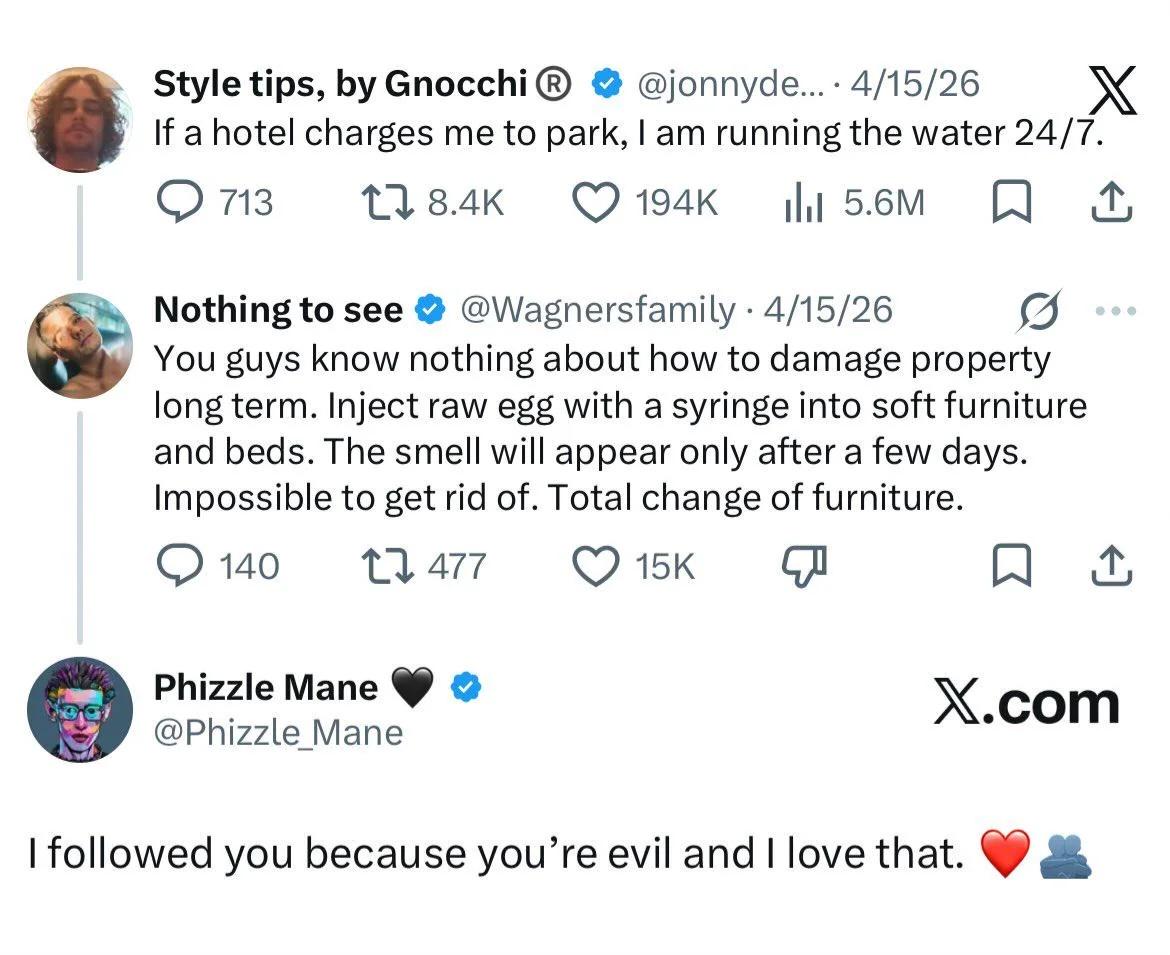
Even better, a bit of melted ice cream poured down the air conditioner vents of your polluting rolling hunks of metal will make your car smell like vomit for eternity.
Jesus, I swear some people are incapable of understanding other places.
I would love to take a train to my vacation destination. Not possible in the US at all. An 8 hour drive can become a 16hr bus or train ride that costs double that of driving.
I live in a country now that has good trains and buses. I love it, it's 100% better.
But I can't bring myself to be so pissed at someone that wants a family vacation and has to drive due to their country's failure to implement public transit.
you could use that exact same argument to justify a lot of bad things and systemic failures
I can be pissed at the system and not those forced to live in it
Most people in the world grow up in a country that is fraction of the size of America, and developed in the era of history before cars. If a city developed and grew in the Middle Ages, it is going to be a tightly organized place, so people can get to other parts of the city by walking or horse draw transportation.
But America had most of its development during the car era, and cities adopted a larger sprawl, even creating suburbs, from which people could drive.
Now that we're built up this way, with lots of suburbs, it's common for people to live 30-60 minutes, by car, to their workplace. Stores restaurants, schools, etc., are all too far to walk, or even bike, and the route may be dangerous due to traffic. Cars are essential to live a normal life.
There is an effort to upgrade public transportation, but things like trains are always going to be better within the cities. Traveling between cities is just too far, and even current trains aren't sufficient. It literally takes the same time to drive, and is probably going to be less expensive than a train ticket. If we had maglev bullet trains it would be faster, but the price would also be much higher.
We've already developed as a car society, and our geographic size makes trains and busses problematic anyway. We can try to add bullet trains, and a other efforts to relieve traffic, but we will probably always be a car culture in America.
I have to say that's simply not true.
America is car centric not because it has to be, but because it was lobbied for.
Back in the 1920s we actually had a more robust transit system. Until Ford and the other auto manufacturers pushed for more roads. I know of places growing up that are now 1.5hrs away by car, but they used to have an affordable train that took 1 hour. I don't remember those trains, but my grandparents did.
And you are right about some points. The density and distance in the US is a challenge. There will never be a bus route near my childhood home. The nearest gas station was 3 miles away and there were not enough people to justify it. But there is no reason why there couldn't have been a bus near that gas station to take people into town.
Also you are 100% wrong about trains. City to city travel is where they would be the most useful in the US. Trains can travel large distances very effectively if given the proper infrastructure. Amtrak is a joke, but it is not even close to good rail infrastructure. Rail can be so much better and is so much better in many countries. And you may say these countries are smaller than the US, and you'd be right, but they are similar in size to many states. If we had travel that efficient within state it would be a major improvement.
A system of hubs designed to take people into cities and between them would be the ideal solution with the current density.
I want American car culture to die. I hope it does, but I won't hate people for needing a car because it is necessary in America.
Absolutely valid, although I disagree with:
But at least you had this qualifier:
I don't mind cars remaining (and even you acknowledge that they are necessary in America), I just want better, faster, cheaper alternatives, so that their use is diminished significantly. When I visit relatives in NYC (often), I love using the trains and busses. My car usually sits unused most of the time I'm there. I would love to use mass transit in my own city if it was decent. About all I use it for is to go to the airport, which has been a terrific convenience. It's nice to be able to tell someone to drop off or pick me up at the local train station instead of the airport.
Your history is correct, and the auto and oil companies even encouraged and incentivized cities to abandon their electric trolly lines, in favor of gas-swilling, smoke belching internal combustible engines. It's really a combination of all the factors we both mentioned, and a whole lot more besides.
A big problem is that travel within cities and suburbs is one kind of transportation problem, and traveling between cities is a different kind of problem, and they often require different strategies and solutions that can be in conflict with each other. Regular trains and subways may work in the city, but not maglevs, which are better for long distance travel. So how do we have both, when new railways are hard to create, and the old ones are already crowded?
Add to that the simple fact that the sheer enormity of the country is an immutable variable that makes transportation alternatives necessary, but also very problematic.
I think a national bullet train infrastructure has to be America's next big improvement, if we could keep the oil companies and their stooges from stopping it.
You talk about there being two problems here, and I agree, but I don't think those problems are incompatible. They have two different solutions, but that's to be expected. First thing, very easy: remove all national and state level speed limits on rail. Rail should be allowed to go at maximum safe design speed.
For high speed intraurban transport, we need to give a DOT-Amtrak collaboration instruction and resources, and just have them start building up lines and capacity as a massive infrastructure project.
For metropolitan transport I think that the northeastern corridor's model (state departments of transportation building and maintaining passenger rail networks that are operated by Amtrak) is probably the best option where available (interstate collaboration would be vital here). Or for a way to handle it without state cooperation, Sound Transit in Seattle is a good model. It's run by all the counties in the metro area and is building out lines of light rail as mandated by bond measures. Neither of these is a replacement for an urban center rail network (such as a subway or trolly system), but they connect towns, suburbs, districts, neighborhoods, etc. The state wide version just also connects even smaller or out of the way places.
That all sounds great. I'd love to see a high speed rail line up the East coast, the West Coast, and up the Middle, and then routes connected across the South, and another across the North. As long as the ticket price was compatible with airline tix, it would be very successful, even it took a bit longer than flying. If much rather take a high speed train over an airplane. It will still be a lot faster and easier than driving.
Yeah, I'm a proponent of building an NYC-Chicago line and a San Diego to Seattle to start as proof of concept and from there expanding, probably with San Francisco-Chicago and Miami-Maine and then try to build legs that can hit a bunch of cities while connecting them to a major spine like Cleveland to Mobile and city connection lines like the Texas triangle.
It'd be a logistical challenge to figure out where all needs to be connected quickly. Like you'd probably want a southern east west line as well as the northern one. But this is exactly the sort of shit that simulation can help figure out. And worst case scenario, it's not like you're going to get that many complaints about a 14 hour (assuming several stops) overnight train ride from nyc to sf
I'd put the Northern line starting at Seattle, going across to Chicago/NY, but the Rockies are going to have a lot to say about that route.
I'd do the same East/West Coast line as you. A line from say, Minneapolis, down through Chicago, and down to Dallas and Houston, hitting St Louis along the way. There are lots of middle America cities that could hook up to a hub like St Louis. There could be lots of regional routes, all over the country.
It really wouldn't be that hard to do, and it would create MILLIONS of jobs, but it would cost a whole bunch, and we are too busy blowing all our money on war that NOBODY wants.
And even without that, we should be looking a universal health care system first.
While personally as a pnwer I prefer NY-Cleveland-Chicago-Minneapolis-Seattle, and I do think that that's a route you likely eventually want if for no other reason than to hit the Dakotas and North Yellowstone, going south of Yellowstone means that you have major cities between the Midwest and the coast, namely Denver and Salt Lake City.
Ultimately I suspect the best option for the spines is something inspired by the interstate with 3 E-W lines, probably aiming for Charleston-San Diego on the south, DC to San Francisco in the middle and NYC to Seattle in the north. But it would require enough commitment to ensure that it actually gets built that way, otherwise it's better to make something worse in the long run that's never in an awkward middle stage where it's not good enough to defend.
That really gets to the core of what I think the problem is. Our country is unable to commit to improving anything when it gets hard. Some parts of it can, I used sound transit as an example in my first comment in part because it specifically is a very young transportation network, originally being approved only 30 years ago or so. But rail networks are long term expensive projects to build and while the government could throw war amounts of money at it, it's highly unlikely. Our best chance is one or two pilot lines that take a decade or so and then us pushing for more and more. That said, if we have an economic depression this could be a part of the way out of it akin to the ccc was in the new deal
It would cost a fortune, but it would change travel in this country significantly, and it feels inevitable anyway. A country our size is perfect for a maglev operation. We have the money, if we could just stay out of war for a decade. Clinton managed to do it, for the most part.
Hey, at least we have a plan for the Trump Depression, right?
Yeah, it feels necessary and a weird mix of inevitable and impossible. It meets so many of our needs, it gives us a practical every day reason to invest in technology and manufacturing of something we can sell to the world and ourselves, it gives us something to focus our energies on and we can power it with solar these days. And politically It's a non starter. I don't know how long the country can remain in one piece. There's a massive anti infrastructure propaganda system. It would be brutally opposed by the air travel industry. If a democrat starts it a republican will end it before ground breaks. And people are pissed about the California high speed rail's delays and issues and lack trust in rail.
It requires massive changes in our country's politics, but any stable position focused on the common good will ultimately come to the conclusion to do it.
Inspired by this discussion, I mentioned high speed rail to a MAGA business guy I've known for a long time, and right away, he brings up California as the reason it will never work and we shouldn't waste money on it.
And I said "Yeah, I know, we need the money to fight wars for no reason."
Yeah. I once had a really bad date with a Californian back when I lived in the Midwest where she used that as an example of why trains are a bad investment. Like, there are a lot of issues with California's high speed rail project, and so many of them are deeply tied to California. And that's a large part of why I think the west coast high speed rail should come after the new york-chicago despite being a west coaster now.
Large infrastructure projects can't be sold on the "they say we may be able to do it for as little as $x" they need to be sold on the "we'd like to do a feasibility study for $y" then sell it on the worst case scenario. And then you use your power of eminent domain where needed. But most importantly you have to actually commit to it.
But yeah, I don't want a California high speed rail type project, I want feasibility studies and accurate projections until we can get what china has done