solrize

joined 2 years ago
MODERATOR OF
[–] solrize@lemmy.world 1 points 6 days ago

Could be. I mostly want uniformity across UIs. So it would be cool to be able to configure Anduril to be like random light X.

[–] solrize@lemmy.world 6 points 6 days ago (2 children)

You mean you found the AI slop with google, not much help.

[–] solrize@lemmy.world 2 points 6 days ago

I've generally heard that it's ok to discharge LFP batteries to 0%. You just shouldn't store them that way (or at 100%) for long periods. Keep in mind that LFP has maybe half the energy density of the highest density NMC batteries, and sodium has maybe half that of LFP. Sodium really doesn't sound that good batteries for portable devices.

[–] solrize@lemmy.world 1 points 6 days ago* (last edited 6 days ago) (1 children)

It wouldn't surprise me if there's not yet any sodium charging chip for small consumer electronics like this. I haven't heard of a sodium powered flashlght, phone, or anything like that before. The only sodium consumer device I know of right now is a Bluetti power station which has 900WH: https://www.bluettipower.com/products/sodium-ion-battery-pioneer-na

It got some attention at its anouncement but tbh it's 10lb heavier and $300 more expensive than the 1024WH lithium version (Elite 100v2). So it's for early adopters only.

If you want to charge a small sodium cell, you can probably program an MCU to deliver the right charge profile, along with a few small external parts. That's how Apple phones worked at least in the past. They saved a fraction of a penny by just incorporating some extra logic and code in their big ASIC instead of having a separate charging chip. It's kind of interesting that the charger was programmed in Forth, on a special Forth processor (b16-small) that they cooked into a hardware macro: https://bernd-paysan.de/b16.html . They hired Bernd (the b16 designer) to write the code and it was pretty intricate because of the cpu's limitations. I don't think I'd have used that approach ;).

[–] solrize@lemmy.world 2 points 6 days ago* (last edited 6 days ago)

Wurkkos TS27 has an LFP battery and is beefy and advertised as a duty light, and it seems nice except then it has this silly RGB ring light that turns it into a fidget toy. I lost interest because of that. YMMV. :)

https://wurkkos.com/products/ts27

Added: I just looked over the kickstarter page for this light. The battery looks to be 10,000mAH nominal, size 32140 which is 4.7x the volume of a 21700. Voltage is 3.0 nominal but looking at the discharge curve at -20C it looks about 2.5V on average, so 25 WH. Not that much better than a 5000mAH 3.6V 21700 (18WH). The sodium is somewhat worse but still viable at -40C and I guess it might be beating lithium by then too, plus it has the ability to accept charging at -40C. I don't see super-cold charging as very important for a flashlight (if you're able to charge your light you can probably keep it at least a little bit warm), though super cold operation can be helpful.

Also, this is a 2500 lumen light which is a far cry from the old Maglights that were perfectly usable. The classic 2AA minimag was around 5 lumens over most of its runtime, the huge 6D was something like 36 lumens, and the nicad powered Magcharger was about 180 lumens. Surely for changing a fuse, a low powered headlamp is preferable to a huge handheld ;).

[–] solrize@lemmy.world 3 points 6 days ago

I guess they must have had better internet in the French Revolution than we have here now! Everyone hates Comcast and now you know why ;).

29
submitted 6 days ago* (last edited 6 days ago) by solrize@lemmy.world to c/flashlight@lemmy.world
 

TLDR: I like it. Write-up will discuss a few nuances. Order link.

Photo, left-right: Wurkkos TS10v2, Emisar D4v2, Wurkkos TS11. So you can see the TS11 is kind of a chonker, but it's ok. If you're not familiar, the TS10v2 is a 14500 light (roughly same energy capacity as the 18350 in the TS11) and the D4v2 is an 18650 light that is considered kind of chunky for that format.

Note: all three lights in the photo are TURNED OFF. Only the standby (locator) leds are on. More about this below.

I've never been into throwers and have never really had one before, unless you count the big incans of bygone years. I ordered the TS11 because there have been a few times recently when I wanted something with throw (trying to look down a hillside at night, or read house numbers from a car) and also, Wurkkos and Sofirn both seem to be giving up on making Anduril lights, so I figured now was the time to get one. They ship the TS11 from a US warehouse and there is an 18650 battery tube available from the China warehouse. I ordered both at the same time (plus another item or two) and IIRC i got free shipping for everything. The TS11 arrived today and the other stuff is not here yet. I think everything has encountered some delays due to the winter holidays but it's no big deal. The orange color is very nice and was one of the attractions.

As you can see, the standby leds for both the pushbutton switch and the front are ridiculously bright, like 5x brigher than the D4v2 switch light, which is already too bright. Come on guys, they are locator lights to help find your light in the dark, not illumination lights. They are distracting if you like to keep the light next to your bed. I think Anduril now has a way to adjust the standby brightness, so I'll see if I can make it dimmer, but if not I might just shut it off since this isn't really a bedside light anyway. A piece of GITD tape is enough of a locator. I do very much appreciate the standby led feature (genius idea that I first saw in Anduril, as alternative to a tritium marker) but this is way overdone.

The light has a reflector (large by EDC standards) and an optic on the front and makes a small, sharp edged circular hotspot without much spill. This is slightly not ideal compared to traditional throwers with deep parabolic reflectors, which had more spill. But it's ok, at least it's not a LEP. It's raining out right now so I haven't taken it outside yet.

I tried to charge it up through an Adafruit USB-C power display but found that the USB charging port was too deeply recessed for the display plug to connect firmly. I was able to interpose a USB-C right angle adapter and charge that way with the display. The light reported 3.8V battery charge out of the box, and it started charging at about 1 amp. It stopped after 45 minutes with about 1.2WH delivered. That's from the USB plug at 5 volts, so I guess a little under 1WH to the battery. The battery is a Wurkkos branded 18350 that says "1100mAH" so I guess it came with about 75% charge.

It's a nice sized handful that makes no attempt at miniaturization, yet it's still EDC-able if you want to do that for some reason. I still see it as sort of a niche light. I will use it but probably not that often. My main current EDC is a TS10 SG which has quite good throw for a tiny pocket light, and is a fraction of the TS11's size and weight despite having about the same battery energy.

The TS11 came with Wurkkos's usual nice packaging, shiny cardboard box with magnetic closure, etc. Included were the battery (inside the light), a USB A-to-C cable and one of those cheap wrist lanyards that you thread through the radiused lanyard hole, plus some spare O-rings. Between the packaging, the light's nice appearance, and the included accessories, it would be a good gift for someone who can use a thrower for outdoors. I definitely think the orange version looks nicer than the black. The 18650 battery tube is not really needed and will probably make the light seem awkward, but I ordered it anyway since I have several other 18650 lights and cross-compatibility is always nice.

I'm sad about Anduril losing popularity with manufacturers, apparently due to UI complexity leading to customer dissatisfaction. Hank is the main holdout but IMHO his designs are too lumen obsessed, leading to technical tradeoffs that I don't really like. I think Anduril 3 will need some redesign to make it easier to customize the UI. I had a brief chat with Toykeeper about this and she seemed open to it, but it's conceptual only so far. If it happens I hope it can bring Wurkkos and others back to the fold. There are some nice Wurkkos lights that I've avoided on principle just because they're not Anduril.

Anyway, that's my NLD for today and I'm happy. Any day with a new light is good.

[–] solrize@lemmy.world 2 points 1 week ago

Sodium batteries are mostly of interest for grid storage or maybe stationary home batteries once they get cheap enough. They are sort of marginal for EV's but might find a place in some cold weather ones. Having them in a few weird flashlights isn't going to help ramp up manufacturing volume compared to that. The real demand will come from power utilities buying gigawatts at a time, not a few flashlight nerds.

I remember the Eternalight and it went through a few nicer incarnations over time The designer was a regular on Candlepower Forums. IDK if the company still exists. The product was cool in some ways. IIRC it uses 5mm leds. The first production flashlight with a Luxeon was the Arc LS and I had two of them. I think the semi-custom McLux TK may have been earlier but my memory by now is hazy. I still have mine. Sodium batteries are different. Aside from the very niche advantage in cold weather charging, they are worse in every way than lithium. The main feature that makes them interesting is potentially lower cost per KWH in the long run. That's great if you want a 100KWH off-grid battery for home, and maybe it can find its way into economy EV's. But nerdy flashlights, nah, battery costs are not much of an issue already. The bigger light and fancier charging and regulation circuitry negate any advantage. We could already use LFP batteries if we wanted to, but we almost never do.


Fwiw Molicel INR 21700's are rated for discharge down to -40C (pdf) though charging only down to 0C. I don't see a need for a sodium ion flashlight just yet, but I'm posting anyway since I guess it's news despite being stupid.

[–] solrize@lemmy.world 2 points 2 months ago (1 children)
[–] solrize@lemmy.world 5 points 2 months ago

Only living people can win the prize. If they die between the announcement and the ceremony they still get it posthumously. I'm pretty sure that has happened now and then.

[–] solrize@lemmy.world 3 points 2 months ago (2 children)

OMG. IV hydration. I wondered why regulate drinking more water, but nooo. Sheesh.

[–] solrize@lemmy.world 7 points 2 months ago

JLR has been paralyzed for the past few weeks due to a cyber attack so the news is that they're emerging from that.

[–] solrize@lemmy.world 2 points 2 months ago (1 children)

"Let me tell you a secret: chess is the most violent of all sports. I’m a pretty good soccer player and a long-distance swimmer, and recently, I’ve taken up tennis, but I can tell you that there’s no sport as competitive – yes, I’ll say as rough – as chess. The only goal in chess is to prove your superiority over the other guy, and the most important superiority, the most total one, is the superiority of the mind. And there’s no luck involved, no picture card coming up at the right time, no roll of the dice that saves you. It all has to come out of your head. You whip him or he whips you. It’s as simple as that. Or as complicated as that."

--Garry Kasparov, former world chess champion

So make a lichess.org account and wreak some havoc over the chessboard :).

5
submitted 3 months ago* (last edited 3 months ago) by solrize@lemmy.world to c/flashlight@lemmy.world
 

Content warning: this is something of a marketing pitch, but it is worth reading. It's about using CT scans to find safety flaws in 18650 cell manufacturing. It's put out by the manufacturer of the CT equipment, i.e. not trying to sell anything to most flashlight users.


cross-posted from: https://programming.dev/post/28431012

  • Google is set to cut hundreds of new jobs in its device and platforms divisions soon.
  • The company has continued to cut its Google Pixel teams, doing so earlier this year as well.
  • Rival Microsoft is considering a new round of layoffs next month, per reports.
13
submitted 8 months ago* (last edited 8 months ago) by solrize@lemmy.world to c/flashlight@lemmy.world
 

It's almost the same as v1.0. Surprisingly complex circuit. 13 minute video.

21
submitted 9 months ago* (last edited 9 months ago) by solrize@lemmy.world to c/rust@programming.dev
 

Question is how to do these in Rust. An example might be a browser DOM: each node has a parent pointer, a list of child pointers, left and right sibling pointers, maybe a CSS node pointer, etc. Inserting or deleting nodes has to repair the pointers to and from the neighboring nodes as needed.

I know this is doable since obviously Servo (Rust's initial driving application) has to do it. I hope the answer doesn't involve the word "unsafe". But I am quite unclear about how to create such a structure under Rust's rules of pointer ownership, and also how to reliably reclaim storage when nodes and trees/subtrees are deleted. Plus there will be thread safety rules that should be statically enforced if possible.

I've heard that doubly linked lists in Rust are handled by an unsafe library, yet this seems even worse. Thanks.


Now I have a use for my Sofirn C01R and that H25LR headlamp with 670nm LED's. Cool. 3 minute exposure to 670nm light in the morning apparently improves color perception for the rest of the week. I'll read more closely to find the right intensity and so on.

1
submitted 11 months ago* (last edited 11 months ago) by solrize@lemmy.world to c/android@lemmy.world
 

A while back, people here kindly explained how typical commercial Android apps get push notifications. Quick version: notifiications are sent through Firebase Cloud Messaging (FCM), which communicates with Google Message Services (GMS), an always-on Android client app preinstalled on most Android phones. There's a FOSS alternative to GMS called MicroG but it's still an FCM client, and FCM is an evil Google service that client apps that use it have to enroll with even if you escape GMS on the client side.

Right now I'm interested in sending myself push notifications from a self-hosted service that I run on a VPS. Of course I don't want to deal with FCM. I also prefer to not have to develop an Android app as opposed to running something like an XMPP client.

It looks like there are some alternatives like Iris and Unified Push (unifiedpush.org). It looks to me that UP becoming the preferred solution, is that right? UP has its own always-on client that can receive messages from a UP server that you can self-host. This sounds ok to me in principle.

My main question is whether UP is somehow worse than GMS, in terms of being a background app that keeps a network connection open. Is GMS anything special in that regard, besides being preinstalled by Google? Would GMS use less battery power or anything like that?

I may also have to look into how XMPP works, if my server program is going to send messages through it. I actually have an unrelated reason to be interested in XMPP. But does that approach sound reasonable? Are there XMPP clients that are non-bloaty, don't eat battery energy in the background, etc.? I'd like a loud audio alert if I get one of these notifications from my server. Can I usually easily set up XMPP clients to allow that only from my own service, while not making sounds for anything else? I'm luddite enough that I still use IRC for online chat, but maybe I have to catch up with the ~~20th~~ 21st century about this. Is there a good community to discuss XMPP development and self-hosting? I.e. I'd want to self-host the XMPP server and use it to send messages to my phone from my own (also self-hosted) server app.

The simplest alternative I can think of is for my server program to just sometimes send me SMS messages through Twilio or similar. The alerts will be infrequent enough that I don't mind going this route. Does that sound easier? It's less in the self-hosted spirit but it gets rid of a lot of software on both the server and the phone, I guess.

Thanks!


8 games, 60 minutes + 30 second increment for Benjamin, i.e. classical TC though a bit quicker than some. Benjamin gets N odds in all games. Leela will play at bullet speed. The hardware is not specified in the thread I linked. Leela will apparently be running a network specially trained to play with knight odds. Match will be livestreamed on Youtube with GM Matthew Sadler commentating. It will take place over 3 days, January 25 through 27th.

For those not familiar, Leela is a neural net chess engine inspired by Alpha Chess Zero. GM Sadler is a co-author of "Game Changer", a book analyzing a bunch of games of Alpha Chess Zero, so he's just about an ideal commentator for this event. It should be interesting.

Added: official page about match: https://lczero.org/blog/2025/01/leela-vs-gm-joel-benjamin/

Results of first 5 rounds: 0-1, 0-1, .5-.5, .5-.5, 1-0. Leela has white in all games so this means Benjamin won the first two, drew the next two, then lost one (game 6 now in progress). Maybe he is getting tired. He said after the first day that he was "knackered".


They apparently do this every year. You have to make an account on their site which subscribes you to an email newsletter (you can unsubscribe) and deal with some popups and upsell attempts, but it's a decent basic 1AAA light from everything I've heard. 90 lumens, 1 level, 60mm long, maybe not great LED tint, i.e. sort of a less nice version of the Skilhunt E3A but still fine.

Users supposedly get free shipping on their first order and someone on reddit claims to have actually received this, but I didn't, and had to pay the $5.

It's 1 per person and there are apparently a lot of people trying to scam the site, so my payment got flagged as possible fraud (card declined). I called the card company and they fixed it, so my order went through.

I'm not a huge fan of Olight for various reasons, but hey, a free light, I'll take it.


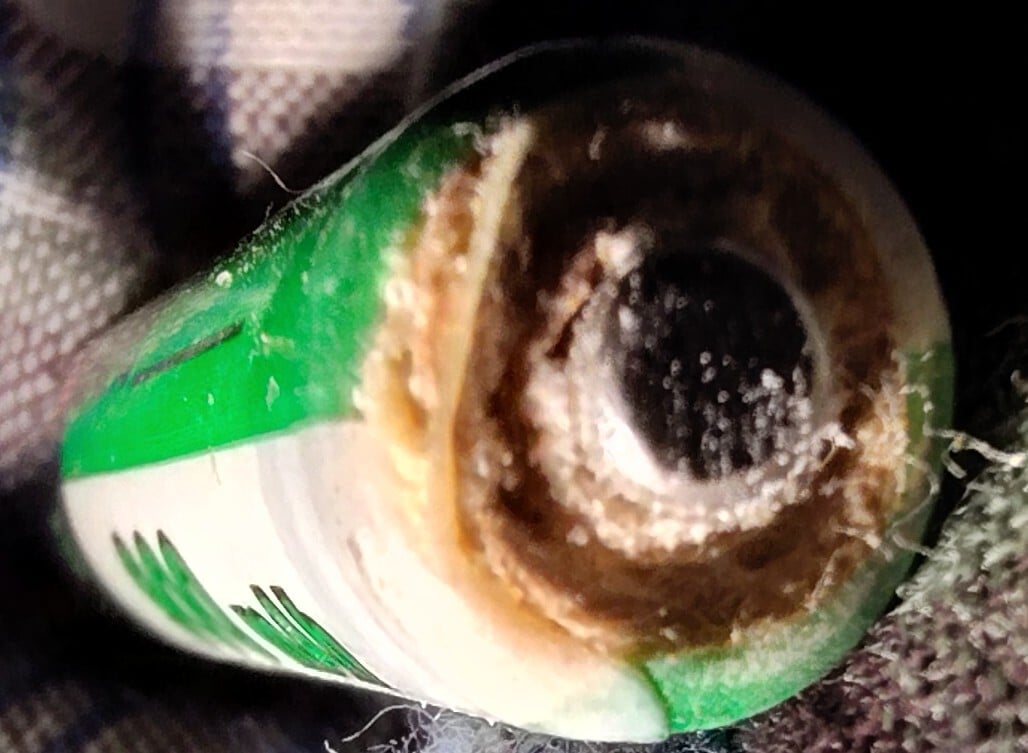
It's an old "Soshine" branded NiMH AAA cell claiming 900mah. I'm not about to test it but I did use it for a while. I've standardized on Eneloops since then. Anyway this is FYI so you know that NiMH leaking is a thing.


Basically I've acquired a burner Android 8 phone and am running the target.com app which is the only way they let you get parking lot delivery at the store. I assume the Target app is spyware. I keep the phone powered off almost all the time which should limit the spying. The thing is, if I power up the phone and order something, then close the app, I still get an alert when the status of the order changes (e.g. it's ready for pickup). So the app is still listening for network traffic from Target.

Can anyone explain what is happening in Android and whether there is a way to make an app really stop? Does the app stay in a running state even after I've closed the UI part of it? Is there somethng like an inetd in Android that listens for network alerts and re-launches the destination app? Are there Android app permissions associated with this, that I can revoke?

I don't want to run this type of app on my main phone, but I had at first liked the idea of using a burner for such things. Now, though, I wonder if I need a separate burner for each suspicious app. Thanks.

view more: next ›