AliSaket

joined 2 years ago
[–] AliSaket@mander.xyz 1 points 3 weeks ago

Not that I know of. There have been discussions around putting some of that into legislation though. I'm not sure about how serious that is, since most of all of this is done behind closed doors.

[–] AliSaket@mander.xyz 40 points 3 weeks ago (2 children)

Joke's on us. Remember the 'great deal' for 15% tariffs? Guess what was included in that. Yep: Better access to the EU market for US agricultire products and the axing of what they call "unfair" trade barriers. Which includes among others plant-health measures, health regulations, vehicle safety regulations and more generally easier mutual recognition of assessments of conformity.

[–] AliSaket@mander.xyz 8 points 1 month ago (4 children)

The problem is more that they make silly unforced errors. Like today, where they made a completely weird strategy call for both or last race, where they had more porpoising than they expected and got DQed. There were more of these errors during the season, albeit not often this consequential. They could have gone into the last few races just fighting it out amongst themselves, but instead they've let a third one get in between them.

If I was Oscar Piastri I would be looking at what other teams can offer

This would be even more true, if McL had decided to back Lando at the beginning of the season. It is precisely the equal opportunity in the most competitive car, that would keep him there (rule changes for 2026 notwithstanding). So the argument is exactly the opposite.

[–] AliSaket@mander.xyz 3 points 1 month ago

Basically the assumption is that the signal x(t) is equal to 0 for all t < 0 and that the integral converges. And what is a bit counter-intuitive: Laplace transformations can be regarded as generalizations of Fourier transformations, since the variable s is not only imaginary but fully complex. But yeah... I would have to brush up on it again, before explaining it as well. It's... been a while.

[–] AliSaket@mander.xyz 2 points 1 month ago

I was at the intersection between mechanical and electrical engineering as well as computer science. And worked in/with (electric) mobility, agriculture, medical/rehabilitation tech., solar energy, energy grid, construction and building tech. As well as some very limited stuff with economics. And I intentionally chose my study courses to be able to work in multiple areas and inter-disciplinary. My latest work is more on the business and management side of things and less technical, though.

What are you studying and what direction are you hoping to head in?

[–] AliSaket@mander.xyz 8 points 1 month ago* (last edited 1 month ago)

Basically two things: 1. Complicated operations in the time domain like convolutions become simple operations in the frequency domain. 2. It is way easier to handle complex numbers and do analysis with them than with explicit frequencies to the point where some things like stability and robustness can be judged by simple geometry (e.g. are the eigenvalues within the unit circle) or the sign of the imaginary part.

EDIT: I forgot the most important simplification of operations: A derivative in the time domain, becomes a simple multiplication by s in the frequency domain. So solving Differential Equations of the system's dynamics becomes pretty easy without having to go back into the time domain explicitly.

[–] AliSaket@mander.xyz 15 points 1 month ago (6 children)

It seems simpler than the Fourier transform, until you realize that the s is a complex number.

Oh, look at that hornet's nest. I wonder what happens if I poke it

As someone who worked with system modelling, analysis and control for years... I do think the Laplace transform is easier to work with 🙈🏃‍♂️

[–] AliSaket@mander.xyz 4 points 1 month ago

It's a bit difficult to advise on such a thing without knowing the people and their situations, so I'll keep it as general as possible and mention a few common traps. And it won't be a clear yes or no, because in the end, only you two can make the decision and take responsibility for your own lives.

When people say, that you change a lot during your 20s (or longer for that matter), it's because of several things, but I'd say the most important are:

First: Your ability to interpret and regulate emotions (the prefrontal cortex is the last part of the brain to fully develop and continues to do so in your 20s). And with that identifying subconscious emotional wounds and patterns driving your decisions, so you can take appropriate action to change your programming where it isn't helpful. In a relationship context both of your attachment styles are very relevant here.

Second: Identifying and letting go of values and ideas that have been instilled in you by your vicinity (parents, religion, friends, TV, internet, or society in general) and identifying your own intrinsic values and drivers. Or in other words: Learning who you, yourself, really are. I know it feels like you already know, but that feeling can be deceiving. I for one don't know of a single person who is let's say 35 and would claim that they truly knew themselves at 20, let alone 17.

So when you say "It has always been my dream to have a family of my own, and that motivated me to propose: why wait if you know what you want?", I hear some alarm bells going off. I would advise you and your fiancée to be very introspective, where this want came from and whether it truly aligns with yourselves and with your current situation, or whether it came from external influences. This is hard to do at your age, even if there is a chance that you are both already mature enough in that regard. Also be very aware, what marriage actually means. To you, to her, to others (e.g. is it a box to tick off, or is it a gate to real fulfillment?) and legally.

I read in one of the answers that you haven't had a real fight yet. A primary predictor of relationship success is your way of conflict resolution. Now don't go looking for artificial conflict to see how you react. But if you for example were to take things in steps, like moving in together before you get married, these conflicts will arise naturally and you would be able to see how that goes. And even if it goes badly at first, if you are both conscious of it and willing, you can both work on the way you react to and communicate during conflict (and in general) to make it succeed. A small word of caution and something to explore (not assuming it's necessarily the case here): A pattern I see often in couples who "don't have fights", is that at least one of the two is avoiding it. Which can be ok, but not if it means always (consciously or unconsciously) abandoning their own boundaries or values.

What complicates all of that, is what people now seem to call "new relationship energy". Basically the hormonal cocktail of your system that makes you feel so excited and in love with the other person. This leads people to ignore existing and potential friction and romanticize the idea of a future with the partner. While it is possible to "keep a spark alive" for your whole life, if you do it right, this "energy" for a lack of a better word, will wear off at some point. At which time other factors like communication skills, conflict resolution, the emotional depth of the relationship and value/need/want alignment become even more important.

I could go on and on (what's your plan for education, jobs, place to live, kids, ...), but I think these are the most relevant parts to make a decision with both eyes open. The journey can be magical as you get to know yourself and the other person together and witness and be part of the growth together. But it will get bumpy and how you two can navigate those bumps will determine where you'll end up. No matter the success, it will be a learning experience. If you are willing to learn and act accordingly.

Good luck you two. And don't forget to enjoy and experience your lives!

[–] AliSaket@mander.xyz 2 points 1 month ago

Please enlighten us. What reports on 'McLaren cheating w/ skid blocks' surfaced a year ago?

[–] AliSaket@mander.xyz 3 points 1 month ago

If the skids expanded, they would protrude more and therefore be more prone to wear. That is the exact opposite of what the "trick" should do. Furthermore they wouldn't be flush with the plank after cooling down again for re-scrutineering, which would be weird because that is tightly regulated.

So I don't know who came up with this rumor, but it makes sense on no level whatsoever.

[–] AliSaket@mander.xyz 14 points 1 month ago

In some places in the world, some people seem to get incredibly clumsy when they're near open windows. In others, they have very guilty consciences to the point of killing themselves.

\s for clarity

[–] AliSaket@mander.xyz 2 points 1 month ago

Ich kann in der Sache die neueste Folge der Anstalt (Abriss-Anstalt) von vor ein paar Tagen empfehlen. Dort werden Missstände der Finanzierung und Subventionierung des sozialen Wohnungsmarktes aufgezeigt. Sowie eben auch wo der neueste "Bau-Turbo" an der Realität vorbei geht.


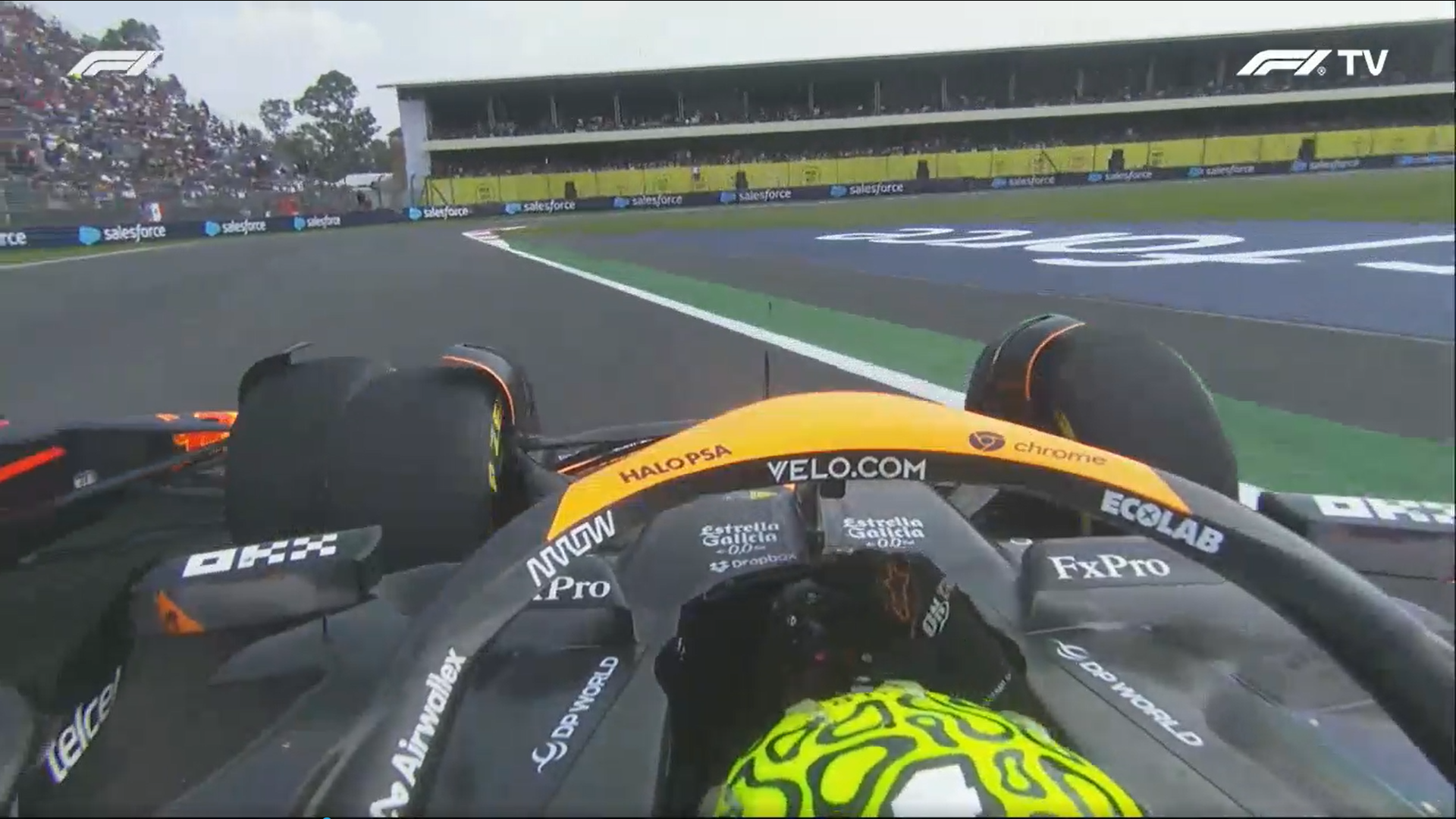
Two 10-second penalties were given to Max after the two incidents in T4 and T8 of the 10th lap of the Mexico GP last Sunday. Additionally, 2 penalty points are added to Max' license which brings the total to 6 during 12 months. If I were to ask you, which of the two incidents would merit the 2 penalty points more, would you have guessed, it's the T4 incident?

In their official document of the T4 incident, the stewards are of the impression, that Lando was in front of Max 'at the entry, apex and towards the exit of the turn when he started being forced off the track' and that Lando would have been able to stay on track to finish the maneuver. (Sidenote: Horner's argument, that one would take the same lines and braking points during a fastest lap and when going wheel to wheel is laughable on its face.) The standard penalty for forcing another driver of the track has been applied. I can't see any problems with the reasoning in this case.

Now for the T8 incident:
'Following the incident in Turn 4, Verstappen attempted to pass Norris on the inside at Turn 8. Verstappen was ahead at the apex of Turn 8 and would have been entitled to racing room.' It is only because he didn't stay on track while doing all this shenanigans and then stayed in front, that he got a 10 second penalty without penalty points, which is the standard penalty for 'Leaving the track and gaining a lasting advantage'. It is not for forcing off another driver, or for provoking a crash (which Lando barely avoided).

And there lies the problem with the current driving standards guidelines. The only one available somewhere is a version from the Imola GP of 2022 (so they might be slightly out-of-date). On the second point of overtaking on the outside, they read:

'In order for a car being overtaken to be required to give sufficient room to an overtaking car, the overtaking car needs to have a significant portion of the car alongside the car being overtaken and the overtaking manoeuvre must be done in a safe and controlled manner, while enabling the car to clearly remain within the limits of the track.

When considering what is a ‘significant portion’, for an overtaking on the outside of a corner, among the various factors that will be looked at by the stewards when exercising their discretion, the stewards will consider if the overtaking car is ahead of the other car from the apex of the corner.

The car being overtaken must be capable of making the corner while remaining within the limits of the track.'

There's 3 problems with this.

  1. It just makes it a race to the apex, which is in itself ill-defined. A quick part-fix: They could clarify it ahead of each weekend, e.g. given the ideal line for a quali lap. If you overtake on the outside, you'll have to get ahead by that apex and still remain on the track. If overtaking on the inside, make sure the 'front tires are alongside the other car by no later than the apex' and you are entitled to 'sufficient room'. If not, you can be forced off track, or the door closed on you respectively. Doesn't read too bad if not for the imprecise definition, the bias towards the inside car (front tires alongside the other car vs. ahead of the other car) and that it only works in one direction (if I overtake someone on the inside and got my tires alongside the sidepod of the one overtaken, I have to do it in a safe manner, but can crowd them off the track depending on the interpretation).

  2. the last part of the overtaken car having to be capable of making the corner has just been ignored until that T4 incident. For a recent example: The US GP. The 'gaining an advantage' is not well defined at all ('This may include giving back the timing advantage up to drop back a position behind the relevant driver') and should imho be explicitely extended by being able to hold a position by going off-track.

  3. Causing a collision is regulated in the International Sporting Code, App. L, Article 2.d). There is nothing about a provocation of a collision which was only avoided by the actions of another driver. So there is a way too large grey area which incentivizes the wronged party to actually make small contact in order for the other driver to get a penalty. And since we aren't playing bumper cars, this should be more clearly regulated, especially since the not leaving 'sufficient room' part has also been criminally negleted over the years.

Now add to all of this the inconsistencies between different stewards, or of the same stewards during the same GP (e.g. TSU penalty vs. VER non-penalty during the US GP a week ago) and we have a completely chaotic situation, where actual racing comes short.

I would love to do an actual deep dive and clip out all relevant incidents back to 2020/21 when Lewis and Fernando brought fourth the same arguments, that seem to have become more clear for a broader audience now that Max is arguably more brazen with his interpretation of the rules and guidelines and others are starting to imitate it. Alas I lack the time. The Mexico and US GPs in 2024 should be more than enough to make the points clear. And it is a positive sign, that the driving standard guidelines will be changed come 2025 and that the drivers had a productive meeting last Friday in Mexico.
view more: next ›