
this post was submitted on 24 Dec 2024
32 points (97.1% liked)

Memes

13364 readers
1683 users here now

Post memes here.

A meme is an idea, behavior, or style that spreads by means of imitation from person to person within a culture and often carries symbolic meaning representing a particular phenomenon or theme.

An Internet meme or meme, is a cultural item that is spread via the Internet, often through social media platforms. The name is by the concept of memes proposed by Richard Dawkins in 1972. Internet memes can take various forms, such as images, videos, GIFs, and various other viral sensations.


Laittakaa meemejä tänne.

founded 3 years ago
MODERATORS
 
all 45 comments
sorted by: hot top controversial new old
[–] UnderpantsWeevil@lemmy.world 4 points 11 months ago (2 children)

https://en.wikipedia.org/wiki/Veblen_good

A Veblen good is a type of luxury good, named after American economist Thorstein Veblen, for which the demand increases as the price increases, in apparent contradiction of the law of demand, resulting in an upward-sloping demand curve. The higher prices of Veblen goods may make them desirable as a status symbol in the practices of conspicuous consumption and conspicuous leisure. A product may be a Veblen good because it is a positional good, something few others can own.

That said, part of the problem with lab-grown diamonds is that they're not competing against a rare commodity. They're competing against a powerful vertically integrated cartel. There isn't any real diamond shortage, just a supply-side monopoly. There isn't a natural high demand for diamonds, just a market saturated with aggressive advertising. There isn't a wholesale diamond exchange judging the rocks objectively on their quality, just a series of elaborate marketing gimmicks and scammy sales goons trying to upsell you.

Diamonds have always been a racket. The one blessing of manufactured diamonds is that they're no longer a racket putting market pressure on industrial grade diamond equipment. But the jewelry exists to separate gullible superficial status-fixated people from their money. Ethics was never part of the equation.
[–] Infynis@midwest.social 1 points 11 months ago

So the answer is just to buy a lab-grown diamond, and then tell everyone it's real, because once the poors have it, it won't be cool anymore

[–] aeronmelon@lemmy.world 1 points 11 months ago

Best comment that I also hated reading all month.

[–] MargotRobbie@lemm.ee 2 points 11 months ago (1 children)

At this point you're not paying money for a diamond, you're paying money for a certificate.

If you want to know how much a diamond is really worth, go to any jewelry store and ask them to appraise the resell value of your natural diamond ring with certificate and all, no matter how much you paid for it, they're probably going to tell you only the precious metal setting is worth any money, and the rock itself is utterly worthless the second you received it.

Which makes diamond a terrible symbol for love.

[–] WhatYouNeed@lemmy.world 1 points 11 months ago (1 children)

Considering more than 50% of marriages end in divorce, maybe a worthless symbol is fitting.

[–] TheBrideWoreCrimson@sopuli.xyz 1 points 11 months ago* (last edited 11 months ago)

"See, our love is just like a diamond: Turns to ~~coal under high pressure and to~~ smoke when heated."
Edited for facts

[–] Pringles@lemm.ee 1 points 11 months ago

I like diamonds, my wife calls me a magpie. I buy her jewelry so I get to look at it while she wears it. That being said, I only buy jewelry with artificial diamonds for my better half. She jokingly reacts affronted when I tell her, with an incredulous face she will go "What? No children died for this? Some husband you are!"

[–] JovialMicrobial@lemm.ee 1 points 11 months ago* (last edited 11 months ago) (1 children)

I'm not even sure where the need for an expensive gem stone came from, diamond or otherwise.

My wedding/engagement ring came from an artist and the bands are sculpted and fit together. It's beautiful and I never have to worry about the stone falling out of the setting, plus it was in our price range. Gem stones can be nice, not arguing against them, but rings without them can be just as pretty and more affordable.

[–] mortemtyrannis@lemmy.ml 1 points 11 months ago (1 children)

It was a marketing campaign from De Beers. Where else would it have come from.

[–] ThatGuyNamedZeus@feddit.org 1 points 11 months ago (1 children)

Anything to the effect of "this ring isn't expensive enough" is the only reason you need to never marry that person.

[–] dharmacurious@slrpnk.net 1 points 11 months ago (2 children)

My (former) best friend got married young, and her and her husband had rings they got at the flea market that cost about 20 bucks a piece. I always respected the hell out of her for that. Her sisters tried to make it out like it was some kind of bad omen, or like it meant they didn't love each other. She had a lot of pressure to cave into and act like a snotty brat about the cost of the rings. She never did, and loved her cheap ass flea market ring.

She turned out to be a terrible person in a multitude of other ways, but on that note, good for her.

[–] Contingencyfork@lemmy.world 1 points 11 months ago

Not the ending I was expecting.

[–] INHALE_VEGETABLES@aussie.zone 0 points 11 months ago (1 children)
[–] dharmacurious@slrpnk.net 0 points 11 months ago (1 children)

I... Do not know what that means lol

[–] MystikIncarnate@lemmy.ca 0 points 11 months ago (1 children)

I think it's a modification of "360 noscope" which is a gaming term for an unexpected change in a game stemming from fps games like counter strike. The term basically relates to a high skill/high luck shot usually involving a quick rotation and/or flick shot, where you didn't use the scope of the weapon to help improve accuracy, but made the shot anyways.

Basically saying it was a highly unlikely outcome...

The "nopost" which replaces "noscope" is probably their way of referencing the above while making it relevant to the context (a post).

I'll admit, the words, taken at face value, do not make a lot of sense. The entire thing relies on a general understanding of the 360 noscope meme.

[–] dharmacurious@slrpnk.net 0 points 11 months ago (1 children)

Thank you!

Also, if I'm not mistaken, this is (at least) the second time you've replied to me when I didn't understand a comment, and done it in such a way to make things very understandable. Can you just follow me around explaining things to me? It's extremely helpful!

[–] MystikIncarnate@lemmy.ca 0 points 11 months ago (1 children)

Ha. That's just how I am. I didn't notice that I did that.

I appreciate the kind words, fellow lemming, and I hope you have a wonderful day.

[–] flambonkscious@sh.itjust.works 2 points 11 months ago

Ha. You two are cute - keep on being awesome

[–] rockerface@lemm.ee 1 points 11 months ago (2 children)

I want to buy a synthetic gemstone that is impossible to be formed naturally. I'm sure there's at least a few.

[–] meyotch@slrpnk.net 1 points 11 months ago (1 children)

I want a stone so un-natural that the mineral is named cthulite.

In it, you see a tiny civilization. You are the cosmic horror.

[–] stinky@redlemmy.com 0 points 11 months ago (1 children)

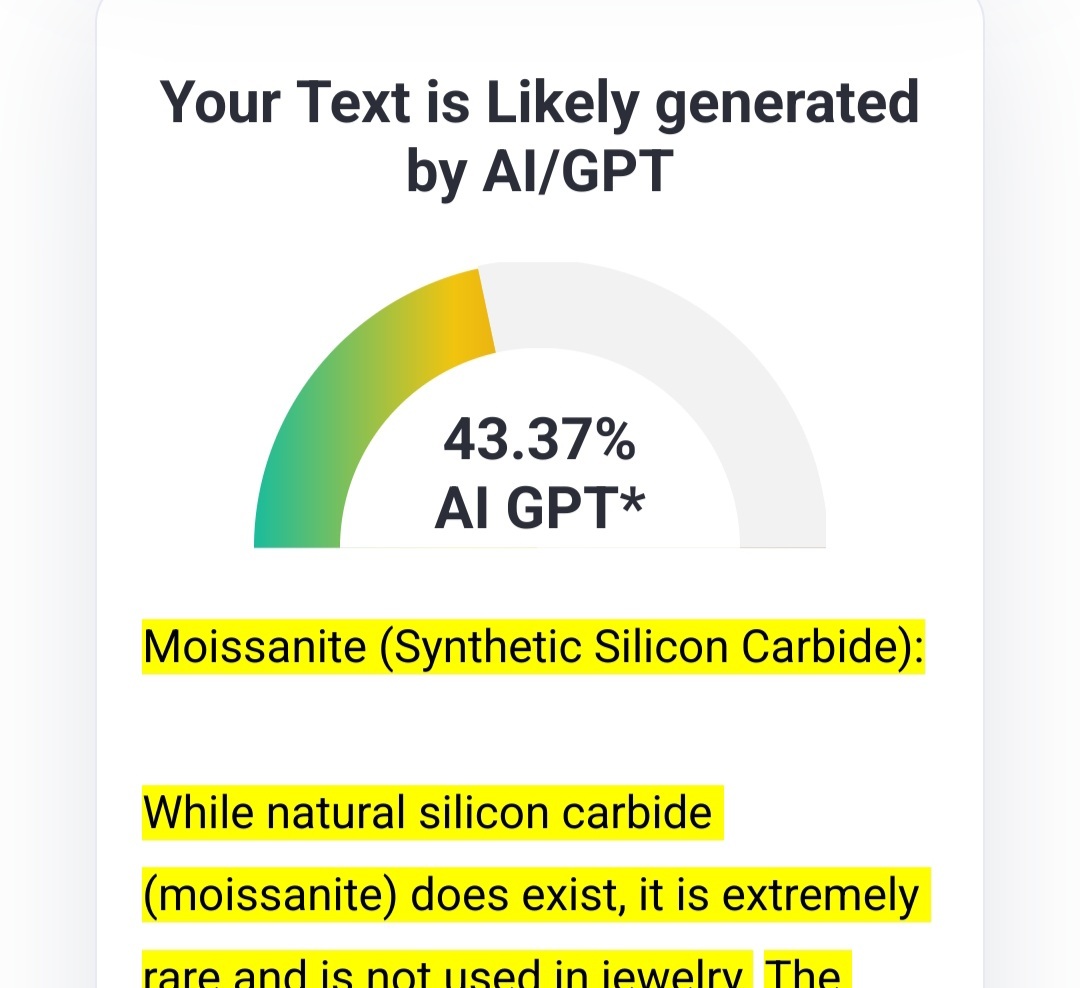
Moissanite (Synthetic Silicon Carbide):

While natural silicon carbide (moissanite) does exist, it is extremely rare and is not used in jewelry. The moissanite used in jewelry is entirely synthetic. Its properties, such as brilliance and hardness, make it a common alternative to diamonds. YAG (Yttrium Aluminum Garnet):

Originally developed for industrial and laser applications, YAG is sometimes used as a gemstone. Although it is named a "garnet," it is not related to the natural garnet family of minerals. Strontium Titanate:

Developed in the mid-20th century as a diamond simulant. It has a much higher dispersion than diamond, giving it a fiery brilliance, but it is too soft for practical jewelry use. Synthetic Rutile:

While natural rutile exists, the synthetic version created in the lab has been used as a gemstone due to its high dispersion and brilliance. The synthetic version is engineered for specific optical qualities. Titanium Sapphire (Ti:Sapphire):

A synthetic material often used in lasers. While not commonly used in jewelry, it is a synthetic gemstone that does not naturally occur in this form. These synthetic gemstones are often engineered for specific aesthetic, optical, or industrial purposes and are distinct from natural gemstones, either because they do not naturally occur in gem-quality form or because they are entirely man-made.

Synthetic Alexandrite (Czochralski or Flame Fusion):

Although natural alexandrite exists, synthetic versions often have unique compositions or colors that don’t occur naturally, created purely for novelty. Boron Nitride Crystals:

Synthetic boron nitride can be engineered into gem-like forms. It’s extremely rare in nature and appears in fascinating, unusual forms in the lab. Synthetic Opal (Novel Patterns):

Lab-grown opals can exhibit color patterns or transparency levels not seen in natural opals, such as extreme brightness or perfectly uniform "play-of-color." Synthetic Quartz Variants:

Quartz can be synthesized with inclusions or colorations (e.g., deep purple or unique patterns) that are unattainable in natural environments. Colored Synthetic Diamonds:

Lab-created diamonds can be grown with colors that are extremely rare or impossible in nature, such as perfectly vibrant reds, blues, or even neon shades due to precise chemical doping. Bismuth Crystals:

While not technically a gemstone, synthetic bismuth crystals are grown in labs and have rainbow-colored, step-like structures not naturally found in geological settings. Synthetic Spinel:

While spinel exists naturally, synthetic spinel can be created in colors or with clarity not found in nature, such as vibrant neon hues. Synthetic Perovskites:

Perovskites are naturally occurring but rare in gem-quality form. Synthetic versions, often used in solar panels, can be cut into unusual, sparkling gems. Synthetic Corundum with Patterns:

Sapphire and ruby (corundum) can be synthesized with added colors or patterns, such as stars, gradients, or even mixed hues that are impossible naturally. Gallium Nitride Crystals:

Used in electronics but can be fashioned into gemstones with unusual optical properties, entirely absent from nature. Synthetic Fluorite Variants:

While fluorite exists in nature, synthetic fluorite can exhibit colors and patterns engineered for jewelry or purely aesthetic purposes. Zirconium Carbide or Nitride:

These materials are synthetic and metallic, with a high refractive index and an unusual, futuristic appearance when polished. Metal-Organic Framework (MOF) Crystals:

MOFs are a class of synthetic porous crystals with complex geometric structures and vibrant colors, making them unique and striking. Hyper-Modified Glass or Vitreous Materials:

Glass-like gemstones doped with rare elements (such as europium or neodymium) can fluoresce or shift colors in ways impossible in natural stones. Synthetic Garnets (Uncommon Types):

Garnets like gadolinium gallium garnet (GGG) or yttrium iron garnet (YIG) are synthesized for industrial purposes but can be cut into gemstones. These stones are not just rare but impossible to find naturally, offering a unique and unconventional aesthetic perfect for someone looking to stand out.

Synthetic Alexandrite (Czochralski or Flame Fusion):

Although natural alexandrite exists, synthetic versions often have unique compositions or colors that don’t occur naturally, created purely for novelty. Boron Nitride Crystals:

Synthetic boron nitride can be engineered into gem-like forms. It’s extremely rare in nature and appears in fascinating, unusual forms in the lab. Synthetic Opal (Novel Patterns):

Lab-grown opals can exhibit color patterns or transparency levels not seen in natural opals, such as extreme brightness or perfectly uniform "play-of-color." Synthetic Quartz Variants:

Quartz can be synthesized with inclusions or colorations (e.g., deep purple or unique patterns) that are unattainable in natural environments. Colored Synthetic Diamonds:

Lab-created diamonds can be grown with colors that are extremely rare or impossible in nature, such as perfectly vibrant reds, blues, or even neon shades due to precise chemical doping. Bismuth Crystals:

While not technically a gemstone, synthetic bismuth crystals are grown in labs and have rainbow-colored, step-like structures not naturally found in geological settings. Synthetic Spinel:

While spinel exists naturally, synthetic spinel can be created in colors or with clarity not found in nature, such as vibrant neon hues. Synthetic Perovskites:

Perovskites are naturally occurring but rare in gem-quality form. Synthetic versions, often used in solar panels, can be cut into unusual, sparkling gems. Synthetic Corundum with Patterns:

Sapphire and ruby (corundum) can be synthesized with added colors or patterns, such as stars, gradients, or even mixed hues that are impossible naturally. Gallium Nitride Crystals:

Used in electronics but can be fashioned into gemstones with unusual optical properties, entirely absent from nature. Synthetic Fluorite Variants:

While fluorite exists in nature, synthetic fluorite can exhibit colors and patterns engineered for jewelry or purely aesthetic purposes. Zirconium Carbide or Nitride:

These materials are synthetic and metallic, with a high refractive index and an unusual, futuristic appearance when polished. Metal-Organic Framework (MOF) Crystals:

MOFs are a class of synthetic porous crystals with complex geometric structures and vibrant colors, making them unique and striking. Hyper-Modified Glass or Vitreous Materials:

Glass-like gemstones doped with rare elements (such as europium or neodymium) can fluoresce or shift colors in ways impossible in natural stones. Synthetic Garnets (Uncommon Types):

Garnets like gadolinium gallium garnet (GGG) or yttrium iron garnet (YIG) are synthesized for industrial purposes but can be cut into gemstones. These stones are not just rare but impossible to find naturally, offering a unique and unconventional aesthetic perfect for someone looking to stand out.

[–] INHALE_VEGETABLES@aussie.zone -1 points 11 months ago (1 children)
[–] Vespair@lemm.ee 1 points 11 months ago

That fucking site is going to cause so much unnecessary strife and difficultly. LLMs are trained on real speech; that site is going to get is wrong constantly. We all want there to be some magic bullet or to pretend that AI is so easily clockable, but the simple truth is that it simply isn't and all shit like this does is end up making people who actually know how to use "advanced grammar" (said sarcastically) like semicolons and em dashes have to deal with a shit ton of harassment from idiotic chuds who can't comprehend that a real person can be more eloquent than "me like good thing!"

[–] finitebanjo@lemmy.world 1 points 11 months ago (1 children)

Shit like that is why I think neuro-atypical people might actually be the correct psychological state and everyone else is just a "normal" animal.

[–] Whats_your_reasoning@lemmy.world 0 points 11 months ago* (last edited 11 months ago) (2 children)

(Edit: The point of this comment was to flip stereotypes inside-out. Yet, providing this perspective seems to have put some folks on the defense. To make it easier to see where these comments are coming from (and that none of this is meant as an attack on anyone), I've provided additional information behind each point.)


An AuDHD perspective:

Neurotypicals tend to lack curiosity and passion for interests.

ClarificationThis is opposed to autistic people “having intense interests.” If a high level of interest in a particular topic is my “normal,” then other people’s levels of interests seem very low by comparison.

They're less in-touch with their senses, sometimes needing mind-altering substances in order to appreciate basic sensory stimuli.

ClarificationThis is opposed to autistic people “stimming” in various forms. Exploring textures, staring at interesting lights, engaging in repetitive physical movements, and more are all examples of “stimming.” A lot of neurotypical people wouldn’t wave their hands between their eyes and a light just to enjoy the visual (and physical) sensations that arise from it - unless they’re tripping balls. Some people can’t seem to appreciate a super soft blanket, or how strange their own body feels, until they’ve taken some kind of mind-altering substance that heightens their sensory experience. Yet, this stuff is part of my "normal." Even just on thoughts and ideas alone, I can’t count how many times I’ve said things that made people go, “What are you smoking? (And are you willing to share?)”

Not only that, but they are overly-invested in "following the group" and "blending in," even if it ends up harming them.

ClarificationWhen you’ve always stuck out, the idea of “blending in” is laughable. I’ve never had the luxury of being a wallflower. I’ve come across so many people who have had good reason to speak up or stand out, yet they’d been terrified of breaking from conformity. From the perspective of someone who lacks the compulsive need to align themselves with an in-group, being so scared of “standing out” feels rather silly.

So yeah, you might be onto something.

[–] BrundleFly2077@sh.itjust.works 1 points 11 months ago (1 children)

What self-important bullshit 🤣

[–] SaharaMaleikuhm@feddit.org -1 points 11 months ago (1 children)

Average neurotypical reaction. Can't expect them to understand 🤷

[–] Bronzebeard@lemm.ee 1 points 11 months ago

Imagine thinking normal people don't have hobbies and then acting superior about it on the Internet...

[–] exasperation@lemm.ee 0 points 11 months ago (1 children)

Neurotypicals tend to lack curiosity and passion for interests.

When the interest at issue is human relationships and social norms, I think it flips the other way around.

Better to characterize things by what type of interests tend to appeal to which.

[–] JackbyDev@programming.dev 1 points 11 months ago* (last edited 11 months ago)

Idk, dude. I've met people I swear are autistic but social but they're overly rigid about social norms and being polite. I don't buy it (what you're saying). Anyone can be interested in anything.

[–] HawlSera@lemm.ee 1 points 11 months ago (1 children)

The fact that the human race sees scarcity as a good thing....

Is everything I need to justify misanthropy in its most literal form (Hatred of humanity)

[–] Saleh@feddit.org 0 points 11 months ago (1 children)

Scarcity of what? Food, water, sanitary infrastructure, shelter, healthcare? Yeah that is bad.

Scarcity of pretty rocks, some people want to wear as accessoires? Fine whatever. Also i wouldn't mind the mining of scarce and pretty rocks, if it wouldn't go with the destruction of the environment and human rights abuses.

[–] FlyingSquid@lemmy.world 1 points 11 months ago* (last edited 11 months ago)

"Fine whatever" until someone thinks that the pretty rock that we used to base the entire financial system around is what we still should base it around again, despite the fact that the whole economy could crash if someone digs a hole in the right place or develops some new refining technology.

[–] huquad@lemmy.ml 0 points 11 months ago (1 children)

This. If you really want an economical alternative, moissanite is a great option. Obviously not 1 for 1, but pretty damn close for jewelry.

[–] Jake_Farm@sopuli.xyz 1 points 11 months ago

They arguably refract better and don't have a history of slavery and death.

[–] southsamurai@sh.itjust.works 0 points 11 months ago (1 children)

They aren't that much cheaper

Getting there, but not down to what I'd call cheaper yet

[–] WhatYouNeed@lemmy.world 0 points 11 months ago (1 children)

Use to work opposite a De Beers building that had a helipad on the roof. Choppers were always flying in and out.

Thought it was the CEO coming and going by heli, but turns out they were for diamond shipments. Safer to transport them by air than on the road.

[–] doktormerlin@feddit.org 1 points 11 months ago

funnily in india where most of the diamonds are grinded they are just selling them on the street like it's some spice

[–] FlyingSquid@lemmy.world 0 points 11 months ago (1 children)

I gave my wife a natural diamond engagement ring, but it belonged to my great-grandmother, so I felt that it was ethical enough. You can't really do much about suffering 120 years ago (or whatever it was) and probably everyone involved in making that ring was treated like shit in one way or another because it was 1904 and everyone who wasn't white, male and rich suffered.

[–] Allero@lemmy.today 1 points 11 months ago

The most suffering-free and eco-friendly ring is the one already made, so, you did the best thing!

[–] uriel238@lemmy.blahaj.zone 0 points 11 months ago* (last edited 11 months ago) (1 children)

It was weird to me, when I was looking for rings and jewelry that there are gems that have a higher brilliance and luster than diamonds (and unlike super-fancy bright glass is actually robust enough for typical use). And yet, the folks that want diamonds want diamonds. Since around 2016 after seeing the Mnuchins in the news, it felt like conflict diamonds and slave-mined diamonds are in.

[–] jumping_redditor@sh.itjust.works 1 points 11 months ago

it's the suffering that makes them special.