I feel slightly offended. Because it's true.
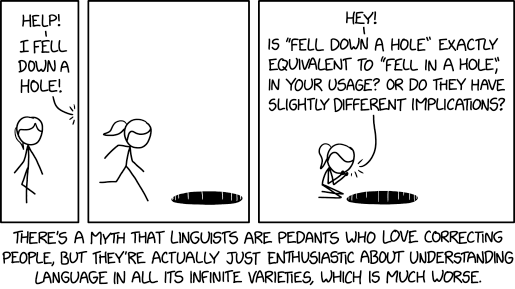
(Alt text: "Do you feel like the answer depends on whether you're currently in the hole, versus when you refer to the events later after you get out? Assuming you get out.")
Do you like languages and linguistics ? Here is for having fun about it
For serious linguistics content: !linguistics@mander.xyz
I feel slightly offended. Because it's true.
(Alt text: "Do you feel like the answer depends on whether you're currently in the hole, versus when you refer to the events later after you get out? Assuming you get out.")
Meanwhile in Swedish, leaving out either word would sound super wrong. I fell down in a hole.
I feel like I'd use "Fell in a hole" if I took up most of the space of the hole, and could probably get out on my own, while I'd use "Fell down a hole" if I took up very little of the space of the hole, and couldn't get out on my own.
If I were to rely on my "guts":
However I'm not a native speaker, and my L1 is rather relaxed when it comes to what prepositions convey. And from a quick websearch, Google lists 3.3M occurrences for "fell in a hole", 2.2M occurrences for "fell into a hole" and 820k for "fell down a hole"; that hints for me that, by default, speakers would use "in a hole" here, unlike I would.
I could say "I fell in a hole" to mean either case (I was in or out of the hole beforehand), but for "I fell into a hole" I would only use it when starting outside the hole. (native speaker)
Like on the one hand it could mean "I fell [while I was] in the hole"
But it could also mean "I fell [and then I was] in the hole"
I am a native speaker, and I do take my word choices very seriously - often to the point of pausing during conversations to find the exact phrasing which will convey the shade of meaning I am looking to convey. I wrote fiction for a while, and it was always extremely important to me to get phrasing right.
I agree with you completely. While I would interpret all of those phrases as equivalent (based on context) if they were to come from someone else, I would tend to use them in exactly the ways you suggest.
Similar for me - I think the depth of the hole matters more? It would sound odd to say "I fell down a pothole".
Agreed. I feel like the dimensions of the hole is relevant. Like if it has to be wider than it is deep to fall in. But it be needs to be deeper than is wide to fall down into.
And maybe the hole has to be at least wide enough that you can lie horizontally in to fall in it? Not sure about that though. But when falling down a hole, that definitely doesn't matter. The hole has to be deeper that I am tall for me to fall down it, horizontal width doesn't matter, it's all about the vertical in that case.
Thank you! I should've linked it in the OP. My bad, fixing it right now!
No worries, I was looking for the explain xkcd and the comic url was there for me to share :)
I think people who think that know more pedants than linguistics and either confuse the former for the latter, or when they meet a real linguist, the linguist's questions sound on first glance like the pedant's ones they are uses to. But I have no empirical data to prove my point
I feel like the pedant would be instead bossing others around, with a "you mean that you «fell into» a hole". Or perhaps voicing useless trivia, like "fun fact: some people say «fell in a hole»! The more you know~".
In the meantime, the linguist doing this (from anecdotal evidence, I'd say that plenty do it) is motivated by curiosity, not trying to show off; in spirit he's the same as "that kid" who disassembles objects to understand how they work, it's just that the curiosity comes off in the wrong situation.