this post was submitted on 19 Apr 2026
299 points (97.8% liked)

Technology

84103 readers
2489 users here now

This is a most excellent place for technology news and articles.


Our Rules


  1. Follow the lemmy.world rules.
  2. Only tech related news or articles.
  3. Be excellent to each other!
  4. Mod approved content bots can post up to 10 articles per day.
  5. Threads asking for personal tech support may be deleted.
  6. Politics threads may be removed.
  7. No memes allowed as posts, OK to post as comments.
  8. Only approved bots from the list below, this includes using AI responses and summaries. To ask if your bot can be added please contact a mod.
  9. Check for duplicates before posting, duplicates may be removed
  10. Accounts 7 days and younger will have their posts automatically removed.

Approved Bots


founded 2 years ago
MODERATORS
 

Scientists in China have demonstrated a wireless power transmission system that uses a ground-based microwave emitter to beam energy to an antenna array mounted on the aircraft’s underside. Importantly, they were able to do this while both the drone and charging system were in motion.

In tests, the car-mounted system kept fixed-wing drones in the air for up to 3.1 hours at an altitude of 15 metres (49 feet). The key challenge that the team overcame was maintaining alignment between the emitter and the drone during flight, wrote Song Liwei, the project’s leader.

top 50 comments
sorted by: hot top controversial new old
[–] sp3ctr4l@lemmy.dbzer0.com 47 points 6 days ago (3 children)

Holy shit.

Getting the ability to remote charge things via microwave.... that are moving?

That's been basically sci fi nonsense, at a practical level, for a long time.

Anybody remember the Microwave Power stations in SimCity 2000?

If you could actually get this tech working, it has an incredible number of potential applications.

[–] notgold@aussie.zone 30 points 6 days ago (2 children)

I remember arguing with a mate in school about the damage a misaligned beam would cause to a city. I think the prevailing theory was a lot of cooked people without much structural damage.

[–] SaveTheTuaHawk@lemmy.ca 3 points 6 days ago (3 children)

That makes no sense. It's the wrong frequency to cook anything.

JFC...is US STEM education really this bad? Lemmy seems to struggle between STEM and Star Trek.

[–] sp3ctr4l@lemmy.dbzer0.com 6 points 6 days ago

I'm sorry, you know the precise frequency that would be used by a fictional/speculative 'microwave' beam emmitted from an orbiting solar array?

You... don't think that 'microwave' might be technically innacurate, but broadly colloquially understood term, to describe the broad concept?

Like maybe a 'phaser' weapon, or a 'lightsaber'?

[–] drosophila@lemmy.blahaj.zone 4 points 5 days ago* (last edited 5 days ago)

It’s the wrong frequency to cook anything.

The idea that microwave ovens use some specific frequency that's good for cooking is a myth.

Dielectric heating occurs over a very broad range of frequencies. What actually matters is the energy density of the EM field. A microwave oven cooks food because its putting more than 1000 watts into a small confined space, your cellphone doesn't because its transmitter is shooting less than 1 watt into the open air (where the energy density quickly diminishes by the square cube law).

[–] notgold@aussie.zone 1 points 4 days ago

No Idea, never went to.school in USA. They haven't cooked anyone while sending them to the moon so can't be that bad.

[–] HiTekRedNek@lemmy.world 3 points 6 days ago (4 children)

Except that theory has no basis in reality.

Microwave ovens work by concentrating that energy into a very small space.

When is the last time you were cooked by radio waves?

Microwaves ARE radio waves.

[–] sp3ctr4l@lemmy.dbzer0.com 6 points 6 days ago

Are you somehow entirely unaware of the DEW crowd control devices that have been being used for like 2 decades now?

https://en.wikipedia.org/wiki/Active_Denial_System

Yeah, the whole point of these things is they basically microwave the outer layer of your skin, when in wide beam mode.

Or, they can be dialed in to be a more concentrated beam... to uh, internally heat up a bit more than just your skin.

But uh, for legal reasons of course nooo they do not do that and cannot do that.

While it is claimed not to cause burns under "ordinary use",[50][51] it is also described as being similar to that of an incandescent light bulb being pressed against the skin,[14] which can cause severe burns in just a few seconds. The beam can be focused up to 700 meters away, and is said to penetrate thick clothing although not walls.[52] At 95 GHz, the frequency is much higher than the 2.45 GHz of a microwave oven. This frequency was chosen because it penetrates less than 1⁄64 of an inch (0.40 mm),[53] which – in most humans, except for eyelids and the thinner skin of babies – avoids the second skin layer (the dermis) where critical structures are found such as nerve endings and blood vessels.

I would imagine that if you had an emorous amount of microwave energy from an orbiting solar array, being beamed to a recieving station on earth, (ie, a very small small space compared to the distance involved) and it uh, missed, yeah, yeah it would microwave people.

There's also this:

https://pmc.ncbi.nlm.nih.gov/articles/PMC8733248/

Brief but intense pulses of radiofrequency (RF) energy can elicit auditory sensations when absorbed in the head of an individual, an effect known as the microwave auditory or “Frey effect” after the first investigator to examine the phenomenon (1). The effect is known to arise from thermoacoustically (TA)-induced acoustic waves in the head (2).

Lin has proposed that the Frey effect may be linked to unexplained health problems reported by U.S. officers in Cuba and elsewhere, the so-called Havana syndrome (3).

Probably don't tell any schizophrenics you may or may not know about that.

[–] cynar@lemmy.world 5 points 6 days ago

Assuming 1MW of transfer, and a 10m diameter beam, your looking at 12.5kW/m^2 . Not instant vaporisation, but dangerous in seconds to humans. The penetration was also mean the energy is delivered internally, where it's harder to deal with (short term).

Any viable power transfer beam also, inherently, makes a good anti personnel weapon.

While the maths is slightly better for short range transfers, like drones, it would still definitely not be something you want hitting your body.

[–] notgold@aussie.zone 1 points 4 days ago

I was in primary school. My understanding of physics was that water is wet not what it was made of.

[–] LincolnsDogFido@lemmy.zip 2 points 6 days ago (2 children)

Yeah, xrays are also radio waves. That doesn't make them inherently less dangerous. Plenty of people have made mistakes around ground and ship based radar systems too and have accidentally cooked their insides. Just because 5G conspiracy theorists took over that argument doesn't mean it has no basis in reality.

load more comments (2 replies)
[–] SaveTheTuaHawk@lemmy.ca 4 points 6 days ago

Uh...they actually got this tech working.

Will the US get this tech working? Can't get anything working after slashing all research and kicking 10,000 phds out of the country.

Cletus and his Ram 1500 is not going to figure this out.

[–] HiTekRedNek@lemmy.world 2 points 6 days ago

We've known about the possibility of doing this for decades.

The NRL did a practical test of it in 2022 iirc.

[–] sircac@lemmy.world 20 points 6 days ago (2 children)

Many comments are about how impractical/useless is this technology TODAY considering easier alternatives... but I see research exploring recharging electric flight devices in flight, which sounds as cool as powerful to have flight devices with larger services and ranges

[–] gian@lemmy.grys.it 2 points 6 days ago (1 children)

I think the biggest problem is that this way you have a beacon to your flying device and your recharging station, it would not be that difficult to build a bomb/missile that follow the trace to the ground station

[–] sircac@lemmy.world 4 points 5 days ago (1 children)

I think that the "recharging" will always be a vulnerable stage and that the objective is to do that puntually and not a continuous dependence on power supply, but still seems safer and easier to abort than the one done currently with non electric planes, and for defense patrolling you will have more important infrastructures that would be targeted first, I still see only advantages if mature enough

[–] gian@lemmy.grys.it 1 points 5 days ago (1 children)

I think that the “recharging” will always be a vulnerable stage and that the objective is to do that puntually and not a continuous dependence on power supply,

For an electric recharge I think you need a decent size infrastucture that you cannot move that much or easily. I don't think that you can do with a enourmous power bank mounted on a truck.

but still seems safer and easier to abort than the one done currently with non electric planes,

Except that you can refuel a normal plane with just a couple of trucks and a strip of road long enough (Sweden built the Viggen around this principle and even the US has the highway designed to work as temporary airfield by some old law).
While it is easy to hit an airport, it became a lot harder to take out all the roads (in part because you will later need them)

and for defense patrolling you will have more important infrastructures that would be targeted first, I still see only advantages if mature enough

Yes, the charging station. Once I take out it, you electric planes are out of order. No more patrolling.

[–] sircac@lemmy.world 1 points 5 days ago (1 children)

I asume this technology when mature enough will not be surrounded by a single point failure. Allowing electric recharge of flying devices, that already have some battery autonomy, without having to land and take off, is clearly more efficient and less vulnerable. Plus mobile electric rechargers, battery deposits and infrastructure will have the same weaknesses than fuel ones (except electric ones would may blow up a bit less under fire)

[–] gian@lemmy.grys.it 1 points 5 days ago (1 children)

I asume this technology when mature enough will not be surrounded by a single point failure.

Up to a point, probably yes.

Allowing electric recharge of flying devices, that already have some battery autonomy, without having to land and take off, is clearly more efficient and less vulnerable.

Maybe is more efficient, but not less vulnerable. To recharge a flying device this way you basically mark the charging station even if you try to hide it, an attack could be carried against the station. Additionally having the drone or plane flying near it give away your position even if you come up with a mobile charging station (you cannot recharge too much far away, physic still stand). Then there is the problem of how much time you need to recharge it to a decent level, I am afraid that it would be in the hours range, and the necessity to keep the alignement, they had this problem also during the test, I suppose in a combat situation it would be way harder and this specific problem will not go away as the tech mature.

On the other hand, to keep the J37 Viggen example, it can be rearmed and refueled in 10 minutes and just need about 500 meters to take off. In this case if you don't see where the plane land, you also need the time to find it, it not give away its position during the operation with a microwave beacon.

Plus mobile electric rechargers, battery deposits and infrastructure will have the same weaknesses than fuel ones (except electric ones would may blow up a bit less under fire)

Once a battery is damaged, it make no difference that it blow up or not, it is useless. And generally a battery fire is harder to put out.

But it would be interesting to see how it eveolve and if it became mature enough to be used in a real combat situation.

[–] sircac@lemmy.world 1 points 4 days ago (1 children)

I have the feeling that current refueling in flight procedures are clearly more vulnerable than this approach that do not require physical coupling, for whatever these are useful (increasing operation autonomy, etc) the same for having to land in air carriers to extend patrolling times, this electric alternative seem safer in both scenarios, and at least with no more weak points than the fuel alternatives.

If is necessary to reload ammo no refueling-in-flight technology applies of course.

And if something blow up the damage radio clearly propagate immediately further than a battery fire, though regaring the situation a persistent fire can become also problematic, but these battery issues are still experiencing improvements, same happened with fuel counterparts (self sealing deposits, etc).

If this technology matures also recharging times will drop, we are seeing huge advances in plugged batteries.

I still see many advantages to the concept.

[–] gian@lemmy.grys.it 1 points 4 days ago (1 children)

I have the feeling that current refueling in flight procedures are clearly more vulnerable than this approach that do not require physical coupling, for whatever these are useful (increasing operation autonomy, etc) the same for having to land in air carriers to extend patrolling times, this electric alternative seem safer in both scenarios, and at least with no more weak points than the fuel alternatives.

I think they are equally vulnerable, only in different ways.

And if something blow up the damage radio clearly propagate immediately further than a battery fire, though regaring the situation a persistent fire can become also problematic, but these battery issues are still experiencing improvements, same happened with fuel counterparts (self sealing deposits, etc).

My point earlier: while it is true that fuel explode and the damage propagate faster, it is easier to replace a tank (trucks) than a battery that can be made useless just damaging it, no need to destroy it.

If this technology matures also recharging times will drop, we are seeing huge advances in plugged batteries.

Up to a point yes, but it has physical limits (not unlike fuel refuelling, only diverse)

I still see many advantages to the concept.

It can. It need to be seen if it is scale well enough to be used on more than a test in a real life situation.

[–] sircac@lemmy.world 1 points 3 days ago (1 children)

Physical coupling and emergency decoupling of a fuel tube in flight due to engaging or having to land and take off from an air carrier seems necessarily more slow and risky than beam interrumpion or nor having to land/take off at all.

Current batteries have not been under the same amount of research than fuel deposits, so I think that being matture enough, contacless repowering seems a great asset in any scenario.

[–] gian@lemmy.grys.it 1 points 2 days ago

Physical coupling and emergency decoupling of a fuel tube in flight due to engaging or having to land and take off from an air carrier seems necessarily more slow and risky than beam interrumpion or nor having to land/take off at all.

Refuelling could be slower, I agree, but I am not sure that is more risky, wireless recharging simply has a different set of problems.

Current batteries have not been under the same amount of research than fuel deposits, so I think that being matture enough, contacless repowering seems a great asset in any scenario.

True, but as far as you can advance contactless recharge, I am afraid physic and air are not on your side.

But as I said, I am curious about the development of this technology, leaving aside the fact that basically you cannot deploy it anyware if not your home county (or allied) and that in my opinion is a way bigger limit to it usefulness.

[–] eleijeep@piefed.social 19 points 6 days ago
[–] axh@lemmy.world 13 points 6 days ago (2 children)

Sounds:

  • Pretty advanced
  • Pretty expensive
  • Quite useless (I mean it definitely has its uses, but I think you could find much cheaper and simpler solutions)
load more comments (2 replies)
[–] AI_toothbrush@lemmy.zip 9 points 6 days ago (2 children)

I mean this is really cool but at the same time doesnt seem usefull? Apparently the peak of modern combat is chinese drones with small bombs and a plastic fiber-optic cable attached to them lol.

[–] pressanykeynow@lemmy.world 6 points 6 days ago (1 children)

There are a lot of different drones being used. For example you can't use fiber-optic for drones that target something 100km afar. Either way the problem with this device is probably the same as with other anti-air systems - it costs, takes time to produce and to train the operator much much much more than to make a drone.

[–] mojofrododojo@lemmy.world 3 points 6 days ago* (last edited 6 days ago)

totaly agree with your firs two points....

re: training and operators - my take on it is this has all the hallmarks of a swarm setup constantly recharging a portion of it's numbers.... Ukraine has illustrated that AI shit's coming quickly, even if llm's and jensen huang are wildly out of touch.

load more comments (1 replies)
[–] Domino@quokk.au 10 points 6 days ago

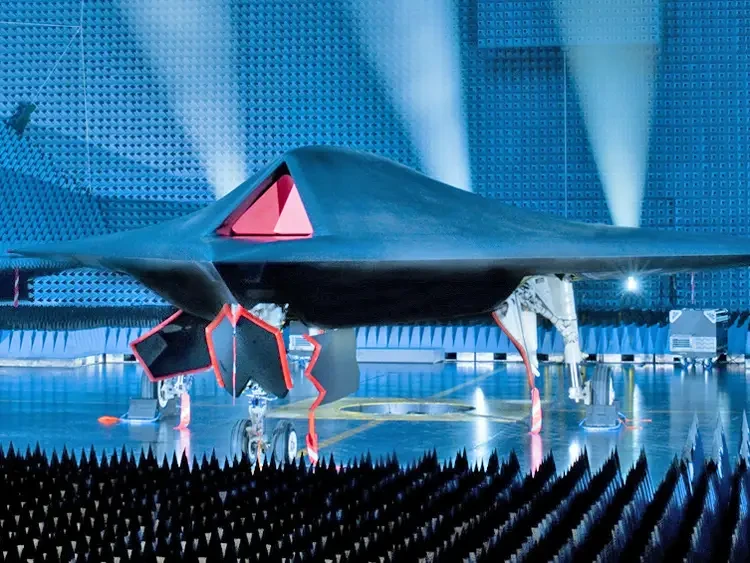
Wow that looks a lot like the UKs Taranis bomber drone.

[–] homesweethomeMrL@lemmy.world 5 points 6 days ago

Sounds cool. And also like an attack vector.

load more comments
view more: next ›
