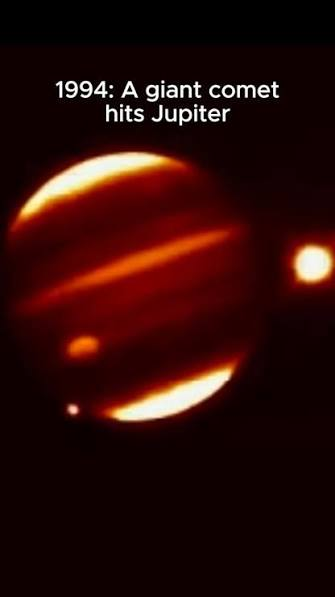
In July 1994, the Solar System put on a display that had never been seen before. A fragmented comet, Comet Shoemaker-Levy 9 impact, collided with Jupiter over the course of several days. This was not a single impact. It was a sequence. Piece after piece of the same object, pulled apart by Jupiter’s gravity, returned and struck the planet one after another.
The comet itself had already been broken before impact. As it passed close to Jupiter, tidal forces stretched and tore it into a chain of fragments, often described as a “string of pearls.” Each of those fragments became its own impactor. By the time they came back around, they were no longer one object. They were dozens.
What made this event unique was not just the scale, but the certainty. Scientists knew it was going to happen. The trajectory was calculated in advance, and telescopes around the world were pointed at Jupiter, waiting. For the first time, a planetary collision was not something reconstructed after the fact. It was observed as it unfolded.
When the fragments began to hit, the scale became clear immediately. Each impact released an enormous amount of energy, comparable to millions of megatons of TNT. The objects entered Jupiter’s atmosphere at extreme speed, compressing the gas ahead of them and generating intense heat. The result was a series of explosions that drove plumes high above the cloud tops.
Some of those plumes rose thousands of kilometers into space.
That detail mattered. It meant the impacts were powerful enough to punch through layers of the atmosphere and eject material upward, where it could be seen clearly against the darkness of space. Bright flashes marked the entry points. Expanding fireballs followed. Then came the aftermath.
Dark scars formed at each impact site. Larger than Earth in some cases, these marks spread and shifted as Jupiter’s atmosphere carried them along. For days, even small telescopes could see the evidence. Jupiter did not look like itself. It looked marked, temporarily altered by a series of collisions that would have reshaped any smaller world.
The impacts did more than create a visual spectacle. They provided data that could not be obtained any other way. Scientists were able to study how energy moved through a gas giant atmosphere, how deep the fragments penetrated, and how material was ejected and redistributed. Chemical signatures appeared in the aftermath, offering clues about both the comet’s composition and the structure of Jupiter’s upper layers.
It also forced a broader realization. Events of this scale are not rare in the outer Solar System. They happen. Usually unseen, usually unrecorded, but happening all the same. What changed in 1994 was not the frequency of impacts. It was our ability to witness one.
For several days, a planet the size of Jupiter was struck repeatedly, in full view of anyone watching closely enough. Not imagined. Not inferred. Seen.
And that changed the way impacts are understood.
Because after that, there was no longer any question of what a large collision looks like in real time.
We had already watched one happen.
A few Video links: https://youtu.be/vxD-1RsL7gI cool music vibe https://youtube.com/shorts/aEX6dnwoUfQ Neil Degrassi Tyson on Rogan YouTube short https://youtu.be/CiLNxZbpP20 News report from the time https://youtube.com/shorts/JqZDqYTMVrg Another short