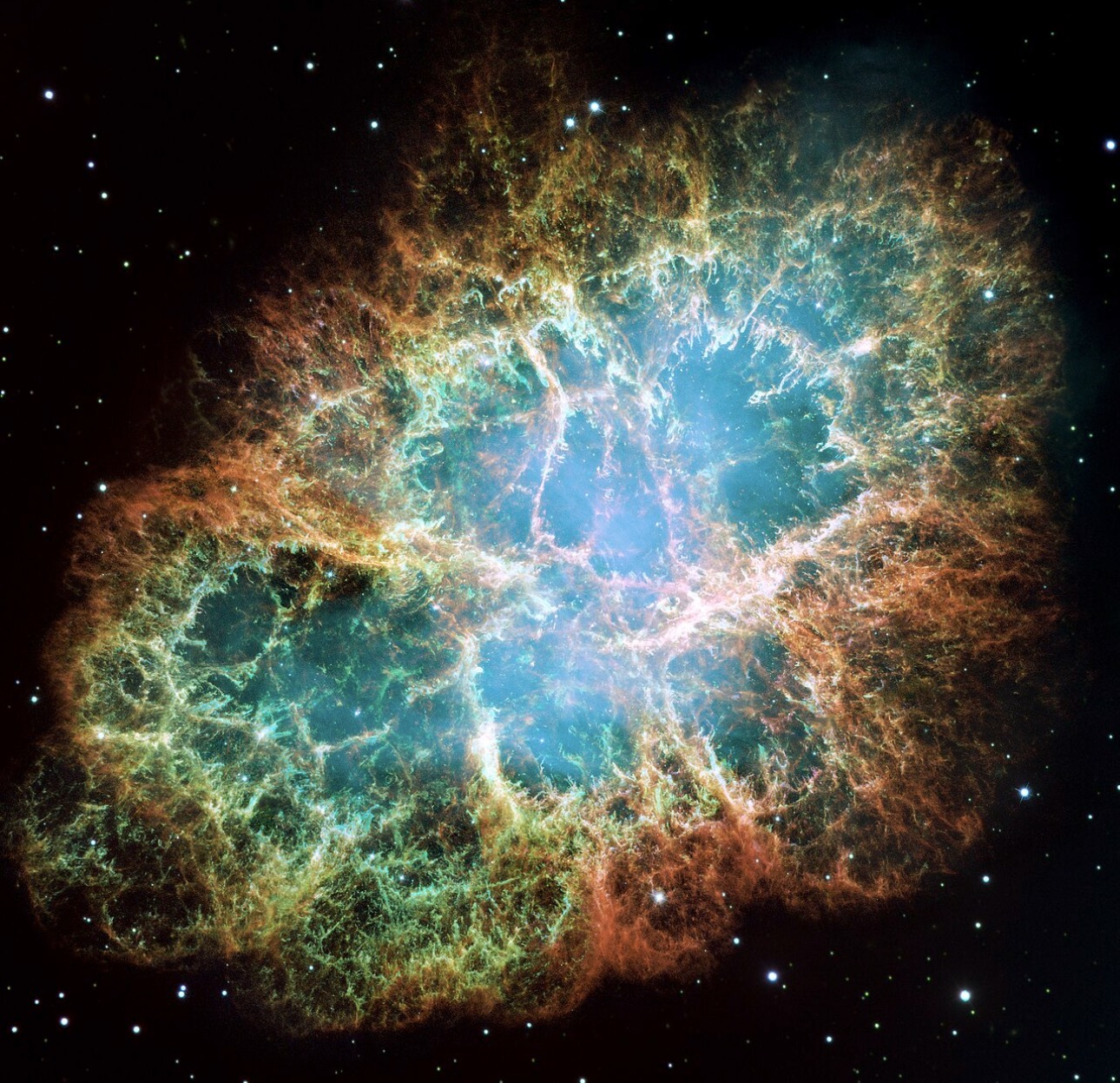
Stars spend most of their lives in a delicate balance. Gravity constantly pulls their mass inward, while nuclear fusion in the core produces enormous energy pushing outward. For millions or even billions of years, these two forces cancel each other out, allowing the star to remain stable. Eventually, however, that balance breaks. When it does, the result can be one of the most powerful events in the universe: a supernova.
A supernova occurs when a star reaches the final stages of its life and can no longer support itself against gravity. In some cases this happens when a massive star exhausts the nuclear fuel in its core. Once fusion stops producing energy, gravity causes the star’s core to collapse violently. The outer layers of the star rebound from this collapse and are blasted outward into space in a colossal explosion.
In other cases the explosion occurs in a binary star system. A dense stellar remnant known as a white dwarf can slowly pull matter from a nearby companion star. As the white dwarf gains mass, it approaches a critical limit where the pressure supporting it can no longer resist gravity. When that limit is crossed, runaway nuclear reactions ignite throughout the star and it detonates in a thermonuclear explosion.
The energy released in a supernova is staggering. For a brief period, a single exploding star can shine as brightly as an entire galaxy containing hundreds of billions of stars. These explosions release enormous shock waves that race through surrounding space, carrying gas and newly formed elements outward at tremendous speeds.
Supernovas are also responsible for creating many of the heavy elements found throughout the universe. Elements such as gold, uranium, and platinum are forged during the extreme conditions of these explosions. When the star explodes, these elements are scattered into interstellar space where they eventually become part of new stars, planets, and even living organisms.
In many cases the collapsed core of the star remains behind after the explosion. Depending on its mass, this remnant can become either a neutron star or a black hole. Neutron stars are incredibly dense objects roughly the size of a city but containing more mass than the Sun. Black holes are even more extreme, possessing gravitational fields so strong that nothing—not even light—can escape.
Although supernovas are rare in any single galaxy, they occur frequently across the universe. Astronomers estimate that thousands of these explosions happen every day somewhere in the observable cosmos. By studying them, scientists gain insight into how stars evolve, how galaxies grow, and how the elements necessary for planets and life are created.
In a very real sense, every atom heavier than hydrogen and helium owes its existence to ancient stars that lived, died, and exploded long before our solar system formed. The iron in Earth’s core, the calcium in our bones, and the gold in jewelry were all created in stellar furnaces and supernova explosions billions of years ago.
The next time you look at the night sky, it is worth remembering that the universe is not static. Stars are constantly being born, evolving, and dying. And occasionally, one of them ends its life in a brilliant explosion that briefly lights up the cosmos.