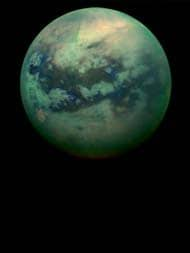
Titan, the largest moon of Saturn, is one of the most extraordinary worlds in the solar system and one of the most scientifically intriguing environments for studying planetary chemistry. Shrouded beneath a dense orange atmosphere and possessing landscapes shaped by liquids, Titan is often described as one of the most Earth-like bodies beyond our planet, though the substances involved are dramatically different. Rather than water flowing across its surface, Titan hosts rivers, lakes, and even rainfall composed of liquid methane and ethane. These conditions create a complex and dynamic environment that has made Titan a major focus in the search for understanding how chemistry evolves on planetary bodies.
Titan’s thick atmosphere immediately sets it apart from most other moons. Composed primarily of nitrogen with smaller amounts of methane and other hydrocarbons, the atmosphere is denser than Earth’s and extends hundreds of kilometers above the surface. Sunlight interacting with methane high in Titan’s atmosphere drives complex chemical reactions that produce organic molecules. Over time, these reactions create a haze of hydrocarbon particles that slowly drift downward, giving Titan its characteristic orange appearance when viewed from space. This constant chemical activity has made Titan one of the richest locations in the solar system for studying organic chemistry.
The surface of Titan remained hidden from view until the arrival of NASA’s Cassini spacecraft in the early twenty-first century. Radar imaging and atmospheric probes revealed a world shaped by weather systems and geological processes that mirror those on Earth in surprising ways. Instead of water cycles, Titan experiences a methane cycle. Methane evaporates from lakes and seas, forms clouds in the atmosphere, and eventually falls back to the surface as rain. These methane rains carve river channels and feed vast lakes near Titan’s polar regions, creating landscapes that resemble terrestrial coastlines and drainage systems.
Several of Titan’s lakes are enormous by Earth standards. Kraken Mare, the largest known sea on Titan, spans hundreds of kilometers across its northern hemisphere. These bodies of liquid methane and ethane form stable reservoirs because Titan’s surface temperature is extremely cold, averaging around minus 180 degrees Celsius. At these temperatures, hydrocarbons that would exist as gases on Earth become liquids capable of flowing across the landscape.
Beneath Titan’s frozen outer crust, however, scientists believe another type of ocean may exist. Measurements of Titan’s gravity field and surface movements suggest the presence of a deep subsurface ocean composed primarily of water mixed with ammonia or other antifreeze compounds. This ocean would lie far below the icy shell, separated from the hydrocarbon lakes on the surface. The existence of such an ocean means Titan may possess two distinct liquid environments: hydrocarbon seas at the surface and a hidden water ocean deep within its interior.
The chemistry occurring on Titan’s surface and in its atmosphere has attracted particular attention from scientists studying the origins of life. The organic molecules forming in Titan’s atmosphere include complex hydrocarbons and nitrogen-based compounds that resemble some of the building blocks associated with biological chemistry on Earth. These molecules accumulate on the surface over time, potentially creating vast deposits of prebiotic material.
While Titan’s extreme cold makes Earth-like life unlikely on its surface, some researchers have explored the possibility that unfamiliar forms of chemistry could occur in its methane lakes. Theoretical studies have suggested that membranes similar to biological cell walls could potentially form from hydrocarbon molecules under Titan’s conditions. Although this idea remains speculative, it illustrates how Titan provides a natural laboratory for studying chemical systems very different from those found on Earth.
The possibility of life becomes more conventional when considering Titan’s internal ocean. If liquid water exists beneath the icy crust and if it interacts with rocky materials in the moon’s interior, chemical reactions similar to those that occur around hydrothermal vents on Earth could potentially take place. Such environments provide energy and nutrients that support microbial ecosystems in Earth’s deep oceans, independent of sunlight. Although Titan’s internal ocean is difficult to study directly, its existence raises the possibility that habitable conditions could exist beneath the surface.
Titan also stands out because of its complex and varied landscape. Radar images from Cassini revealed mountain ranges, dunes composed of hydrocarbon particles, and vast plains sculpted by flowing liquids. The dunes near Titan’s equator stretch for hundreds of kilometers and resemble desert landscapes on Earth, though they are made from organic grains rather than sand. These features demonstrate that Titan is not a static frozen world but an active environment shaped by atmospheric and geological forces.
The most detailed exploration of Titan occurred in 2005 when the Huygens probe descended through the moon’s thick atmosphere and landed on its surface. As it drifted downward, the probe captured images of branching river channels and rounded ice rocks scattered across the ground. These images provided the first direct glimpse of Titan’s landscape and confirmed that liquids had once flowed across the surface near the landing site.
Future exploration of Titan is already being planned. NASA’s Dragonfly mission, scheduled for launch in the coming years, will send a nuclear-powered rotorcraft to explore the moon’s surface. Dragonfly will fly between different locations, studying Titan’s chemistry and geology in unprecedented detail. By analyzing organic materials and investigating environments shaped by methane rainfall and hydrocarbon lakes, the mission aims to better understand the processes that shape Titan’s unusual environment.
Titan’s combination of thick atmosphere, active chemistry, and diverse landscapes makes it one of the most compelling objects in the solar system for studying planetary evolution. It represents a world where organic chemistry unfolds on a planetary scale, providing insight into how complex molecules form and interact under conditions very different from those on Earth.
Although Titan may not resemble a traditional habitable world, its rich chemical environment offers scientists a rare opportunity to observe how the ingredients associated with life develop in natural planetary systems. By studying Titan, researchers gain insight not only into this distant moon but also into the broader question of how life’s chemical foundations might arise throughout the universe.