this post was submitted on 07 Mar 2026
4 points (100.0% liked)
otherworldly
47 readers
17 users here now
Your hub for paranormal, conspiracy, urban explore and extraterrestrial. We also post about unsolved murders, hidden technologies, and any related subjects. Have fun and be nice.
founded 3 weeks ago
MODERATORS
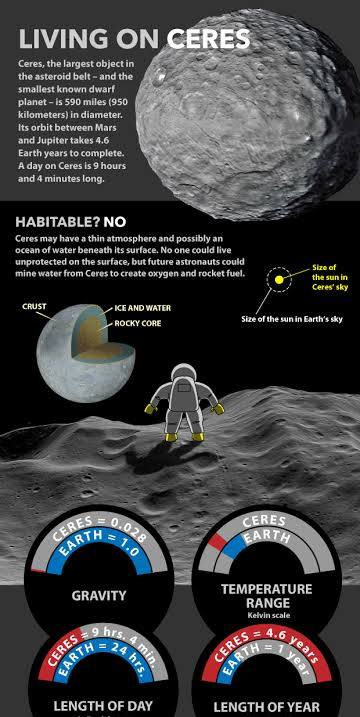
Ceres, the largest object in the asteroid belt and the smallest recognized dwarf planet in the solar system, has become an increasingly important focus in planetary science. Once believed to be little more than a large asteroid, Ceres has gradually revealed itself to be a far more complex world. Observations made by NASA’s Dawn spacecraft in the mid-2010s transformed scientific understanding of this distant body, showing that beneath its seemingly quiet surface lies evidence of water, salts, and geological processes that may still be active today. While Ceres is not currently considered as strong a candidate for life as some of the icy moons of the outer solar system, its unusual composition and internal structure make it one of the most intriguing objects between Mars and Jupiter.
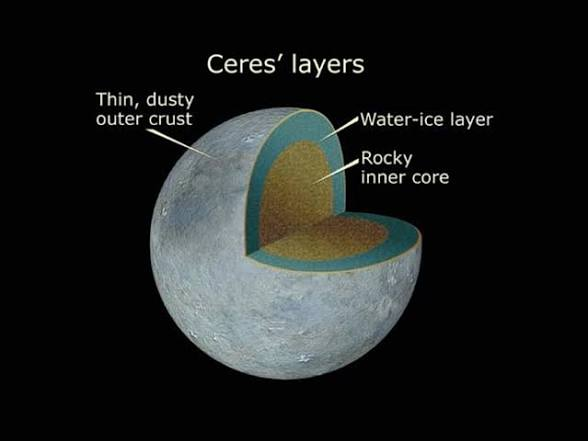
One of the most surprising discoveries about Ceres is the presence of water in multiple forms. The dwarf planet’s crust is believed to contain large quantities of water ice mixed with rock and minerals. Measurements of its density suggest that a significant portion of the interior is made of hydrated materials rather than solid stone. This has led scientists to conclude that Ceres likely formed with a substantial amount of water incorporated into its structure early in the history of the solar system. Beneath the outer crust, many researchers believe that Ceres once possessed, and may still contain in places, pockets of briny liquid water. Rather than a fully global ocean like those suspected on some icy moons, Ceres may harbor localized reservoirs of salty liquid trapped within its interior.
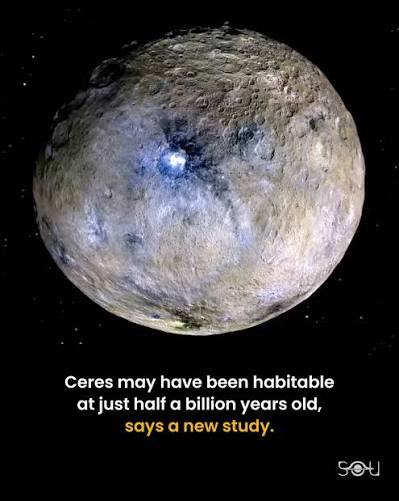
Evidence for these brines became clearer when Dawn observed the famous bright deposits scattered across parts of the dwarf planet’s surface. The most prominent of these deposits lies within Occator Crater, where a cluster of brilliant white patches reflects sunlight strongly against the darker terrain. Detailed analysis revealed that these deposits consist largely of sodium carbonate and other salts. Such materials are believed to have formed when salty liquid water from below the surface rose upward through fractures, reached the surface, and then evaporated in the vacuum of space. The remaining salt crystals formed the highly reflective patches that caught scientists’ attention when Ceres was first imaged up close.
The existence of these salt deposits suggests that Ceres experienced cryovolcanic activity in its relatively recent geological past. Cryovolcanism occurs when water, slush, or briny mixtures erupt instead of molten rock. One of the clearest examples of this process on Ceres is Ahuna Mons, a solitary mountain rising roughly four kilometers above the surrounding terrain. Its shape and structure strongly resemble a dome formed by material pushing upward from beneath the crust. Many scientists interpret Ahuna Mons as a cryovolcano, created when subsurface brines forced their way upward and solidified after reaching the cold surface.
The presence of salts, hydrated minerals, and possible subsurface brines indicates that Ceres once hosted an environment where water and rock interacted extensively. Such interactions are important because they drive chemical reactions that can produce complex compounds. In planetary science, these reactions are often viewed as key ingredients in the broader chemistry that precedes life. On Earth, water interacting with rock can release elements and minerals that support microbial ecosystems. While there is currently no evidence that such biological processes ever occurred on Ceres, the chemical activity implied by its geology shows that the dwarf planet is far from being an inert object.
Another important factor shaping Ceres is its location in the asteroid belt. This region contains remnants from the early solar system that never fully formed into planets. Because Ceres formed in this environment, it likely preserves materials dating back more than four billion years. Studying its composition helps scientists understand how water and organic compounds were distributed during the early stages of planetary formation. Some researchers even believe that objects similar to Ceres may have contributed water and chemical building blocks to the inner planets during the chaotic period when the solar system was still forming.
Despite its modest size, Ceres also appears to retain a surprising amount of internal heat. While it lacks the powerful tidal heating seen on moons such as Enceladus or Europa, the decay of radioactive elements within its interior may have helped maintain pockets of warmth for long periods. Combined with salts that lower the freezing point of water, this internal heat could allow briny liquids to persist beneath the surface much longer than previously expected.
The discovery of these internal processes has changed how scientists view the asteroid belt as a whole. Instead of being composed solely of dry, rocky debris, the region may contain bodies that once held significant quantities of water and potentially experienced complex geologic evolution. Ceres stands as the clearest example of this possibility. Its mixture of rock, ice, and salts places it somewhere between the rocky inner planets and the icy worlds of the outer solar system.
For this reason, Ceres is sometimes described as a transitional object. It shares characteristics with both asteroids and icy moons, making it an important laboratory for studying how small planetary bodies evolve. Although it does not currently rank among the most promising locations for extraterrestrial life, its chemistry and subsurface activity still provide valuable insight into the processes that shape habitable environments elsewhere.
Future missions may eventually return to Ceres to investigate its interior more closely. Scientists hope to better understand the extent of its subsurface brines, the timing of its cryovolcanic activity, and the role it may have played in delivering water and organic materials throughout the early solar system. Each new observation adds another piece to the puzzle of how this unusual dwarf planet formed and evolved.
What once appeared to be just another asteroid has instead proven to be a complex and dynamic world. Ceres reminds scientists that even small bodies in the solar system can possess rich geological histories, hidden reservoirs of water, and clues about the conditions that shaped the earliest chapters of planetary formation.
there doesn't seem to be anything here