The Discovery
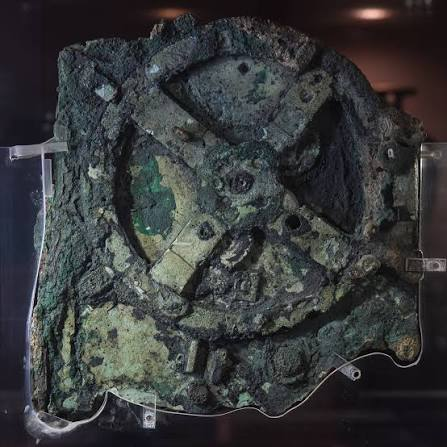
In 1901, sponge divers working off the coast of the Greek island of Antikythera discovered the remains of an ancient shipwreck on the seafloor. Among statues, pottery, and other artifacts from the wreck was a strange corroded object that initially appeared to be little more than a lump of bronze and stone.
When the artifact was brought to the surface and examined more closely, researchers realized something extraordinary. Hidden inside the corroded fragments were intricate bronze gears, carefully cut and arranged like the internal components of a clock.
The object eventually became known as the Antikythera Mechanism, and it would turn out to be one of the most mysterious pieces of ancient technology ever found.
⸻
An Ancient Mechanical Computer
Further study revealed that the mechanism dated to roughly the second century BCE, during the era of ancient Greek civilization. When scientists began reconstructing the device using modern imaging techniques, they discovered a complex system of interlocking gears.
The mechanism was not a simple tool. It was capable of performing calculations related to astronomical cycles.
Researchers believe the device could predict:
The phases of the Moon.
Solar and lunar eclipses.
Planetary movements.
Astronomical calendars used by ancient Greek societies.
In effect, the mechanism functioned as a kind of mechanical computer designed more than two thousand years ago.
⸻
How It Worked
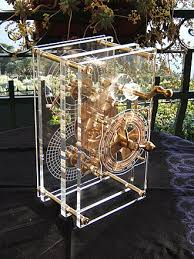
The device originally sat inside a wooden box about the size of a small shoebox. On its front and back were circular dials marked with inscriptions and scales.
Inside the box were dozens of precisely cut bronze gears that rotated together when a crank was turned. By adjusting the mechanism, the user could simulate the motion of celestial bodies across the sky.
When the gears moved, the dials would show where the Sun, Moon, and possibly even known planets would appear on a particular date.
The level of mechanical sophistication shocked historians, because machines of comparable complexity did not appear again in Europe until medieval clockmaking over a thousand years later.
⸻
Why It Surprised Scientists
Before the Antikythera Mechanism was discovered, historians believed that ancient technology did not include complex gear systems.
Most known ancient tools involved simple mechanical principles like levers, pulleys, and water-driven devices. Precision gearwork was thought to be a much later invention.
The Antikythera Mechanism forced scholars to rethink how advanced ancient engineering might have been.
The device suggests that Greek scientists and craftsmen possessed far greater mechanical knowledge than previously believed.
⸻
The Hidden Technology Question
Because the mechanism appeared so unexpectedly sophisticated, some people have wondered whether it represents a form of lost or hidden technology.
One possibility is that devices like this were once more common but simply did not survive the passage of time. Bronze objects were frequently melted down and reused throughout history, which means many similar machines may have disappeared completely.
Another explanation is that the mechanism was a rare experimental device created by a small group of skilled engineers working with astronomical knowledge developed by Greek mathematicians.
Either way, it shows that ancient civilizations sometimes reached technological achievements far beyond what later historians expected.
⸻
Modern Investigation
Scientists have used advanced imaging techniques such as X-ray scanning and 3D modeling to study the fragments of the mechanism in detail.
These scans revealed tiny inscriptions carved into the metal plates that describe how the device operated. The text appears to function almost like an instruction manual for the user.
By combining the surviving fragments with digital reconstruction, researchers have been able to create working models of how the original mechanism likely functioned.
These reconstructions confirm that the device was capable of predicting complex astronomical events with impressive accuracy.
⸻
A Window Into Ancient Science
The Antikythera Mechanism provides an extraordinary glimpse into the scientific world of ancient Greece.
Greek astronomers such as Hipparchus and Archimedes were known to have studied celestial motion and mechanical systems.
Some historians believe the mechanism may have been influenced by or derived from scientific traditions associated with these thinkers.
If that is true, the device represents the physical expression of centuries of accumulated astronomical knowledge.
⸻
Legacy of the Machine
Today the fragments of the Antikythera Mechanism are preserved in the National Archaeological Museum of Athens.
It is often described as the world’s first analog computer, and it remains one of the most remarkable artifacts ever recovered from the ancient world.
The mechanism reminds us that human ingenuity has deep roots in history. Civilizations long before modern times were capable of remarkable scientific insight and engineering skill.
Sometimes the past still holds technological surprises waiting to be rediscovered.
⸻
Discussion
Do you think the Antikythera Mechanism represents a rare one-of-a-kind invention, or could there have been other complex machines in the ancient world that were simply lost over time?