Note: This is just an example of a translation request.
What is the character on the left saying? I can read the character, but I can't understand what that single sound is supposed to mean.

Welcome to !translators@lemmy.ca!
This is a community for all things translation. Whether you need help translating a phrase, want to practice your language skills, or seek feedback on your work, you’ve come to the right place.
How to Participate
Need a translation? Post your request with the original text, target language, and any context. Our polyglot community is here to help!
Want to practice? Share your translations and ask for reviews. Constructive feedback is always welcome.
Offering help? Browse requests and contribute your expertise. Please only translate into your native or fluent languages.
■ Rules & Guidelines
★ Be clear and specific: Include the source language, target language, and context for accurate translations.
★ No machine translations: Human translations only—this is a space for learning and collaboration.
★ Respect others: Keep discussions civil and supportive.
★ No spam or low-effort posts: Avoid repetitive or overly simple requests (e.g., single words).
★ Use tags to in the post title to clarify the language pairs: Use the two-letter ISO language code. e.g. [ja > en] This tag means that the poster is requesting to have Japanese text translated into English.
■ Tips for Quality Translations
★ Provide context (e.g., formal/informal tone, audience).
★ Mention any specific challenges or nuances.
Let’s build a helpful and inclusive space for language lovers!
Note: This is just an example of a translation request.
What is the character on the left saying? I can read the character, but I can't understand what that single sound is supposed to mean.
Note: This is just an example of how to respond to a translation request. I like to write a detailed explanation when I think the topic is interesting, but it's not a requirement
tl;dr: He is agreeing with what Doraemon is saying.
Detailed explanation: The character on the left (Sewashi, Nobita's grandson from the future) is basically repeating the last bit of what Doraemon is saying. 〜な (as well as 〜ね) ending is used to imply that you want the listener to agree with you. If they agree, they would say そうだな、そうですな (less common)、or そうだ・ですね. We can just shorten it to な or ね.
For fellow Canadians, it's like saying:
"He's not very bright, eh?"
"Yeah, eh."
I just realised you are the OP on this and the last post I commented on, and you're posting questions and answering them yourself to provide examples. Derp on my part.
For anyone interested in why, Nobita (right) is already aware Doraemon (middle) is from the future and should understand the possibility of meeting his grandchild when time travel is available. Hence Doraemon calling him an idiot.
Haha, yeah, I had to "fake" activity to get the ball rolling. I really appreciate you joining in and adding more context!
Oh thank you. In that case excuse the pun but
k0e desu
k0e san
It's also convenient between japanese and English that "ga aru mon (mono) ka" is an established colloquial phrase. Both languages have the equivalent phrase "is that a thing/nah that's not a thing"
Just for fun, let's see how Google Translate did on this:
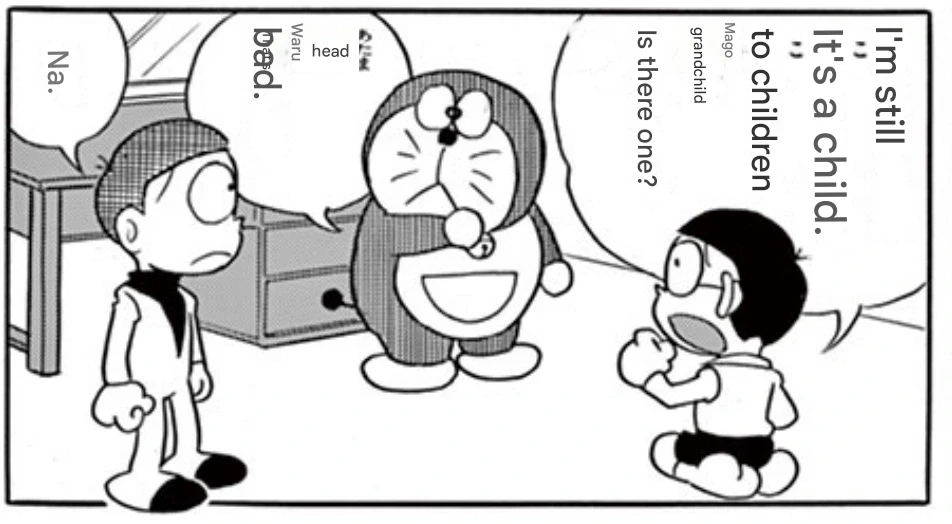
XD
(btw, I'm amazed how closely this work resembles Tezuka's style!)
Won't be losing my job to Google Translate just yet, it seems lol