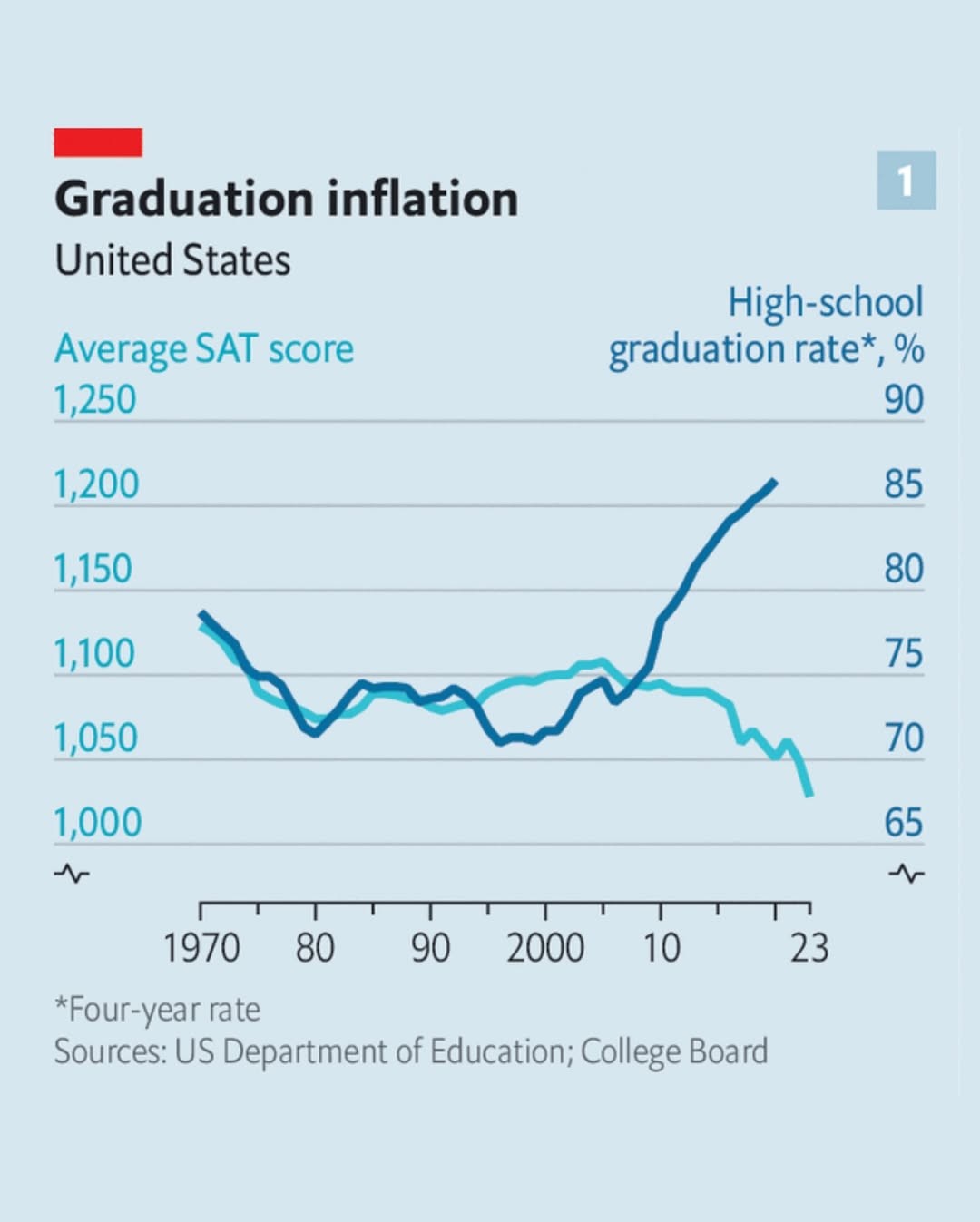
This seems like a problem
Just post something 💛
Lemmy's general purpose discussion community with no specific topic.
Sitewide lemmy.world rules apply here.
Additionally, this is a no AI content community. We are here for human interaction, not AI slop! Posts or comments flagged as AI generated will be removed.
This seems like a problem
I think you need more data to know if there is a problem, lowered SAT score average may be that more people are attempting the SAT that previously wouldn't, which in and of itself isn't an issue.
If I had to hazard a guess with only the data presented, both stats are likely being influenced by increased pressure to get a high school diploma & college degree, as higher percentages of job requirements list at least the former, but a lot of times list college degree when it may not be needed. So more people try to get into college by taking the SAT.
According to a few sources the number of students taking the SAT declined during and after the pandemic, with an all time peak in 2019, although numbers have been going back up in recent years
College enrollment has also dropped over the past decade
There are a lot of data points to control for, but so far it doesn't look pretty to me
This graph makes the SAT drop look worse than it is and speaks to the demographic on Lemmy, smart people who see a drop in broader test scores as a broader drop in intelligence. This isn't what is being shown. It's showing how when the high school dropouts are included the scores drop 150 points so we need to improve the part of education that serves the people who were excluding themselves from graduation.
We can address the primary factors of drop out/low scores by solving wealth inequality and food insecurity.
This graph makes the SAT drop look worse than it is
Yes, an example of why dual y-axis plots are problematic (when the variables are not direct mathematical transformations of each other).
And notably, many changes have been introduced to the SAT and SAT scoring over that time. It's unclear to me from the information here how those have been accounted for in the data.
I think it's mostly an illustration of the issue with the "No Child Left Behind" initiative.
Teachers are forced to pass students that should rightfully fail, so the students who normally would be held back or forced to retake a class are taking the test before they're ready.
It's still a bad thing unless people decide to make college free for all people, and at least in the US, the country can't even afford universal health care.
If someone is taking the SAT and getting 1000, they are so much better off going to a trade school and becoming an air condition repair person or learning home repair. Many of those people with 1000 will not graduate college, will not graduate with substantial debt, and will be trying to get office jobs in a country that already has too many people wanting that and not enough skilled people doing physical work.
It's not what people want to hear, but everyone has strengths and weaknesses. Some people are terrible at intellectual things, some people are terrible at things requiring dexterity, some people are terrible with things requiring emotional intelligence.
Another "forbidden topic" that I'll likely get in trouble for (for no reason) is that people who have children at older ages are more likely to have less healthy or even disabled children. There are costs to society of "let's try to have everyone stay in school and delay marriage and children until people's 30s."
Yes, we need to reduce income inequality and food insecurity and make sure everyone has wages that are livable, but the whole everyone gets a trophy thing is bad resource management. Yes, food insecurity and wealth is part of the issue, but everyone has access to a library. 1000 is so low, it's barely doing better than random guessing. Teachers are very happy to help out kids who don't understand things; they often can't motivate students to do anything on their own these days.
If a kid is getting a 1000 on the SATs, there's either no ability or no motivation or some combo, and college will not change that. Advanced schooling should not be encouraged by society for people who can't even understand a tiny amount of the basics.
This graph is actually encouraging and I suspect anyone who cannot process why doesn't have high sat scores.
More people are graduating. People who drop out don't take the sat. Since the sat drops at a slower rate then the graduation rate increases, those previous drop outs are on average better at the sat.
Analysis of this graph could be an sat question.
I generally agree that the graph doesn't imply anything bad, but without knowing the distribution of test scores, we can't conclude that average sat performance actually improved. With a general sat score statistic we could attempt to predict how an X% increase in presumed low performers looks like, and then compare that to reality.
The graph indicates the average test score dropped. I'm looking at what can be inferred from this limited data and how it could be structured to reveal a person's ability to apply critical thinking.
The graph alone isn't enough, it would need some blurb with the details you're mentioning and more to make the choices unambiguous.
The number of students taking the SAT peaked in 2019
It’s showing how when the high school dropouts are included the scores drop 150 points
What is your basis for this claim? I don't doubt that's a possibility, but the number of students taking the test both rose and fell over the past decade, with a fairly consistent drop in scores
I think it was 2006 or 07 when they introduced the writing portion of the SAT, which students were broadly unprepared for. I was one of the first go-around. It was... weird?
When a measure becomes a target it ceases to be a good measure.
when a measure becomes tied to your paycheck, you will do everything to inflate that measure as much as possible.
When a measure is used for a 100% target goal, sure.
Many measures, like food safety and reducing workplace accidents, are used as targets but not as 100% targets like with graduation. They set realistic goals.
Graduation being set at any target is counter productive because it never takes into account varying demographics or the fact that not all kids are able to graduate, yet the target is always 100%.
And by not all kids can graduate I mean the ones who could do the work, but cannot in the setting. A few friends from high school dropped out to work full time in tech or got their GED and went on to complete college. They just couldn't handle the restrictive and overbearing public education system.
HS graduation rates were really under 75% from the 70s through 00s?!
I mean that’s my cohort (wassup my GenX underachievers!) but I’m still shocked…
Before No Child left Behind, schools/teachers were allowed to fail students. After that that 'educational reform' they were not.
Hence why most of our educational metrics go down, while our graduation rate went up. We simply lowered the bar.
There is no bar anymore. The 10% that aren't graduating are the kids that literally don't even show up to school. If a kid is at least at school half the time, they'll graduate. Don't even need to do anything, just being there is enough. Kids are "graduating" with actual GPAs <1.
It would be extremely difficult to graduate with a GPA less than 1. A 1 represents a D, so anyone graduating with a less than 1 would have to fail at least one class, and get a D in every other class. There is a minimum number of credits required to graduate, so failing multiple classes while still graduating is very difficult
It was closer to 1/3rd of students dropping out when I graduated high school, but living in the deep south was also a factor there.
I graduated in 2002 in a class of 600. We were around 800 in 10th grade, which was the start of high school at the time.
This looks expected and not a bad thing at all. Higher pressure to graduate and higher expectation that a college degree is necessary means more kids attempt the test - including those kids who might've dropped out in previous years. I think it's fair to assume that on average the kids who dropped out probably wouldn't've scored as highly on their standardized tests.
Teachers are being instructed to pass with grades as low as 20 percent
There is no hope for the future
What do you mean?
Do individual teachers get to arbitrarily decide who passes highschool in the US?
In a roundabout way. If Chemistry 1 is a required class for graduation and you fail it, you either have to repeat it or don’t get to graduate. That’s how it used to be, now there’s much more pressure to pass everyone no matter what, due to school funding being directly tied to pass rates.
But what I'm asking is, who decides if you pass chemistry 1?
In my country you would take a standardised chemistry 1 exam paper at the end of the year that everyone in the country doing chemistry 1 would take and would get a grade based on how well you did, and if you get less than like 40% you would fail.
In the US can the teacher just decide after the test what a passing grade is?
The teacher can pass or fail you
You could do all the work or none of it and it is up to them to say "pass" or "fail" by giving you a grade
After a test you could "round" the grades. Like if it was a very hard test and the highest grade was a 60%. You could round everyone's test up by 40%.
If you made a 0%, now you have a 40%. Everyone passes!
(Don't think this is too common, but plausible)
Teachers are "encouraged" to not fail any student by a lot of pressures.
You have to go above any beyond to fail high school. Trying hard and getting bad grades will generally get you enough to pass. Teachers will "work" with you.
So the kids own teachers mark their exams and can just arbitrarily round up tests so that no one fails after the kids have already taken the exam?
due to the fuckass limpdick way the US has setup it's federal system, the answer to this is the same as it is to most "how is X in the USA" questions...it depends.
in many parts of the country, individual teachers have very wide leeway to pass/fail people (and are heavily incentived to just pass anyone)
Here in Belgium we don't have any standardized tests either. It's less hassle and allows for more flexibility for teachers and schools (the difficulty can vary wildly between schools).
I think that the literature says standardized tests are better, but our education is (was?) among the best, so I don't think it's a deciding factor.
Freedom of education is a big thing here, the government only can give a rough overview of what teachers should teach. For better or worse, standardized tests would never fly here.
That sounds good if it works, but presumably you still leave mandatory education with some kind of official qualification right?
So if it's not standardised, does that mean people pay more attention to where you went to school Vs the grade you got?
Yes, it is somewhat school dependent.
But the schools all want to be amongst the best. So the quality is pretty high up. Haven't heard of anyone whose degree was questioned because they came from a "bad school". There will be at least some bar they will have to meet somewhere.
Though degrees from some schools are more appreciated than others.
Anyone can start a school, that is a right guaranteed by our constitution. It comes from a time where the Liberals were afraid of Catholics interfering in their education and vice versa so they limited the power the government has over education. And looking at what's happening in the world, it still seems relevant to me.
Being able to hand out recognized diploma's and receiving government subsidy is a bit more difficult, but also far from impossible and you can always send your students to the government organized exam center.
So if it’s not standardised, does that mean people pay more attention to where you went to school Vs the grade you got?
If you're going to university/college it doesn't really matter since you just enrol (or take an entrance test for a few majors). Of course, your chances of getting through will depend on the school you went to. If not, I suppose yes. But isn't that the same as everywhere else, or do you also have national exams for trades?
There are no universal American standardized tests for most required subjects. The standardized tests that do exist vary wildly because they are not federally standardized but instead determined on a state level. Generally they include math and reading. Some states test science, some don’t. Some test every year, some do intervals. It’s a mess.
Like in Pennsylvania reading and math are assessed yearly grades 3-11 but science is only done grades 4, 8, and once in high school (just has to be passed to graduate and only covers biology, year you take it can vary as a result). However, some states like Texas and California assess science every year. Some states like Arkansas and North Carolina use course work and final exams to determine proficiency
a fail is 40% now?
Fuck me.
Things have changed since I went to school so I can’t give you the exact details of how it works now, but whether you pass a class or not in most US schools is/was based not only on how well you do on a standardized test at the end of the semester*, but also how well you did on class work and tests during the semester. If you bomb everything it’s possible to get into a hole where even if you do great on the final exam, it still might not lift you up to a passing grade, depending on how all the assignments are weighted. So the teacher decides all of your in class grades, which determine if you pass or fail.
* I’m actually so old that we didn’t even do that when I was in school, and now I couldn’t tell you if the standardized tests are national or state based.
How does this chart factor in the decade 2005-2015, when the SAT was scored out of 2400? With prior to 2004 and since 2016 being scored out of 1600.
I knew about the first change, so it's interesting that scores DROPPED while graduations shot up in '05 according to this chart. But I didn't know about the 2016 change and I guess that is the next drop, but not by 800 points which is interesting.
I imagine they're taking the score as a percentage then applying the percentage to 1600 instead of 2400.
But you're right that it doesn't seem to account for changes, either in the test or in the high school curriculum.
Is this due to the "no child left behind" policy?
Yeah, I think it's a case of schools meeting their metrics by any means necessary, because we shouldn't be seeing reading and math skills dipping while graduation rates go up.
The policy works because it's tied to funding. If your school doesn't graduate 90% of it's students, it gets less federal/state money.
“Works” is doing some heavy lifting here. It’s also ass backwards, districts with students that are failing need more funding to address the root causes of the failure, not less. Cutting funding is like blaming the electrician for the house having bad wiring.
more funding doesn't increase performance. some of the most expensive per student funding still has the worst educational outcomes.
increased parental income is the metric that massively increasing student performance and outcomes.
but nobody wants to talk about that because that's socialism if we start raising incomes. y
we want the electricians (the teachers) to put in good wiring while the housing i burning down, and we tell them they are assholes if they point out the fire and call losers if they get burned while trying to teach the students.
the root of educational issue is socio-economic and cultural. rich people have zero issues with their students being educated up the wazoo and often spend less per student because they live in districts that support learning and has no economic impediments to it.
More funding means more opportunities to expand free breakfast/lunch programs, tutoring support, after school programs, basically every program that has been shown to help students from low income homes costs money.
I’m not sure how the hell cutting funding from the schools of poor students is supposed to help them… go ask anyone teaching in a segregated school in the northeast how decades of funding cuts have served their students. Or examine any study that’s come out in the past 20 years about how NCLB has been an utter failure.
I took the test like 3 times and I did horribly on my first 2, statistically I'm probably lowering the average even though my final score is higher than my parents.
These tests are bullshit predictors of anything except how much you’ll pay the College Board. Good lord the money they make.
Yes I was wondering if anyone was going to mention them. My partner teaches AP CS classes and the monopoly they have is ridiculous.
25% of the population without a secondary education diploma looks pretty bad to me. To me it looks like a positive that that number has been increasing in the last 2 decades. For comparison: the EU target is 9% and the average across the EU countries is now 9.5%.
I wouldn't try to link those SAT scores to graduation numbers. Graduation numbers will be for both vocational and academic schooling, while the SAT scores are only relevant for the academic route.