By Brett O’Keefe, Associated Civic News Press, Jefferson City, Mo.
JEFFERSON CITY, Mo. — Walmart has begun testing small onsite “pod hotels” inside portions of its warehouse facilities, allowing employees to sleep at work in what the company says is an effort to address rising housing costs and long commutes.
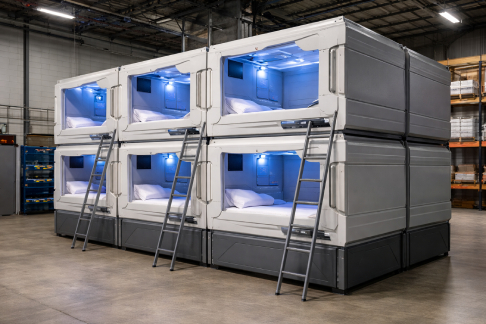
The pilot program, which launched quietly earlier this year at a warehouse outside Jefferson City, places compact sleeping pods in unused sections of company-owned buildings. The pods include a bed, ventilation, lighting, and limited storage, according to company materials reviewed by the local press.
Walmart officials describe the program as voluntary and temporary, aimed at workers who face long drives, unstable housing, or short-term financial strain.
“This is about flexibility and support,” said company spokesperson Andrea Collins. “We’re looking at ways to meet associates where they are, especially as housing affordability continues to challenge workers across the country.”
Employees pay a reduced nightly fee deducted from their paychecks, the company said. Walmart declined to specify the cost but said it is lower than average local rent.
Some workers, however, say the arrangement raises concerns about boundaries between work and personal life.
One warehouse employee, who spoke on condition of anonymity for fear of retaliation, said the pods blur the line between rest and labor.
“You’re never really off the clock when you’re sleeping at work,” the employee said.
The worker also said employees staying in the pods are not allowed to use warehouse bathrooms until their scheduled shift begins, a policy the company said is tied to security and access controls.
“I’ve learned to hold it in until my shift starts,” the employee said.
Walmart confirmed that restroom access for pod users is limited outside of working hours but said alternative solutions are under review.
Labor advocates said the program reflects broader pressures facing low- and middle-income workers.
“When the solution to housing costs is sleeping at your job, something is fundamentally broken,” said Karen Delgado, a labor policy analyst with a Midwest workers’ rights group. “This shifts the burden of a national housing crisis onto employees.”
Walmart said early feedback from the pilot has been positive, citing internal surveys that show strong demand among some workers. Company officials said the Jefferson City program is serving as a model for potential expansion.
“If current trends continue, we anticipate rolling this out to additional locations in 2026 and 2027,” Collins said.
Local officials said they were aware of the pilot but emphasized that no zoning laws were violated, since the pods are located inside existing commercial structures.
Walmart employs more than 1.6 million workers in the United States, many of whom live in areas where rents have risen faster than wages. The company has raised starting pay in recent years, but critics argue the increases have not kept pace with housing and transportation costs.
For now, the pod hotels remain limited to a small number of facilities. Whether they become a common feature of Walmart warehouses nationwide may depend on how workers respond to the idea of sleeping just steps from the job they will clock into the next morning.
I ate the onion, right, right?
Did you?
No, but i could have.