this post was submitted on 11 Apr 2025
1117 points (99.6% liked)
Science Memes
20626 readers
1952 users here now
Welcome to c/science_memes @ Mander.xyz!
A place for majestic STEMLORD peacocking, as well as memes about the realities of working in a lab.
Meta Post Tags
Rules
- Don't throw mud. Behave like an intellectual and remember the human.
- Keep it rooted (on topic).
- No spam.
- Infographics welcome, get schooled.
If you are here asking: "Is this a science meme?"
Probably, yes. We use the Dawkins definition of meme: a replicating idea, not just an image macro with a fact on it. A good post here doesn't need to teach you something. It needs to make you ask something: who, what, where, when, and especially why or how.
Science isn't a filing cabinet of facts, it's a conversation. For example, a photo of an eel or other localized wildlife counts because most people never see one, and wonder is the first step of inquiry. A car meme counts if it makes you curious about what's under the bonnet. If you want to talk about something you noticed in the world, chances are someone else wants to talk about it too.
We moderate for vibe, not category. Pruning is light, especially where a post creates interesting discussion. Experimenting is encouraged.
See the pinned paper on Shitposting as Public Pedagogy if you want the academic case for why this works.
Research Committee
Other Mander Communities
Science and Research
Biology and Life Sciences
- !abiogenesis@mander.xyz
- !animal-behavior@mander.xyz
- !anthropology@mander.xyz
- !arachnology@mander.xyz
- !balconygardening@slrpnk.net
- !biodiversity@mander.xyz
- !biology@mander.xyz
- !biophysics@mander.xyz
- !botany@mander.xyz
- !ecology@mander.xyz
- !entomology@mander.xyz
- !fermentation@mander.xyz
- !herpetology@mander.xyz
- !houseplants@mander.xyz
- !medicine@mander.xyz
- !microscopy@mander.xyz
- !mycology@mander.xyz
- !nudibranchs@mander.xyz
- !nutrition@mander.xyz
- !palaeoecology@mander.xyz
- !palaeontology@mander.xyz
- !photosynthesis@mander.xyz
- !plantid@mander.xyz
- !plants@mander.xyz
- !reptiles and amphibians@mander.xyz
Physical Sciences
- !astronomy@mander.xyz
- !chemistry@mander.xyz
- !earthscience@mander.xyz
- !geography@mander.xyz
- !geospatial@mander.xyz
- !nuclear@mander.xyz
- !physics@mander.xyz
- !quantum-computing@mander.xyz
- !spectroscopy@mander.xyz
Humanities and Social Sciences
Practical and Applied Sciences
- !exercise-and sports-science@mander.xyz
- !gardening@mander.xyz
- !self sufficiency@mander.xyz
- !soilscience@slrpnk.net
- !terrariums@mander.xyz
- !timelapse@mander.xyz
Memes
Miscellaneous
founded 3 years ago
MODERATORS
you are viewing a single comment's thread
view the rest of the comments
view the rest of the comments
From what I understand green eyes are a bit weird as far as coloration goes, as they look green due to the way light is interacting with small amounts of melanin in the iris (the same pigment that makes eyes brown) rather than due to green pigment. I’m not sure that could be replicated in fur vs in a liquid environment like with the eye.
Birds mimic green colored pigments with iridescence (except turacos, they have green pigments for real) in their feathers, but I’m not sure that’s something mammals can do structurally in fur the way birds can in feathers.
Both blue and green eyes in humans and blues and many greens in vertebrates are structural, yeah. Yes the structural coloring could be recreated in fur or skin. (noting that many mammals do structural IR effects in their fur, famously polar bears)
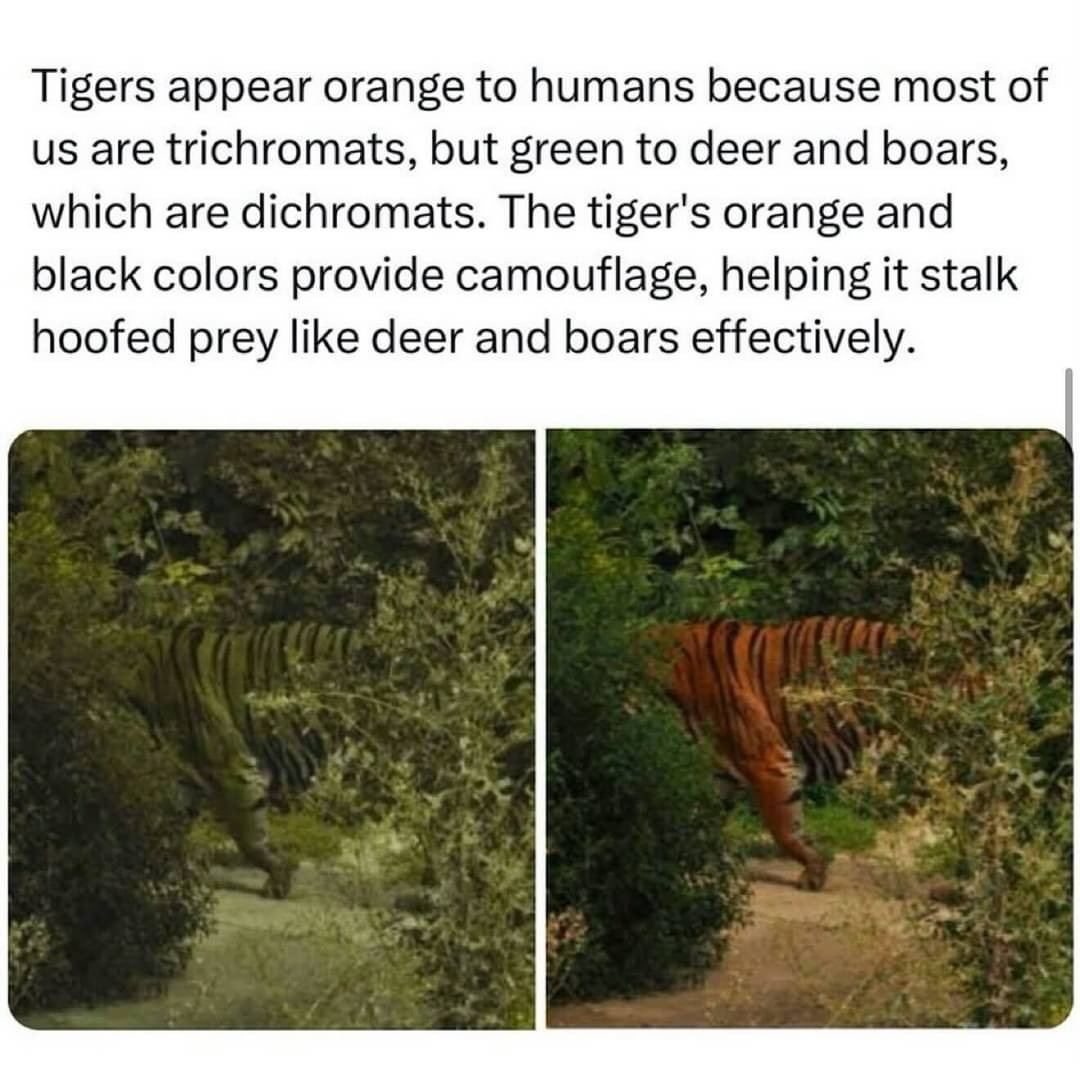
I wish I could find the sources from when I was reading about this months ago, it was more about evolution in terms of things that can happen and not ‘random’ mutations, and one of the examples was tigers with orange fur instead of green. It’s not physically impossible to have structural coloring (although the fact there are no green mammals suggests a strong inhibition somewhere along the line), but you first have to have the genetic and molecular groundwork laid to allow it to happen. Ex: it’s not physically impossible for animals to manufacture their own vitamin C, but humans just can’t do it because we don’t have the necessary molecular pathways other animals use. I hope that makes sense for what I’m trying to get at.