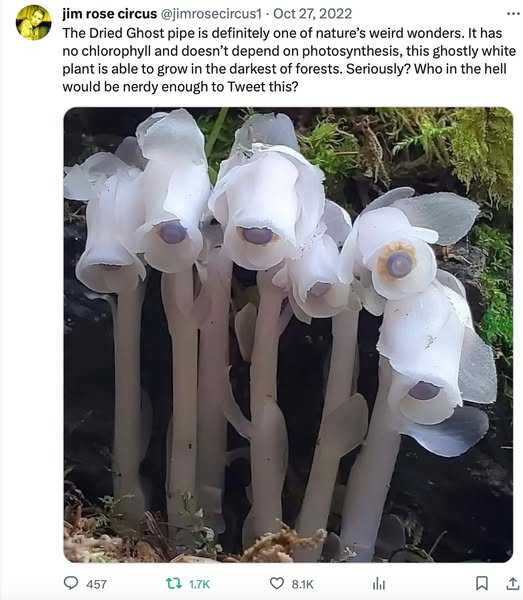
Monotropa uniflora: https://en.wikipedia.org/wiki/Monotropa_uniflora
A place for majestic STEMLORD peacocking, as well as memes about the realities of working in a lab.

Meta Post Tags
Rules
If you are here asking: "Is this a science meme?"
Probably, yes. We use the Dawkins definition of meme: a replicating idea, not just an image macro with a fact on it. A good post here doesn't need to teach you something. It needs to make you ask something: who, what, where, when, and especially why or how.
Science isn't a filing cabinet of facts, it's a conversation. For example, a photo of an eel or other localized wildlife counts because most people never see one, and wonder is the first step of inquiry. A car meme counts if it makes you curious about what's under the bonnet. If you want to talk about something you noticed in the world, chances are someone else wants to talk about it too.
We moderate for vibe, not category. Pruning is light, especially where a post creates interesting discussion. Experimenting is encouraged.
See the pinned paper on Shitposting as Public Pedagogy if you want the academic case for why this works.
Monotropa uniflora: https://en.wikipedia.org/wiki/Monotropa_uniflora
Ah! Thanks for the clarification. I should've done a side-search to check before posting.
Hmm, wikipedia says... "... Instead of generating food using the energy from sunlight, it is parasitic, and more specifically a mycoheterotroph" though.
this species tend to be "more common" but its very unusual that it shows up on different continents, but not in a continious population, disjunct its called. it occurs north america all the way to china, russia, india, ,,etc. but tends to be rare consider how fickle these plants are(super specific fungi and environment). thier seeds are most similar to orchids(which can be partial or full mycoheterotroph). fun fact there used to be another type of mycohetroph in the americas, this is even more unusual since its mostly found in asia(around 100+ species i think a ton got discovered in the last few years i have been keeping up with this genus is really interesting) thismia americana was suppose to grow in lake calumut area, but it went shortly extinct(that we know of) after it was discovered, they had been trying to find this plant ever since, 1912(by Pfiffer)(another species in asia wasnt seen for 151 years after it was discovered until 2017(South america has thier own thismia(but its likely they are a different genus ). because mycohetereotrophs are rarely seen plants,(you wouldnt know its there unless flowering), like a normal plant you know its there even without leaves, it has stems, branches etc.
i was on the sub for plant ID, and they had gnome plant once posted(pretty rare in the redwood forest in the north west pacific coast), and monotropa hypotytis.