this post was submitted on 07 Feb 2025
1001 points (98.1% liked)
Science Memes
20626 readers
1976 users here now
Welcome to c/science_memes @ Mander.xyz!
A place for majestic STEMLORD peacocking, as well as memes about the realities of working in a lab.

Meta Post Tags
Rules
- Don't throw mud. Behave like an intellectual and remember the human.
- Keep it rooted (on topic).
- No spam.
- Infographics welcome, get schooled.
If you are here asking: "Is this a science meme?"
Probably, yes. We use the Dawkins definition of meme: a replicating idea, not just an image macro with a fact on it. A good post here doesn't need to teach you something. It needs to make you ask something: who, what, where, when, and especially why or how.
Science isn't a filing cabinet of facts, it's a conversation. For example, a photo of an eel or other localized wildlife counts because most people never see one, and wonder is the first step of inquiry. A car meme counts if it makes you curious about what's under the bonnet. If you want to talk about something you noticed in the world, chances are someone else wants to talk about it too.
We moderate for vibe, not category. Pruning is light, especially where a post creates interesting discussion. Experimenting is encouraged.
See the pinned paper on Shitposting as Public Pedagogy if you want the academic case for why this works.
Research Committee
Other Mander Communities
Science and Research
Biology and Life Sciences
- !abiogenesis@mander.xyz
- !animal-behavior@mander.xyz
- !anthropology@mander.xyz
- !arachnology@mander.xyz
- !balconygardening@slrpnk.net
- !biodiversity@mander.xyz
- !biology@mander.xyz
- !biophysics@mander.xyz
- !botany@mander.xyz
- !ecology@mander.xyz
- !entomology@mander.xyz
- !fermentation@mander.xyz
- !herpetology@mander.xyz
- !houseplants@mander.xyz
- !medicine@mander.xyz
- !microscopy@mander.xyz
- !mycology@mander.xyz
- !nudibranchs@mander.xyz
- !nutrition@mander.xyz
- !palaeoecology@mander.xyz
- !palaeontology@mander.xyz
- !photosynthesis@mander.xyz
- !plantid@mander.xyz
- !plants@mander.xyz
- !reptiles and amphibians@mander.xyz
Physical Sciences
- !astronomy@mander.xyz
- !chemistry@mander.xyz
- !earthscience@mander.xyz
- !geography@mander.xyz
- !geospatial@mander.xyz
- !nuclear@mander.xyz
- !physics@mander.xyz
- !quantum-computing@mander.xyz
- !spectroscopy@mander.xyz
Humanities and Social Sciences
Practical and Applied Sciences
- !exercise-and sports-science@mander.xyz
- !gardening@mander.xyz
- !self sufficiency@mander.xyz
- !soilscience@slrpnk.net
- !terrariums@mander.xyz
- !timelapse@mander.xyz
Memes
Miscellaneous
founded 3 years ago
MODERATORS
you are viewing a single comment's thread
view the rest of the comments
view the rest of the comments
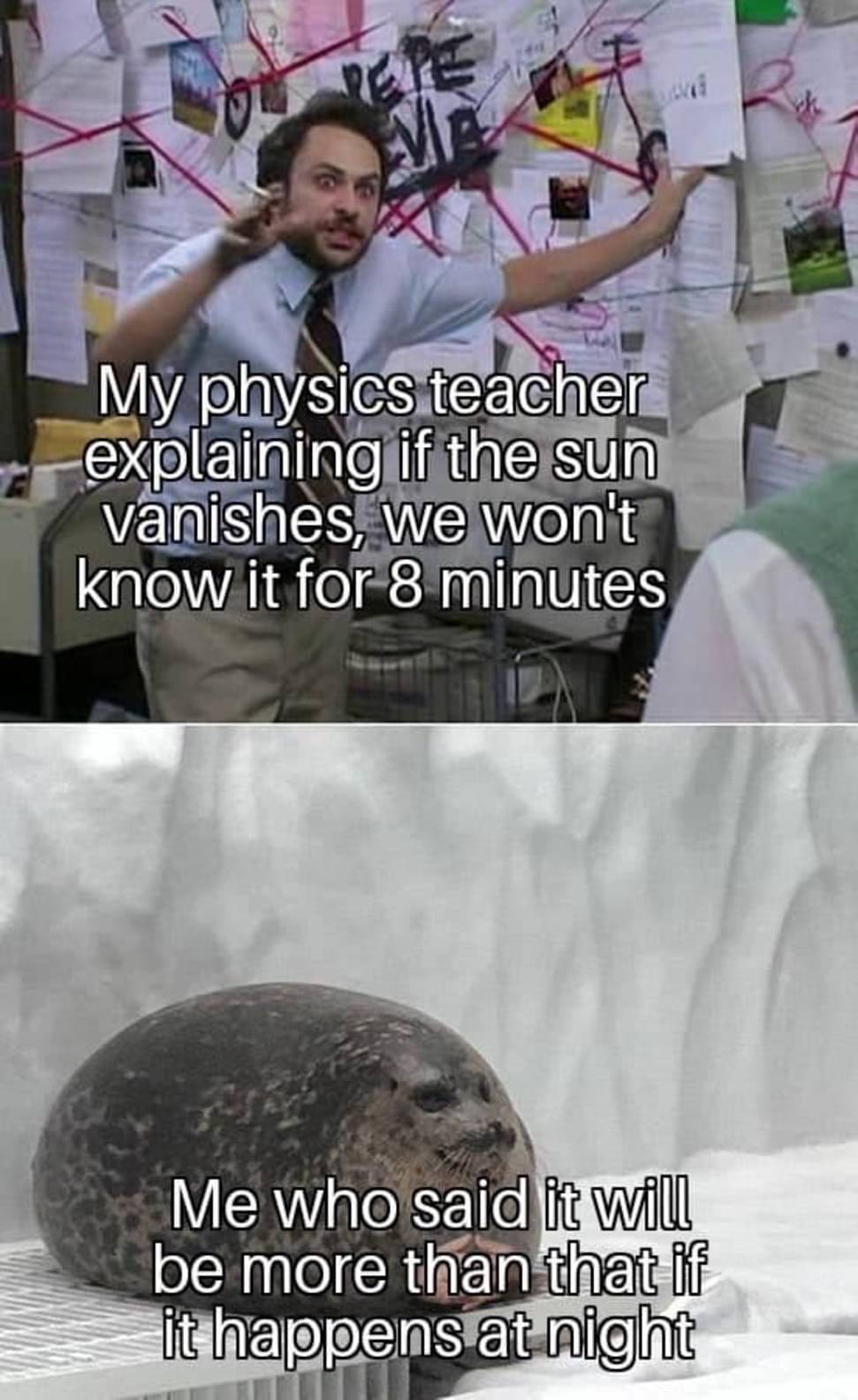
Doesn't the earth itself provide a significant amount of heat from the core? I'm sure I read somewhere that for something like every 10 meters down you dig, the temperature raises by 1° celcius. So maybe we'd not notice a temperature drop so quickly?
The surface would eventually freeze over. But some life would almost definitely survive deep underground and underwater, near geothermal vents not unlike those that hosted the first lifeforms on Earth. And, maybe, in some billions or trillions of years, Earth would stray near another star system, get captured by its gravity and slowly thaw out, restarting the evolution of life.
Would hydrothermal vents produce enough heat? Or would the oceans freeze over? And then would there just be thermal bubbles surrounding the vents in oceanic ice?
The oceans would eventually freeze over, but the deep ocean could stay liquid for tens of millions of years. Ice is a pretty good insulator, and there is more than one moon in the solar system suspected to have liquid oceans under a layer of ice.
Even if they were to, there is still the deep biosphere
Fucking fascinating. Thanks for the share
Not sure how quick exactly, but the earth doesn't provide enough heat, not even close. Kurzgesagt has a video on a similar subject, without the ~~trillions~~ 1.7e17 Watts showering the earth every second we'd get awfully cold awfully quick. They are talking about slowly moving away from the sun, but they conclude it would get real icy