this post was submitted on 14 Jan 2025
1142 points (98.9% liked)

Science Memes

20710 readers
810 users here now

Welcome to c/science_memes @ Mander.xyz!

A place for majestic STEMLORD peacocking, as well as memes about the realities of working in a lab.


Meta Post Tags


Rules

  1. Don't throw mud. Behave like an intellectual and remember the human.
  2. Keep it rooted (on topic).
  3. No spam.
  4. Infographics welcome, get schooled.


If you are here asking: "Is this a science meme?"

Probably, yes. We use the Dawkins definition of meme: a replicating idea, not just an image macro with a fact on it. A good post here doesn't need to teach you something. It needs to make you ask something: who, what, where, when, and especially why or how.

Science isn't a filing cabinet of facts, it's a conversation. For example, a photo of an eel or other localized wildlife counts because most people never see one, and wonder is the first step of inquiry. A car meme counts if it makes you curious about what's under the bonnet. If you want to talk about something you noticed in the world, chances are someone else wants to talk about it too.

We moderate for vibe, not category. Pruning is light, especially where a post creates interesting discussion. Experimenting is encouraged, but keep it in good faith and never punch down.


Research Committee

Other Mander Communities

Science and Research

Biology and Life Sciences

Physical Sciences

Humanities and Social Sciences

Practical and Applied Sciences

Memes

Miscellaneous

founded 3 years ago
MODERATORS
 
you are viewing a single comment's thread
view the rest of the comments
[–] big_fat_fluffy@leminal.space 5 points 2 years ago (1 children)

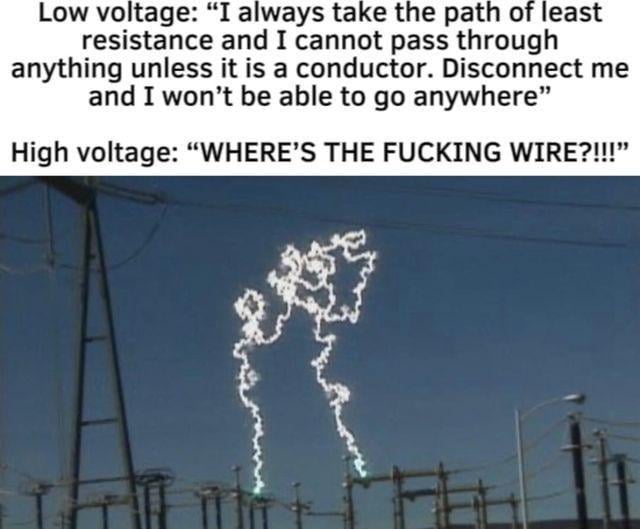
How about in vacuum? Do you get fancy arcs or glows or what?

[–] MataVatnik@lemmy.world 4 points 2 years ago (1 children)

In typical conditions, an electrical arc forms when the electric field strength exceeds the dielectric strength of the medium (like air). In a vacuum, there is no medium to ionize, which theoretically makes it difficult for an arc to form. However, electricity can still arc in a vacuum under certain conditions, such as when high voltages are involved or when the electrodes are extremely close together.

https://peacepower.ca/faqs/can-electricity-arc-in-a-vacuum#%3A%7E%3Atext=In+typical+conditions%2C+an+electrical%2Celectrodes+are+extremely+close+together.

[–] big_fat_fluffy@leminal.space 4 points 2 years ago (1 children)

I was thinking neon lights. I mean that's basically an arc, just spread out. I think I heard that there's a glow in vacuum too, just not as nice as with neon.

[–] Trigger2_2000@sh.itjust.works 1 points 2 years ago

Well, a quick search turned up this: Vacuum Arc

However, like the above comment, it seems to refer to freeing electrons from the conducts, so, IMHO, you no longer have a vacuum.

If you could somehow maintain a perfect vacuum; I wonder how this concept Virtual particle would come into play (or if it would at all).