this post was submitted on 14 Jan 2025
946 points (90.0% liked)
Comic Strips
23614 readers
1596 users here now
Comic Strips is a community for those who love comic stories.
Rules
-
😇 Be Nice!
- Treat others with respect and dignity. Friendly banter is okay, as long as it is mutual; keyword: friendly.
-
🏘️ Community Standards
- Comics should be a full story, from start to finish, in one post.
- Posts should be safe and enjoyable by the majority of community members, both here on lemmy.world and other instances.
- Any comic that would qualify as raunchy, lewd, or otherwise draw unwanted attention by nosy coworkers, spouses, or family members should be tagged as NSFW.
- Moderators have final say on what and what does not qualify as appropriate. Use common sense, and if need be, err on the side of caution.
-
🧬 Keep it Real
- Comics should be made and posted by real human beans, not by automated means like bots or AI. This is not the community for that sort of thing.
-
📽️ Credit Where Credit is Due
- Comics should include the original attribution to the artist(s) involved, and be unmodified. Bonus points if you include a link back to their website. When in doubt, use a reverse image search to try to find the original version. Repeat offenders will have their posts removed, be temporarily banned from posting, or if all else fails, be permanently banned from posting.
- Attributions include, but are not limited to, watermarks, links, or other text or imagery that artists add to their comics to use for identification purposes. If you find a comic without any such markings, it would be a good idea to see if you can find an original version. If one cannot be found, say so and ask the community for help!
-
📋 Post Formatting
- Post an image, gallery, or link to a specific comic hosted on another site; e.g., the author's website.
- Meta posts about the community should be tagged with [Meta] either at the beginning or the end of the post title.
- When linking to a comic hosted on another site, ensure the link is to the comic itself and not just to the website; e.g.,
✅ Correct: https://xkcd.com/386/
❌ Incorrect: https://xkcd.com/
-
📬 Post Frequency/SPAM
- Each user (regardless of instance) may post up to five (5 🖐) comics a day. This can be any combination of personal comics you have written yourself, or other author's comics. Any comics exceeding five (5 🖐) will be removed.
-
🏴☠️ Internationalization (i18n)
- Non-English posts are welcome. Please tag the post title with the original language, and include an English translation in the body of the post; e.g.,
Sí, por favor [Spanish/Español]
- Non-English posts are welcome. Please tag the post title with the original language, and include an English translation in the body of the post; e.g.,
-
🍿 Moderation
- We are human, just like most everybody else on Lemmy. If you feel a moderation decision was made in error, you are welcome to reach out to anybody on the moderation team for clarification. Keep in mind that moderation decisions may be final.
- When reporting posts and/or comments, quote which rule is being broken, and why you feel it broke the rules.
Banned Artists
The following artists are banned from the community.
- Jago
- Stonetoss
It should be noted that when you make reports, it is your responsibility to provide rational reasoning why something should be removed. Saying it simply breaks community rules is not always good enough.
Web Accessibility
Note: This is not a rule, but a helpful suggestion.
When posting images, you should strive to add alt-text for screen readers to use to describe the image you're posting:
Another helpful thing to do is to provide a transcription of the text in your images, as well as brief descriptions of what's going on. (example)
Web of Links
- !linuxmemes@lemmy.world: "I use Arch btw"
- !memes@lemmy.world: memes (you don't say!)
founded 2 years ago
MODERATORS
you are viewing a single comment's thread
view the rest of the comments
view the rest of the comments
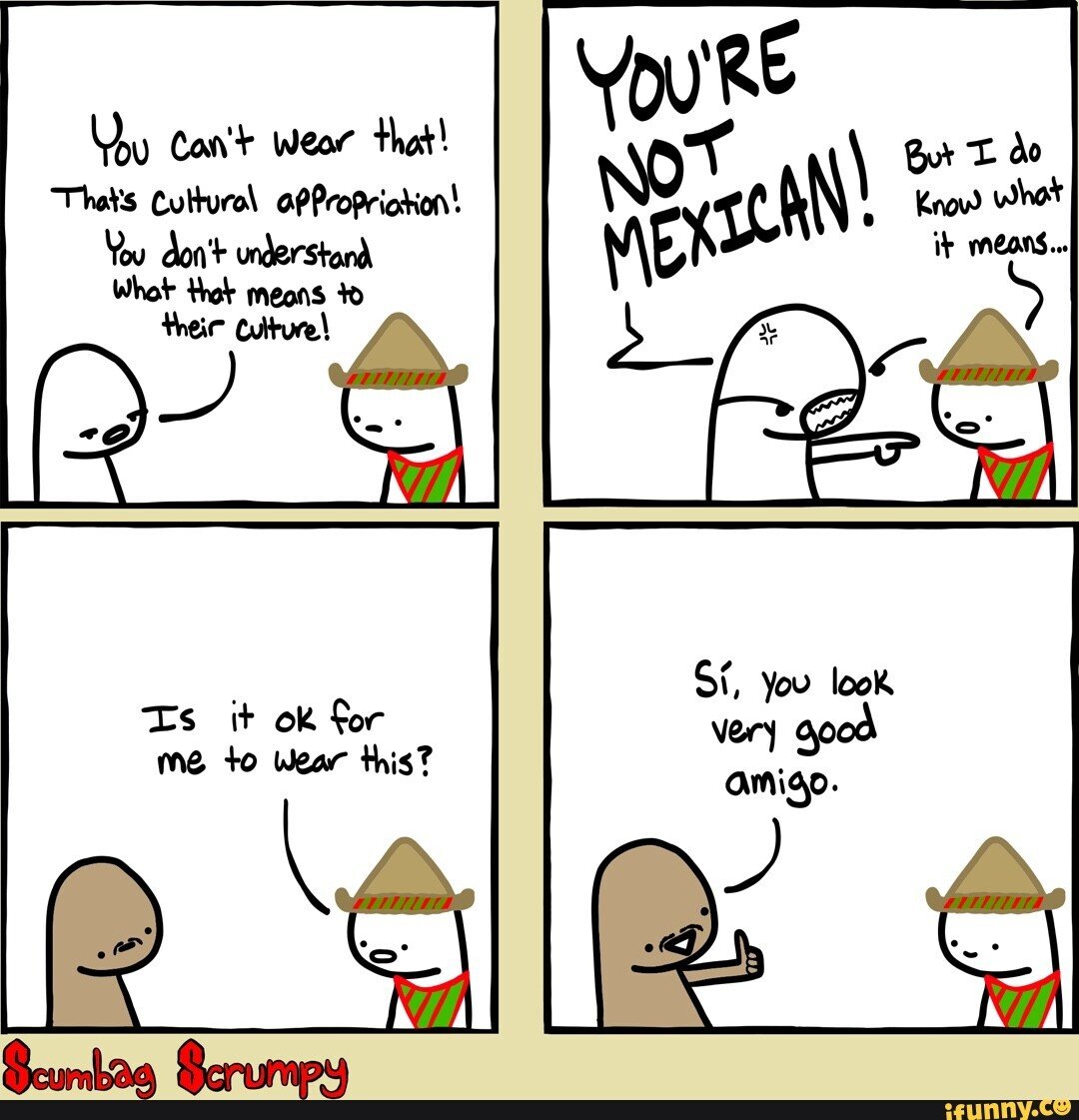
Enjoying other cultures isn't appropriation. I think the line where it becomes appropriation is profiteering. If you are commodifying and profiting off someone else's culture that's pretty shitty. Obviously that's not a perfectly clear cut line (who 'owns' culture?), but it's a good place to start.
I think that’s still tricky. For instance, most parts of the world have few Japanese migrants, yet Japanese restaurants are almost everywhere. Usually these are owned by other Asian migrants. This is clearly profiteering, but I don’t see it as particularly problematic.
I think you can apply the socioeconomic and derogation lenses here. Socioeconomically, Japan has been ahead of nearly every other Asian country for a long while, with only places like China and Singapore recently catching up to them. So, I think that makes it feel okay. And derogatively, I don't think these restaurants are successful because they specifically aren't being run by Japanese people. So that's good on the front as well. So I'd say, yeah, overall it feels fine. However, I'm not Japanese and don't have a wealth of additional context that might provide counter arguments.
So is every company making and marketing tortilla chips and salsa appropriating culture if they are from New York City? Is every pizzeria that isn't in Italy profiteering off of Italian culture? Is a French Bistro in Kansas City wrong? Is it wrong to wear a Scottish Kilt made in Viet Nam?
I think each of the described situations has a different specific answer because the topic is nuanced. As stated above, it can sometimes to be messy to say who owns some piece of culture. But beyond that, the most useful tool is an examination of socioeconomic power dynamics.
If there is a cultural group that is poor, and an outsider from a rich/wealthy group commodifies and sells their culture, while giving nothing to those people, you'd probably agree that that's a shitty thing to do. Their culture obviously had some kind of material wealth value that they received none of.
However, if you take a situation where both parties are well off it seems a lot less shitty. Especially if the cultural group in question is already commodifying and profiting off the same piece of culture.
If you can't unravel the knot of cultural ownership, then does anyone really own it? It would appear to me that "everyone" owns it at that point and can partake in it freely and adapt it to their wants an needs. And no matter the culture, there is always socioeconomic disparities within that group. No matter how small or downtrodden they may appear to you. Someone is always going to be a little bit better off than you and someone else is always going to have a little more power than you.
So is Tostitos racist for not mailing checks to every Mexican person everywhere? Because they sure as hell are making bank selling those chips and Salsa to you. OMG! are YOU part of the problem?
Sorry for the double reply, but another useful perspective in this is derogation. I often forget this idea because I'm very class minded, but it's also very important. This is the idea that a culture can be profited off of while simultaneously despising the people that practice it. In practice, this exists as a business around a specific cultural item succeeding specifically because the business is NOT owned/operated by the original cultural group. Some of the best examples of this are around Black American culture in the US. Some cultural products were only valuable AFTER they were owned, operated, and proliferated by White Americans. Which is kinda just Racism Classic™ but allowing certain useful things to cross the cultural line for profits sake.
The know of cultural ownership is absolutely unravel-able in many situations, just not all. In some situations it's exceedingly clear and in others, not. I think you're trying very hard to find hard-and-fast, absolute rules for these situations, but they don't exist. The keyword is nuance, nuance, nuance. Each situation is different and each situation deserves scrutiny as to whether or not it crosses the line. This is a judgement call made by each and every person.
If you really want me to engage on the specific situation of Tostitos/chips and salsa I will, so you can see the process of my scrutiny.
First, I think that as any item of culture becomes more and more diffused (ethically or not), it's original ownership becomes diluted. Things that were once appropriation in the distant past, if done today, would not be considered as such as the context around them changes (in a myriad of ways).
So, if Tostitos started as a company today, I'd say making chips and salsa is not appropriation. But, if Tostitos was founded a long time ago, before chips and salsa were a foodstuff ubiquitous across the US and Tostitos was created by one outside of that cultural ownership, then I'd say it likely was appropriation. It also might be fair to argue that in the modern day for Tostitos specifically, "the damage has been done" and there really isn't much fixing it, so consuming their products isn't necessarily problematic. But this would be a point as to why identifying appropriation early on and stopping it is especially important.
As to whether I'm part the problem - for Tostitos no, but for other things almost certainly yes. I'm human and I don't know everything, and I've certainly made mistakes in this area, but that's okay. What's important is that once I've learned something is in fact a mistake, I own up to it and stop making that mistake.
also when it becomes an issue is influenced by how accurate it is, how overused it feels, and (obviously) if it was made with the intent to insult
I think academically, derogation is often considered as a component. Like profiting off a culture while simultaneously despising the culture and the people who own it.
It's a tough line to draw, because even if they aren't the main profitees, the culture where the thing originated often still profited. e.g. AFAIK rock'n'roll getting popular with white americans was pretty good for black americans, even though many of the best selling artists (e.g. Elvis Presley) were white.
The popularization of Black American music is indeed a complex topic in this arena. Like, obviously a lot of cultural outsiders made a lot of money off of the situation, but there were at least some benefits to the arrangement, although whether or not they outweighed the cons is perhaps difficult to say. For example, if outsiders had abstained entirely from profiting, what would have changed? Obviously more of the money made percentage-wise would've gone to the owning culture, but would there have been less money overall? Would it have reached the same levels of popularity? If so, it almost certainly wouldn't've happened as quickly, right? These are difficult questions to answer and I'm not educated enough in this area to really offer any. So, while not worth a damn, my gut feelings is that there are at least some strong arguments as to why overall the absence of outsider profiting would've been better for the owning culture.
With rock'n'roll, it was not even just about money, it also did a pretty good job of bridging the gap between black and white people - I don't think it's realistic to say that this would have worked equally well if all the bands had been black.