1142
A place for majestic STEMLORD peacocking, as well as memes about the realities of working in a lab.

Meta Post Tags
Rules
If you are here asking: "Is this a science meme?"
Probably, yes. We use the Dawkins definition of meme: a replicating idea, not just an image macro with a fact on it. A good post here doesn't need to teach you something. It needs to make you ask something: who, what, where, when, and especially why or how.
Science isn't a filing cabinet of facts, it's a conversation. For example, a photo of an eel or other localized wildlife counts because most people never see one, and wonder is the first step of inquiry. A car meme counts if it makes you curious about what's under the bonnet. If you want to talk about something you noticed in the world, chances are someone else wants to talk about it too.
We moderate for vibe, not category. Pruning is light, especially where a post creates interesting discussion. Experimenting is encouraged.
See the pinned paper on Shitposting as Public Pedagogy if you want the academic case for why this works.
Voltage and current are related, of course, but Ohm's law is just a simplification of circuit theory for static circuits, and the version most are taught early on assume zero inductance and zero capacitance in the circuit. Drop in an alternating current, some capacitors and inductors, and you've got yourself a more complex situation, literally, with the scalar real number representing resistance replaced with the complex number representing impedance.
And when you have time variance that isn't a simple sinusoidal wave of electric potential coming from a source, even the definition of the word "voltage" starts requiring vector calculus to even be a coherent definition.
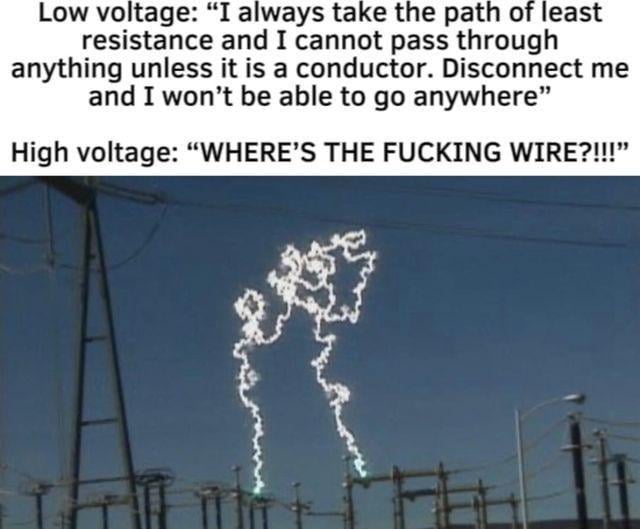
So when I take a simple battery of DC cells to create a low voltage power source, I can still induce current using some transformers and inductors (which store energy in magnetic field) and abruptly breaking open the circuit so that the current still arcs across high resistance air. That's the basic principle of how a spark plug works. In those cases, you're creating immense voltages for a tiny amount of time, but there's never any real risk of significant current being pushed through any part of a person's body. And as soon as you draw off some of the current, the voltage immediately drops as you deplete the stored energy wherever it is in the system.
And anything designed to deliver an electric shock to a person (or animal) tends to be high voltage, low current. Tasers, electric fences, etc.
So it's current that matters for safety. A high voltage doesn't always induce a high current. And current can cause problems even at relatively low voltages.