66
What do a Mafioso, an ancient Mesopotamian temple and a Roman aristocrat have in common?
(media.fedia.io)
Crossposted from https://fedia.io/m/historymemes@piefed.social/t/4518293
David Graeber's Debt: The First 5000 years in a memeshell (actually no the book is about much more than that).
What a meme with no implications for contemporary politics whatsoever.
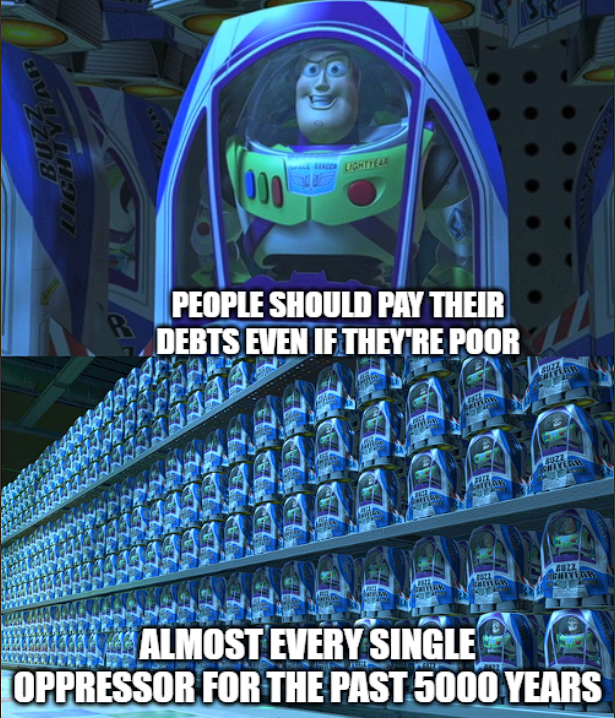
I appreciate the sentiment, but this is absolutely not how it works.
Obligation to pay back debts is essential to have a functional financial system, which in turn is needed in order to people be able to consume today (buy houses, start businesses) at the expense of tomorrow. If you start cancelling debt, or forcing government to pay it back, you create wrong incentives and either stifle the money supply or cause debt bubbles.
Where the criticism should go is, why do people need to take on debt in the first place? Education should not require it, the state should invest in its people and pay for it. Housing should be cheap enough that rent should be affordable on a minimum-wage paycheck. Or supported by the government if unemployed.
Debt should only be needed for investing in the future, not covering essential spending. But it should be still possible and it should be expected that it's paid back.
That's not really the point of the book (and therefore the meme). You should at least read the introduction, but basically the book explains the massive role debt has had in human history, but one theme that shows up again and again is essentially payday loans, rich people using debt as a way to justify their violent control of labor or resources while making I seem like the poor's fault. I also want to note (the book points this out in the introduction), but in modern developed countries you don't in fact always have to pay your debts. Bankruptcy is a thing, and nobody gets told to, say, sell themselves or their family into slavery to pay their mortgage.
Well, that's kind of a problem with memes. They're simple images with text, so the context you've meant for it is not visible for the rest of us. Nevertheless, I appreciate your elaboration, the book sounds interesting and every time I hear about it makes me want to read it.
My unpopular opinion is that memes ruined the internet. People used to write their thoughts, now they just post a vague meme they saw on the meme page that copied it from a different meme page. Accelerated by the monitization of said meme pages.
People get their "news" from memes like they're browsing zany headlines. No need to fact check, it's text on an image so it's gotta be true. Be sure to post them everywhere, too.
This isn't an insult to this post specifically (no offense to you, OP) but meme culture in general.