this post was submitted on 21 Aug 2026
668 points (96.3% liked)
Cool Guides
6687 readers
1 users here now
Rules for Posting Guides on Our Community
1. Defining a Guide Guides are comprehensive reference materials, how-tos, or comparison tables. A guide must be well-organized both in content and layout. Information should be easily accessible without unnecessary navigation. Guides can include flowcharts, step-by-step instructions, or visual references that compare different elements side by side.
2. Infographic Guidelines Infographics are permitted if they are educational and informative. They should aim to convey complex information visually and clearly. However, infographics that primarily serve as visual essays without structured guidance will be subject to removal.
3. Grey Area Moderators may use discretion when deciding to remove posts. If in doubt, message us or use downvotes for content you find inappropriate.
4. Source Attribution If you know the original source of a guide, share it in the comments to credit the creators.
5. Diverse Content To keep our community engaging, avoid saturating the feed with similar topics. Excessive posts on a single topic may be moderated to maintain diversity.
6. Verify in Comments Always check the comments for additional insights or corrections. Moderators rely on community expertise for accuracy.
Community Guidelines
-
Direct Image Links Only Only direct links to .png, .jpg, and .jpeg image formats are permitted.
-
Educational Infographics Only Infographics must aim to educate and inform with structured content. Purely narrative or non-informative infographics may be removed.
-
Serious Guides Only Nonserious or comedy-based guides will be removed.
-
No Harmful Content Guides promoting dangerous or harmful activities/materials will be removed. This includes content intended to cause harm to others.
By following these rules, we can maintain a diverse and informative community. If you have any questions or concerns, feel free to reach out to the moderators. Thank you for contributing responsibly!
founded 3 years ago
MODERATORS
you are viewing a single comment's thread
view the rest of the comments
view the rest of the comments
I have conflicting thoughts about this.
More often than not this explanation is just used as a excuse to hate whatever group you want while labeling yourself as the good one. But applied to the ultimate consequences most people would still be intolerant.
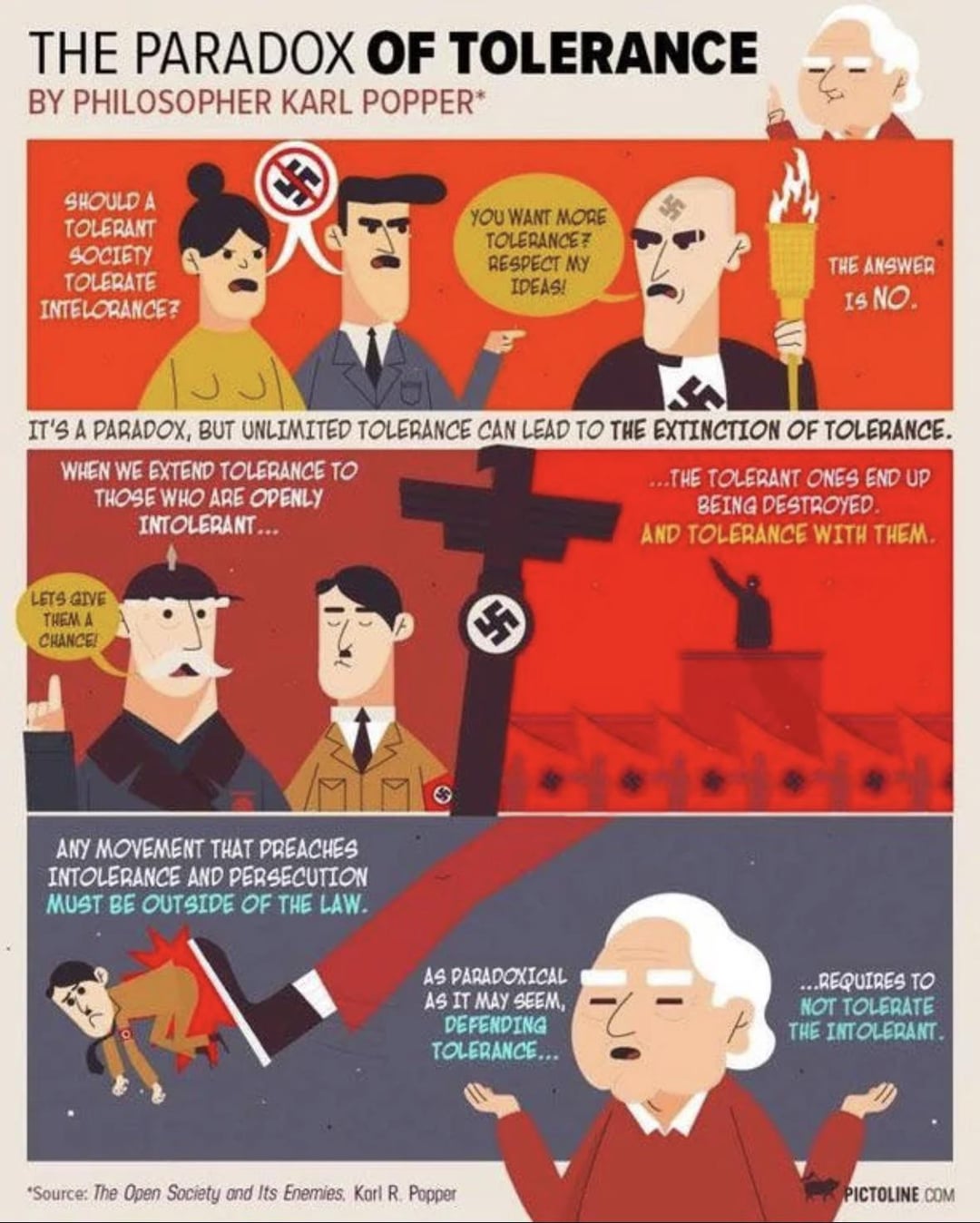
The classical example of not tolerating nazis because they are intolerant to others, is used because it's a flawless example. The definition of a nazi is a person who wants to eliminate other groups from society just because what they are. A tolerant society cannot exist with them, so they have to go. Perfect.
But we have real life problems when we move from the perfect example to practical cases.
1The "everyone I don't like is a nazi" problem. Someone who wants to be a good intolerant just have to label their opponents as nazis, no matter if they are or not. Just the label is good enough.
While Nazis are used as a classical example. The more pure definition is, that tolerant society should not tolerate people who are intolerant. Thus, only allowed intolerance is the intolerance to the intolerant, any other type of intolerance should then make you a valid target for intolerance.
And here is when I see the biggest problem. That society doesn't usually fit most people values. I would give you several examples. Take billionaires, take robbers, take whatever kind of person you don't like, not only don't like but you don't want anyone like that in your society, for reasons different to them being intolerant. There are other undesirable values in a person that sometimes are worse than intolerance. The lack of tolerance to those people really puts you in the same spot as the Nazi in the paradox of intolerance. As you are hating on people for reasons different than they not being tolerant.
I see two honest solutions and one dishonest one.
The first honest solution is to strictly adhere to the idea of being tolerant everyone but the intolerant idea. Which will imply a higher effort to accept people in the society that you currently don't want to accept. Embrace that tolerance is the ultimate goal and just reject the intolerant, accepting everyone else, no matter what.
The second honest solution is to reject complete unconditional tolerance to everyone but the intolerant. Create a more strict set of values of what the society should tolerate. And embrace the idea that complete unconditional tolerance is a not the goal.
The dishonest solution is just lie about it. Seek excuses, loopholes or overcomplicated cherry picking reasonings on why the people you don't want to tolerate are actually intolerants and then covered by the paradox of intolerance and be happy with it.
To each their own. In the later years I'm feeling myself leaning more for the second honest solution. Unconditional tolerance is not a goal per se. I try to create a developed moral system that could actually be universal and that everyone and anyone could and should follow. And think that maybe I should not tolerate anyone that breaks this ethical rules. Basically instead of saying that the "golden rule" is to be tolerant and that's the only rule that people is not allowed to break. My golden rule is more on the lines of "be a good person", which is harder to define but I think it's more solid, and that's the only rule that should not be broken.
And here ends my TED talk.
There are also a plurality of underlying issues not explored by this, because it's treated as first order only problem. Like... why is it that people become intolerant and why they blame certain groups for things.
And usually that's underlying economic or inequality conditions in the society or other forms of social upheaval.... which people generally don't want to address so much as they want to focus on the social sorting of hating and being hateful as the 'solution'. It's much easier to be tolerant when you are in an environment where members are all roughly of equal status, harder when there are perceived or real inequalities and abuses of power.
Real world is more complicated because people don't hate for no reason. They may, have very legit reasons, and you likely may have the same reasons directed towards a different group.
Everyone does vastly over simplify this, because well, they want to use is as a litmus test to prove they are good and other people are bad, and that's the only 'use' of this principle. Which is what folks do with a lot of moral/social guidelines... they want to reduce them to sorting mechanisms with themselves on the 'right' side of the sort... and if you challenge that notion maybe it's not that simple... you must be one of the 'bad' people.
Further, everyone is intolerant of something. Even if they won't admit it. Nor will they admit... that they and everyone else make mistakes. People's mind and behaviors change... a whole other second order factor also totally outside the scope of this 'paradox'. and for a lot of folks on lemmy... you can't ever change or be reformed from your previous views... etc.
We also have the wonderful case of social movements that seek to turn innocuous behaviors into intolerable assaults on themselves, like the 'manspreading' nonsense from Tumblr.
I think it's better understood as a phenomena, not a principle or a rule or any of that. You don't have to 'accept' or 'reject' it. You should think about it though, about the implications of where you draw the line, because in real life it is never as clean as 'nazis bad, everyone non-nazi good', and there are so many legal and other examples that get into murkey waters.
Being a billionaire is a choice, a choice to hoard money to the detriment of everyone and everything around you. One could easily choose to not be a billionaire by paying taxes and funding their local social support services and donating to charity. Intolerance of greed on the scale of billions of dollars should be the norm as it is actively detrimental to society.
Robbery is a violation of personal safety and social boundaries and is also actively detrimental to society. It is also a choice.
Intolerance of the choices of others that violate the social contract of "don't be greedy, don't steal, don't hurt others, etc..." is valid intolerance in my opinion.
Nazis are intolerable because they are intolerant of the vast majority of humanity itself and for reasons outside of most people's control. Sure, you can make it a choice and convert to Judaism, but the vast majority of Jews are born into Judaism; It's not a choice like greed on the scale of billions or breaking and entering.
For that reason alone, Nazis are worth disposing of. The myriad additional reasons to hate Nazis just makes the job easier.
But that's just people exploiting ambiguity, not a real problem with the principle. It's an implementation problem. And since every other alternative will be dependent on a similar definition with a threshold up define bad, this one can't be substantially worse.
You're counting wrong when you're talking about "most". If most people hated society you would not see cities larger than a few thousand people. People are annoyed by it, but they accept it because they know what they get in return (conservative propaganda is essentially about lying about what makes society good)
We already do partial tolerance. It's called fines instead of deportation, it's called reputation instead of tarring. What you're really looking for here is stronger cultural enforcement.