this post was submitted on 11 Aug 2026
1128 points (98.8% liked)
Work Reform
17209 readers
1659 users here now
A place to discuss positive changes that can make work more equitable, and to vent about current practices. We are NOT against work; we just want the fruits of our labor to be recognized better.
Our Philosophies:
- All workers must be paid a living wage for their labor.
- Income inequality is the main cause of lower living standards.
- Workers must join together and fight back for what is rightfully theirs.
- We must not be divided and conquered. Workers gain the most when they focus on unifying issues.
Our Goals
- Higher wages for underpaid workers.
- Better worker representation, including but not limited to unions.
- Better and fewer working hours.
- Stimulating a massive wave of worker organizing in the United States and beyond.
- Organizing and supporting political causes and campaigns that put workers first.
founded 3 years ago
MODERATORS
you are viewing a single comment's thread
view the rest of the comments
view the rest of the comments
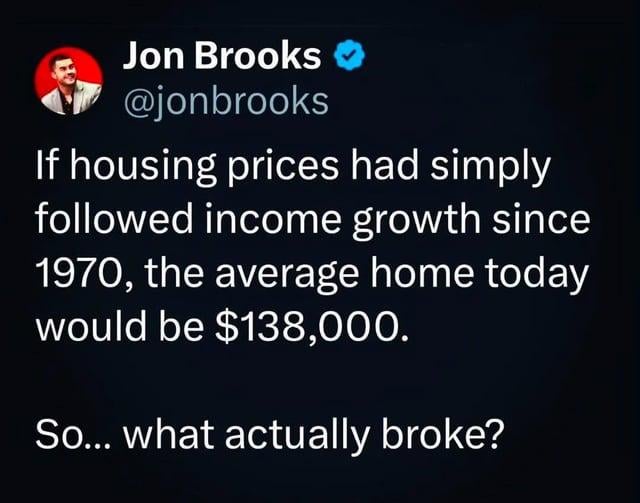
People in the thread talking about supply and demand curves and their impact on prices are, in my view, generally correct. But there's another component to that which came in on the same time frame, that people generally don't seem to discuss / highlight, though I'm not entirely sure why?
Since the 1970s, women have significantly shifted into the work place -- though typically not in the realm of construction/home building and trades. On the demand side, it puts upward pressure on prices because you have 'double' the income to bid up prices / a ton more buyers. And the lack of proportional increases in the sector workers, puts upward price pressure on the supply side too as there are more people wanting homes, but relatively fewer people building them.
Another huge component in the mix, is the increase in city building requirements/regulations. Permitting/city fees alone can cost a person hundreds of thousands of dollars on a build. In some areas, typically densely populated urban spots, such requirements make sense for safety reasons. In others, such requirements reduce the number of companies able to comply, and the degree of innovation in the sector. "Normally" you'd have companies trying to reduce operating expense through innovation in their processes to get more market share, but housing doesn't really function like that.
Interesting point about adding women entering the workforce en masses adding more buying power to the housing market while adding relatively less supply.
I also think that supply and demand is generally true, along with another commentor's perspective that construction quality has gone up, safety regulations more protective, etc.
I'll also add another factor that I haven't seen mentioned yet: interest rates and other mortgage terms. Depending on where in the world you are, interest rates are generally lower and allowable mortgage terms generally longer than they were 50 years ago. I recently compared my initial mortgage payment of my first home in 2020 with the initial mortgage payment of my father in 1985, and found that they were almost identical when adjusted for inflation. My house however, was newer, larger, in better condition, and in a bigger city. In my anecdotal case at least, I got a better deal than my dad... at least until he eventually renewed at a much lower interest rate after the debt crisis subsided.
Not sure where you are in the world, but in the 1980's there was a huge interest rate spike in many areas i think -- Canada for example had interest rates spike up to 20% practically overnight as a result of US trade shenanigans, and instability in the middle east.... (sounds familiar, though we haven't seen as drastic a shift this time). But like, for 40 years prior that, and 20 years post the 90s, it hovered around 5%. Recently (post 2010) it fluctuates a bit, but generally around that 3-5% mark still. Lately they ticked up a bit I think.
Anyhow, point being that your Dad's first payment in a 1985 home is basically a payment during a time of rather high rates/uncertainty. Interest rates in 2020 were at historic lows, so in terms of your first payment amounts, they were at one of the lowest rates in recent history (even if the house prices were still really high). So you're comparing a period of really bad rates for your dad, during a short period of time that saw the worst rates recorded, against a period of really artificially good rates for yourself. I dunno, I don't think that'd be too big a factor expanded out.
Besides, mortgages were a lot easier to get, in general, back 20-30+ years. Down payments were flexible, regulators weren't so anal / hostile towards industry, and credit checks were far less common place. Hell, I'm just an elder millennial, and I got my first condo more than a decade ago by doing a mortgage plus a signature loan to shore up the down payment (avoiding the additional insurance fees for CMHC stuff) -- so not only were the downpayment requirements FAR less (5%, compared to 5% to 20% depending on the price of the home, but always more than 5% in metropolitan areas), but you didn't even need that full 5% down payment - you could get like 3%, and do a personal loan for the other 2%. "Signature" loans were common place, where there was no real collateral other than the borrowers word -- small FIs routinely extended 20-30k credit equivalents. That sort of setup is practically unheard of these days, and would get a FI in serious trouble with most regulators. But either way, that's more about 'getting people into homes', than it is about the base home-prices and how they changed relative to other assets. But the broader point being that I don't think the interest rates are a significant factor in it, especially if you're comparing two historic outliers in your case.
Oh, the other obvious factor is immigration, particularly in Canada's scene. Like if you look at a real home price index and compare it against Canada's immigration volumes, they have similarly timed spikes and dips for good reason. Rents and housing prices have been falling ever since Canada put a cap on immigration/immigration trends reversed (particularly students for the rent side). Canada recently had a year where 100% of our population growth was from immigration. The population of the country and the demand for housing is artificially pumped through the immigration program, to the detriment of locals / people interested in sustainable growth patterns. You can't dump 700,000 new people into a country, all as grown adults needing homes and all the supports/amenities associated, and NOT expect there to be issues. Hell, Trudeau appointed his grade school buddy Miller as our immigration minister, and while there he was all "We need more people! Immigration is great! The more we can get the better it is for Canada!" -- then people got really pissed about housing/affordability, and Miller got re-appointed to a housing file, at which time he's suddenly sayin "We gotta cap immigration! It's causing too much strain on our systems, its not sustainable!". Guy just shills whatever he's told to shill. Our government explicitly takes actions to try and jack up those housing prices, especially as it's become one of the only 'growth' areas for gdp. Housing price-related taxes pay for numerous big gov depts, so if they dip, the gov has serious problems.