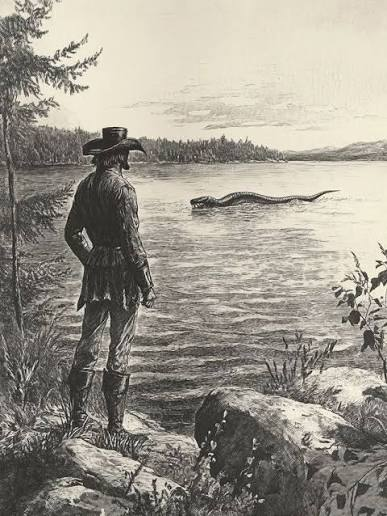
Champ is the name given to the alleged lake monster said to inhabit Lake Champlain, a 120-mile-long freshwater lake bordering Vermont, New York, and Quebec. Often compared to Scotland’s Loch Ness Monster, Champ has been part of regional folklore for centuries, blending early explorer accounts with modern eyewitness reports.
One of the earliest references dates to 1609, when French explorer Samuel de Champlain documented a large fish described by Indigenous people and possibly observed by himself. His writings mention a creature with a long body and formidable teeth. Historians generally believe he was describing native species such as sturgeon or gar, but the account later became folded into Champ lore.
Sightings increased in the 1800s as settlements grew around the lake. Newspapers occasionally reported strange serpentine forms surfacing or long, dark shapes moving beneath boats. Witness descriptions tend to follow a pattern: a creature between 15 and 30 feet long, dark in color, sometimes with humps breaking the surface and a narrow neck rising briefly above the water before disappearing.
The most famous modern “evidence” emerged in 1977, when Sandra Mansi photographed what appeared to be a dark object with a neck-like protrusion rising from the lake. The image gained national attention and was analyzed repeatedly. Decades later, skeptics suggested it was likely a floating log or partially submerged tree branch. No conclusive biological evidence has ever been produced.
Lake Champlain’s environment contributes to the mystery. The lake is deep—over 400 feet in places—with shifting currents, submerged logs, and changing light conditions. Large sturgeon, some exceeding six feet in length, inhabit the waters. Optical distortions, boat wakes, and temperature gradients can create convincing illusions, especially at a distance.
Despite the lack of physical proof, Champ remains culturally significant. Local businesses use the creature in branding, and some communities treat it as a playful regional mascot. In 1982, Champ was even granted symbolic protection by local lawmakers, partly to encourage tourism.
No verified specimen, clear video, or biological trace has confirmed Champ’s existence. Still, the legend persists, fueled by recurring eyewitness accounts and the human tendency to search dark water for something more.
Old sailor stories after often the most exaggerated