musicalphysics

joined 2 months ago
[–] musicalphysics@discuss.online 1 points 11 hours ago

It is in general possible to bridge between the two but requires custom and specific hardware.

[–] musicalphysics@discuss.online 1 points 14 hours ago (2 children)

We can’t hear the photonic guitar because the music it creates is in the form of light waves. In absolute frequency the waves are also pitched high compared to our audio range. In musical terms though they are the same pitches and octaves as produced by an acoustic instrument. We can’t see the photonic waves either as the frequencies are too low for that. Plus the visual range doesn’t even cover an octave. The timescales are also too short so there’s a variety of reasons.

The ADSR was my attempt to use a physical example to motivate why the timescales are shorter for the photonic guitar. The photonic guitar has plenty of sustain relative to the timescales that its physical size sets.

You can use dielectric type materials to vary the wave speed within the photonic guitar.

Strings are plucked using an electrical impulse. This sucker’s electrical.

In practice though the instrument is played by using math and guitar measurements.

Thanks for the questions.

[–] musicalphysics@discuss.online 2 points 16 hours ago (4 children)

Sure, I can try. Let’s back up a bit. First, I made the photonic guitar the same size and shape as an acoustic guitar so we’d get a similar physical response. While many resonance equations are typically written as a function of frequency it is really the size of the wave relative to the object that physically matters. Since the speed of light is roughly a million times faster than sound, the frequency range where light is the same size as the sounds we hear is a million times higher. 20 Hz - 20 kHz sound waves becomes 20 MHz - 20 GHz light waves.

The second part is the time response of a musical instrument can be described by ADSR, attack, decay, sustain, and release. Attack is the initial response of the instrument to a new note which then decays into the instruments sustained response as the note is held. Eventually the response ends, or releases. Suppose I measure an acoustic guitar’s ADSR at a particular frequency. While this would typically be expressed in time, it is physically more descriptive to express each portion of ADSR relative to the period, or the time for one cycle, of the test frequency.

We know acoustic guitars are good for music so a photonic guitar with the same ADSR as an acoustic would also be good for music. Let’s just consider one part, sustain. Suppose the sustain for an acoustic is 1000 periods at our test frequency. The photonic guitar equivalent wave at the same size has a frequency a million times higher, thus the time of a 1000 period sustain is a million times shorter. 1 second of music in our time is equivalent to 1 millionth of a second in photonic guitar music time.

[–] musicalphysics@discuss.online 0 points 17 hours ago* (last edited 14 hours ago)

Edit: double posted so adding more info. The guitar and bass are first recorded direct and clean, no effects. We take these clean signals and re-record with the plugin played through a fender amp. I use both an sm-57 and r121 in to a focusrite scatlett. Drums are software. A recording engineer does the mix and master.

[–] musicalphysics@discuss.online 2 points 19 hours ago (6 children)

Thanks! I’ve started with the plugin version of the photonic guitar as it provides the greatest flexibility for musicians and requires the least development resources. The instrument version itself is also a pursuit but there are challenges. First, we can’t directly hear the results. On top of that the instrument operates roughly a million times faster than an acoustic guitar. We just can’t play fast enough. It is possible to overcome the time difference and plug an electric guitar into a photonic guitar and play it that way but that requires some fancy equipment. The required fancy equipment needs to be designed and built first, but it is possible.

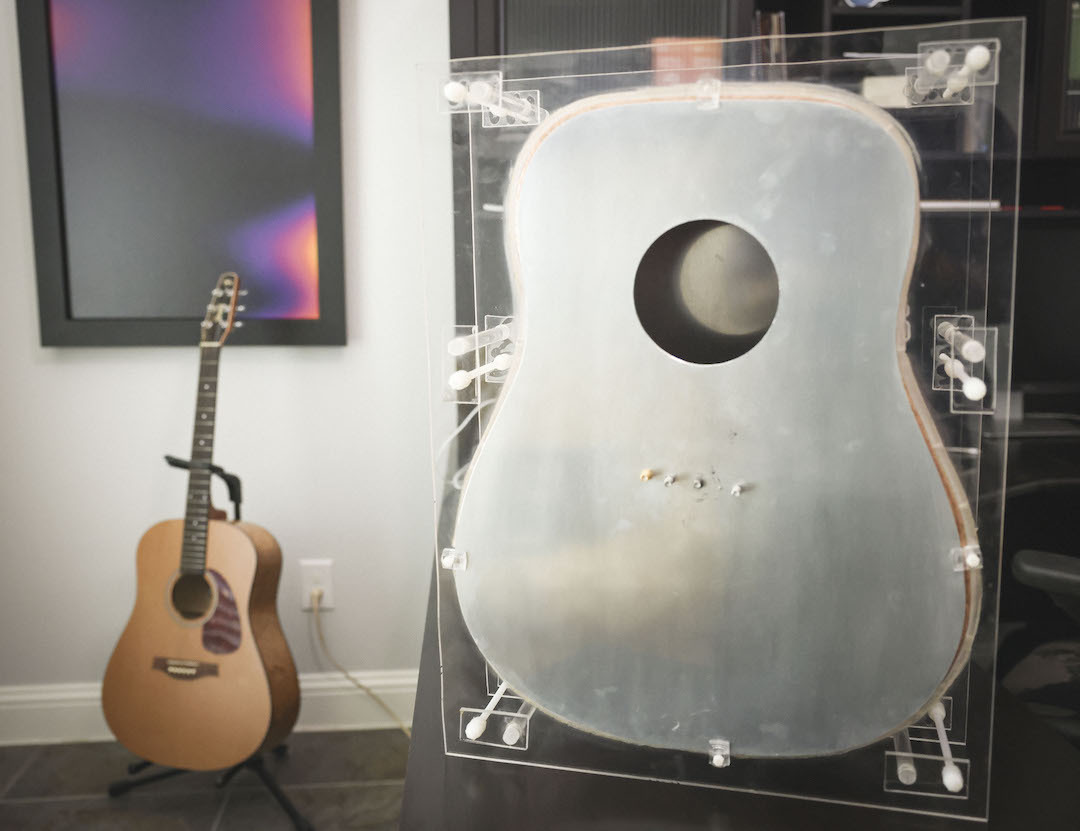
Naturally the photonic guitar uses coaxial cables for strings that resonate electrically based upon cable length. In principle we could build a guitar neck to physically play but that leaves the time difference and hearing issues.

Thanks for the question.


I created a new kind of guitar that y'all may be interested in. The photonic guitar uses the resonance of electricity and light to create music in the same way an acoustic guitar uses the resonance of vibration and acoustic waves. I started research on this instrument as a physics undergrad and focused on the topic for my Ph.D. After graduating, I spent time doing space science research for government agencies like NASA and the DoD. I quit being a professor a few years ago so I could resume research on my photonic guitar. We can't hear this instrument directly, for a variety of reasons, so I've created a plugin that utilizes measurements of these instruments to recreate their musical output as an effect for electric guitars. While the photonic guitar shares the same kind of physical foundation as an acoustic guitar, the photonic guitar is capable of a broader array of musical effects. I've linked to a demo of an electric guitar, played through the photonic guitar plugin, and connected to the drive channel on a fender amp. The photonic guitar pushes the existing distortion into a new regime. https://cosmicstudio.io/wp-content/uploads/2026/02/Demo-2-Master_1.mp3
Fallon is a traitor that lacks anything resembling decency or standards. Nobody should listen to him on any topic.

I don’t see how a RYGB monitor is bad news.

How does one objectively measure color?

If color is in light then why do people see yellow from an RGB monitor when no yellow light is present? If color is a physical property of light how do we see color? Do the chemicals in our cones see/respond to color? How? How is color detected by chemicals in our eye transmitted to the brain? Does electricity also support color? If so, how?

I’m a physicist and no, color is not a physical property of light. Color is a subjective experience created by our mind in response to electrical signals from our eyes.

[–] musicalphysics@discuss.online 1 points 6 days ago (2 children)

The color yellow subjectively exists. Like I said at the beginning, color is a product of the mind. Objectively, as in is it directly measurable, light has no color. Physics deals with objective measurements.

[–] musicalphysics@discuss.online 1 points 6 days ago (4 children)

You can call it whatever you want but color isn’t a physical property of light. It is a construction of the mind. You claim a certain wavelength is yellow. A computer display can show a combination of red and green pixels that we perceive to be the same shade of yellow even though the original yellow wavelength isn’t present at all. Color isn’t from the light itself but from our mind.

view more: next ›