I'm not sure, but if cake is being served, count me in.
dgriffith
joined 2 years ago
I take umbrage at item 4, but I don't have the time for the correct kind of reply.
If you could go to chatgpt and put in this prompt for me and then read the result, that'd be great.
"Please make a long, meandering reply to the assertion that Nic Cage should not be in movies, stating that Nic Cage is perfect for those movies that need that Nic Cage energy."
Yeah that's just the norm in Australia for nearly every year as almost the whole country experiences just two seasons - "wet" or "dry".
P.S. sorry about giving you the idea to plant all those eucalypts over there during the gold rush, that was a bit of a mistake.
How are these any worse than the MAMILs?
Let's see, they are:
-
Generally faster and more unpredictable.
-
Heavier, compared to MAMILs endless quest to have the lightest rig possible to get that PB time to work. So when they hit a pedestrian, they hit hard.
-
Driven by kids without a fully formed concept of risk and consequence.
-
Who are not wearing hi-vis lycra and safety gear.
So overall, I'd prefer middle aged men in lycra.
Don't worry, general physics means that this is just another investment scam.
I'll explain it out so you can get the general idea;
In order to reflect a sun's worth of sunlight, you need a reflective surface in low earth orbit that is somewhat larger than the angular size of the sun from our perspective on the ground. Imagine just using an ordinary mirror at home, you need to see the whole of the sun in it, and that works out to be about a little mirror about the size of your thumb at arm's length. In low earth orbit that mirror ends up being about 2km across.
To get that kind of reflective surface area in orbit you need about a couple of thousand 50 metre wide reflectors on satellites, just to reflect light to a single location with the rough equivalent of sunlight.
And then at the height of low earth orbit the earth eclipses the sun for quite a bit of time, so the sats that can see the sun during the night below on Earth are actually only able to do so for a couple of hours before sunrise or after sunset. So now you need to launch 10x more sats so that the sats that can see the sun can reflect light to where you want it.
So let's just say 20,000 sats to start with.
With some clever engineering, you could probably make them the same size as SpaceX sats, and they launch about 25 at a time for a customer cost of about 70 million USD.
My calculator says that the launch cost for this is 56 billion USD. And then sats in that orbit with huge, high drag panels will get pulled into the Earth's atmosphere after about 5 years, so you just need 56 billion up front plus about 10 billion a year to maintain the constellation, forever, and with all of that stuff flying around up there you can direct 1 suns worth of solar energy to 1 location.
Now you could take that array and split it up and provide, maybe a moonlight effect to a hundred places, and maybe, maybe, a hundred someones might pay the hundred million a year to feebly light their city streets or something. Seems a bit of an ask when there's plenty of ways already to turn night into day locally for a lot cheaper.
BUT - you could also repurpose those 20,000 sats to provide a dozen sun's worth of energy to any point on earth during the day when about half of them can easily see the sun.
This sure sounds like a practical equivalent of a death ray to me, which means all this bullshit will never get anywhere because no country in the world will allow anyone to build it.
So rest easy, this is just another way to scam venture capitalists and won't go much further than these press releases.
No no, the article clearly states that locals are INFURIATED, all of them. There's no mild annoyance or irritation, it's fury or nothing these days I'm afraid, that's just how it is.
Flying toasters need to make a comeback I reckon.
Lithium ion batteries have a sweet spot of around 60 to 80 percent charge where very little wear takes place to charge or discharge. If you could keep it to just that 20-30 percent usage in that range it would pretty much last ten thousand cycles.
Charging to 100 or discharging below 50-60 percent accelerates the wear on the battery, but it is still much better than the wear rate on lead acid batteries that are cycled in a similar manner.
The picture you offer for comparison is literally a truck load of batteries though. Seeing that an EV's battery typically fits under the floor pan of the car, are we talking like, the equivalent of 10 cars worth of batteries in that pic?
But once the interior of a car catches fire from whatever starting source the pictures all look pretty much the same as they're all filled with lovely hydrocarbon-based plastics that all burn in the same manner.
Kyle and Jackie O’s controversial breakfast radio show taken off air after hosts fall out
And nothing of value was lost.
I'm sure we did a cycle of network booting thin clients and windows terminal services about 10 or 15 years ago. 🤔
Hi all,
In an effort to liven up this community, I'll post this project I'm working on.
I'm building a solar hot water controller for my house. The collector is on the roof of a three-storey building, it is linked to a storage tank on the ground floor. A circulating pump passes water from the tank to the collectors and back again when a temperature sensor on the outlet of the collector registers a warm enough temperature.
The current controller does not understand that there is 15 metres of copper piping to pump water through and cycles the circulating pump in short bursts, resulting in the hot water at the collector cooling considerably by the time it reaches the tank (even though the pipes are insulated). The goal of my project is to read the sensor and drive the pump in a way to minimise these heat losses. Basically instead of trying to maintain a consistent collector output temp with slow constant pulsed operation of the pump, I'll first try pumping the entire volume of moderately hot water from the top half of the collector in one go back to the tank and then waiting until the temperature rises again.
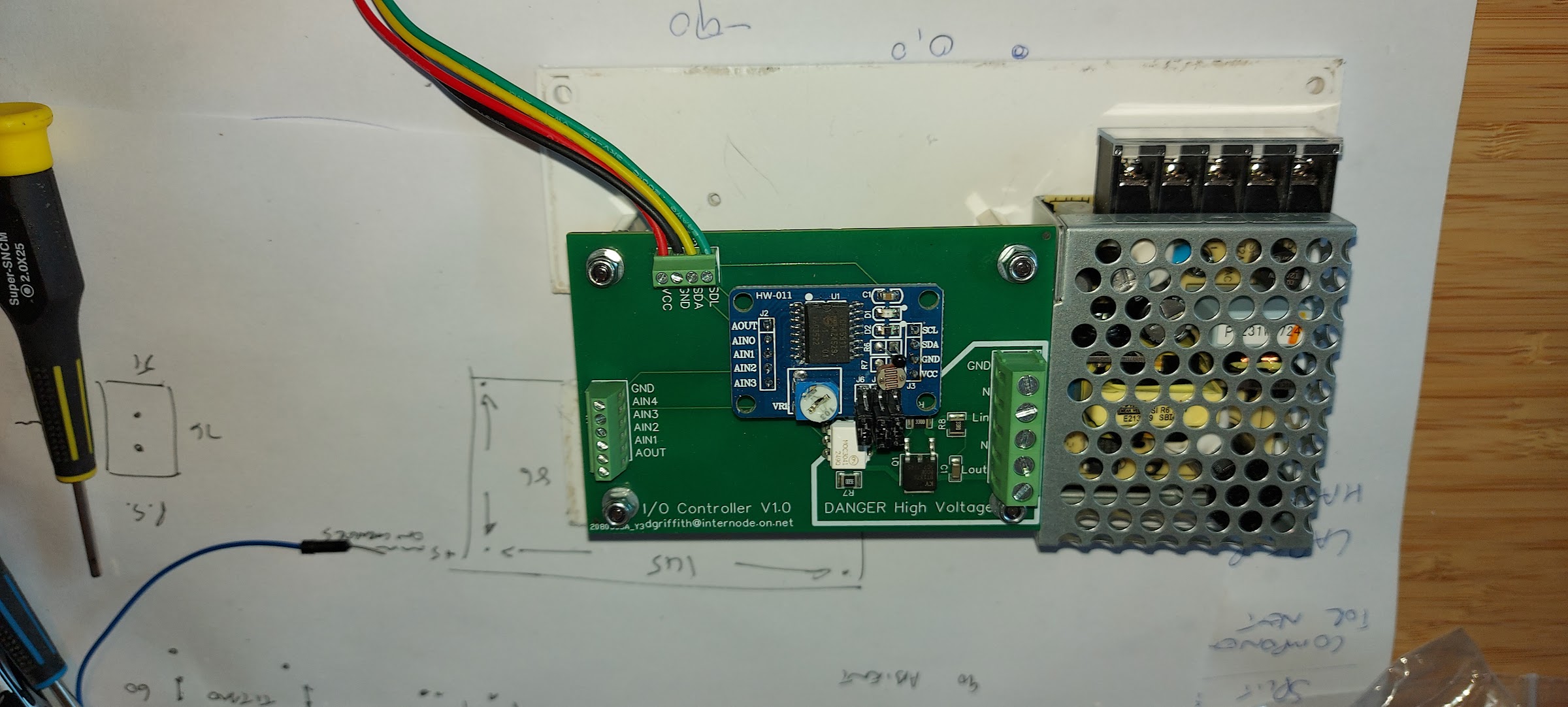
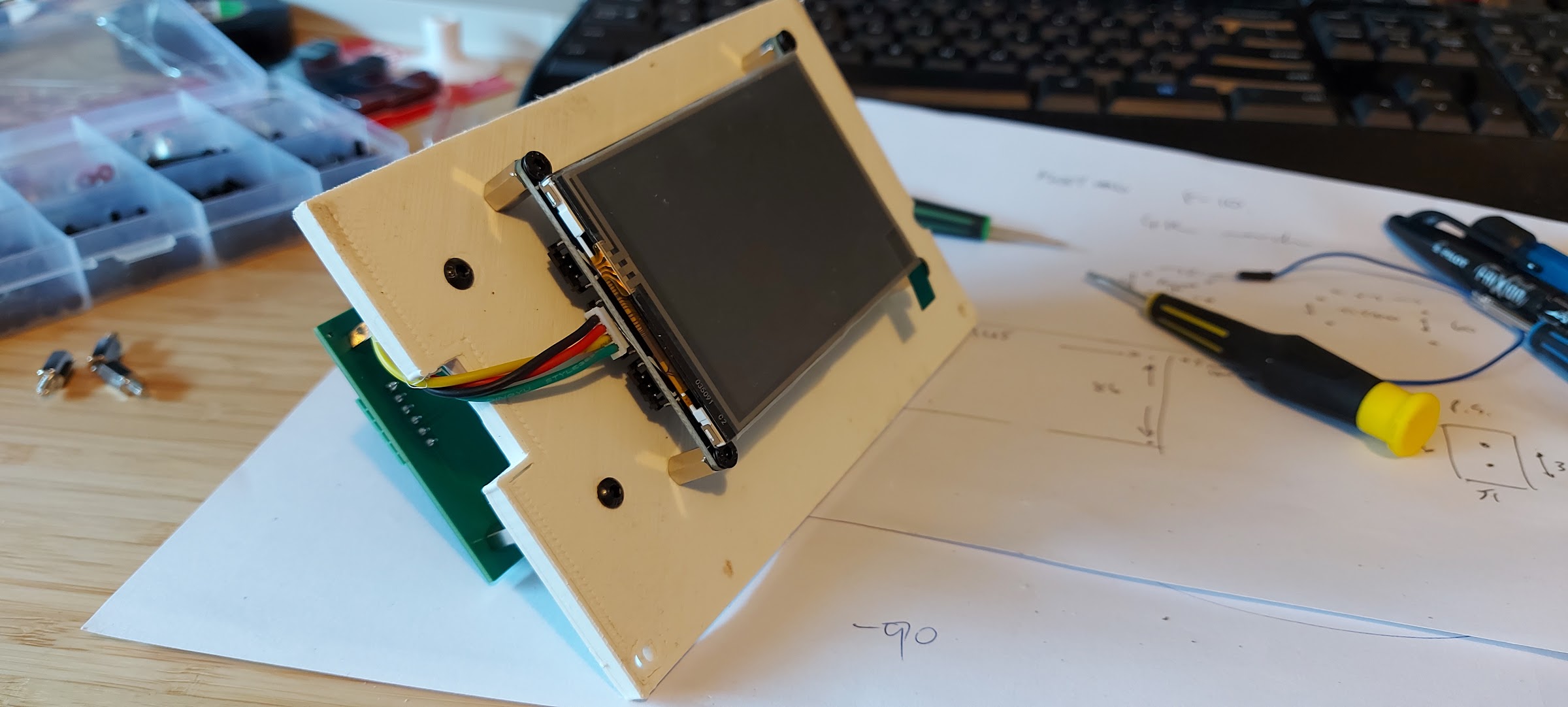
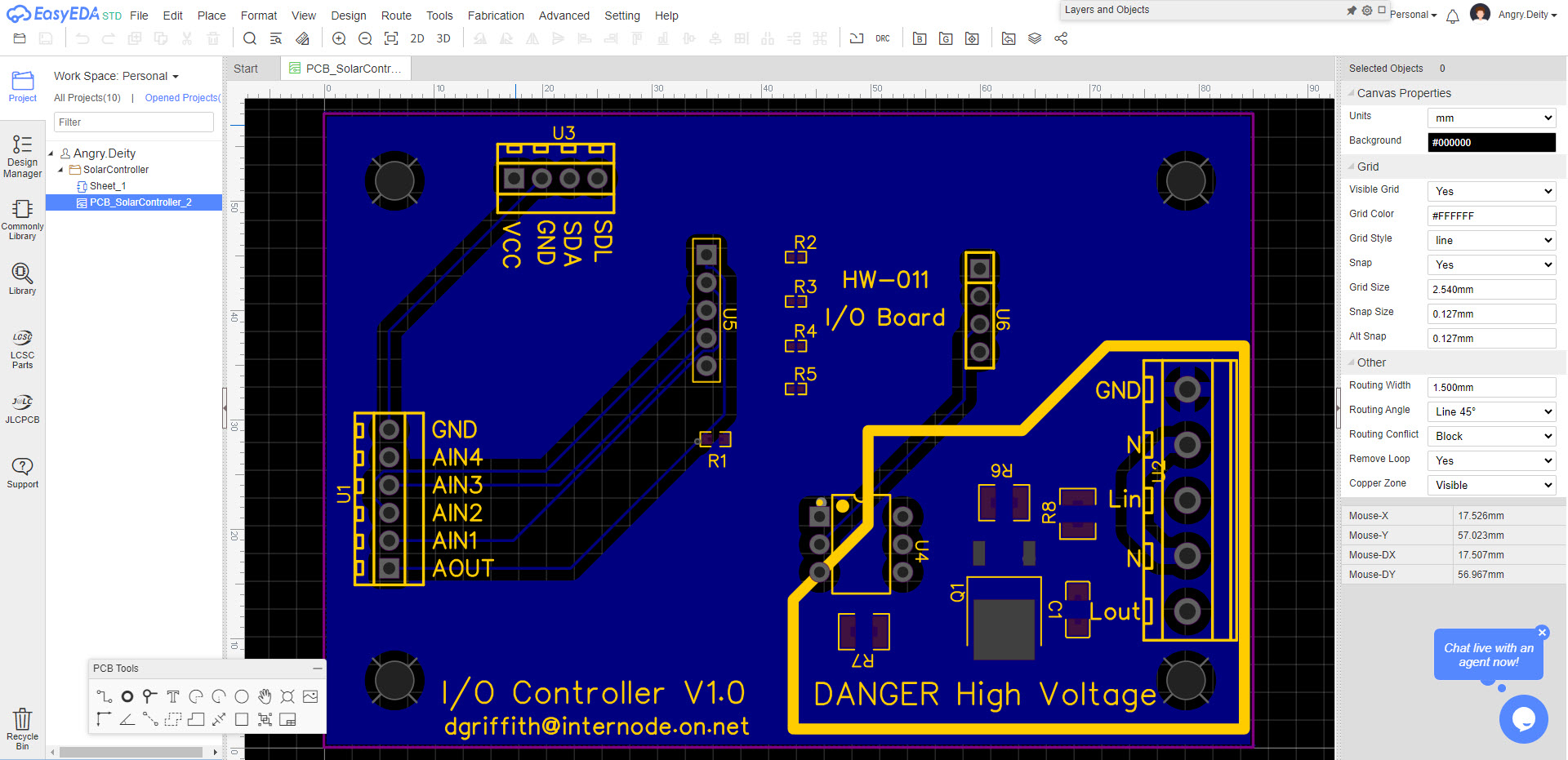
I am using an Adafruit PyPortal Titano as the controller, running circuitpython. For I/O I am using a generic ebay PCF8591 board, which provides 4 analog input and a single analog output over an I2C bus. This is inserted into a motherboard that provides pullup resistors for the analog inputs and an optocoupled zero crossing SCR driver + SCR to drive the (thankfully low power) circulating pump. Board design is my own, design is rather critical as mains supply in my country is 240V.
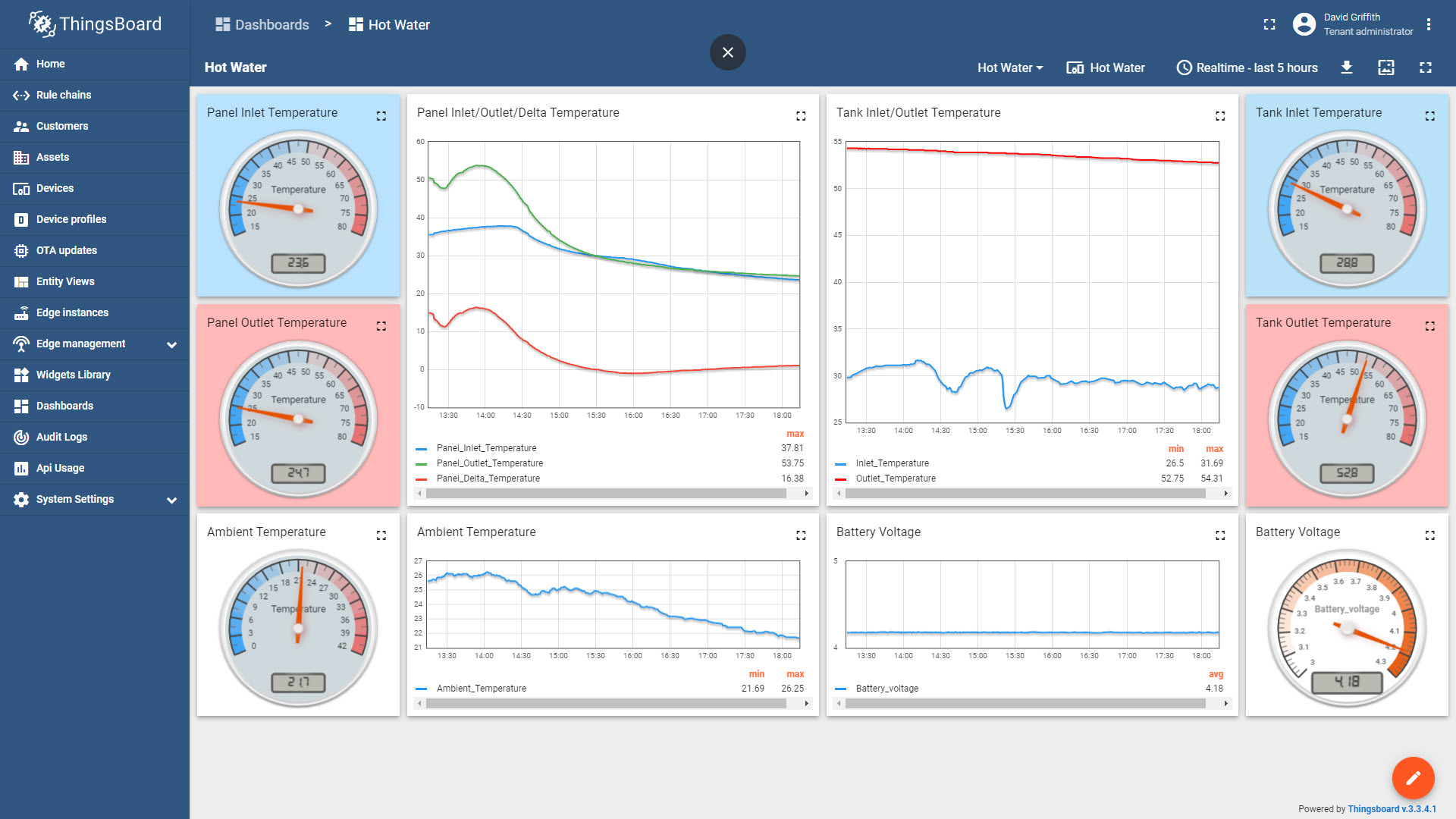
The original sensors are simple NTC thermistors, one at the bottom of the tank, and one at the top of the collector. I have also added 4 other Dallas 1-wire sensors to measure temperatures at the top of tank, ambient, tank inlet and collector pump inlet which is 1/3rd of the way up the tank. I have a duplicate of the onewire sensors already on the hot water tank using a different adafruit board and circuitpython. Their readings are currently uploaded to my own IOT server and I can plot the current system's performance, and I intend to do the same thing with this board.
The current performance is fairly dismal, a very small bump of perhaps 0.5 - 1 deg C in the normally 55 degree C tank temperature around 12pm to 1pm, and this is in Australia in hot spring weather of 28-32 degrees C.(There's some inaccuracy of the tank temperatures, the sensors aren't really bonded to the tank in any meaningful way, so tank temp is probably a little warmer than this. But I'm looking for relative temperature increases anyway)
Right now , the hardware is all together and functional, and is driving a 13W LED downlight as a test, and I can read the onewire temp sensors, read an analog voltage on the PCF8591 board (which will go to the NTC sensors), and I'm pulsing the pump output proportionally from 0-100 percent drive on a 30 second duty cycle, so that a pump drive function can simply say "run the pump at 70 percent" and you'll get 21 seconds on, 9 seconds off. Duty cycle time is adjustable, so I might lower it a bit to 15 or 10 seconds.
The next step is to try it on the circulating pump (which is quite an inductive load, even if it is only 20 watts), and start working on an algorithm that reads the sensors and maximises water temperature back to the tank. There are a few safety features that I'll put in there, such as a "fault mode" to drive the pump at a fixed rate if there is a sensor failure, and a "night cool" mode if the hot water tank is severely over temperature to circulate hot water to the collector at night to cool it. There are the usual overtemp/overpressure relief valves in the system already.
All this is going in a case with a clear hinged cover on the front so I can open it and poke the Titano's touchscreen to do some things.
Right now I am away from home from work, so my replies might be a bit sporadic, but I'll try to get back to any questions soon-ish.
A few photos for your viewing pleasure:
The I/O and mainboard plus a 5V power supply mounted up:
The front of the panel, showing the Pyportal:
Thingsboard display showing readings from the current system:
Mainboard PCB design and construction via EasyEDA:

view more: next ›
If it's classed as a "major" fault that essentially renders it unusable, the customer gets to choose the remedy, not the retailer.
This is usually so the customer can get their money back for a shit product, but there's nothing stopping them from a replacement.
Umart's claim that it's "an upgrade" doesn't hold much weight. If you buy X gigabytes of ram and it fails and you want a replacement with the same X gigabytes of ram, that's not an upgrade. It's restoring the status quo of the original purchase where they got a physical quantity of a product.