A dark and troubled past.
bytejunk
joined 1 month ago
Here's a few of the common ones. I would note that this isn't any sort of gospel - it depends a lot on the maestro, and on the piece itself.
For a fast waltz, for example, it's very likely that the conductor will only signal the "downbeat" (ictus) and be much more... subjective withe the rest of the motion, and allow some freedom instead of keeping some robotic tempo that could sound forced and boring, it's really a very dynamic form of communication.
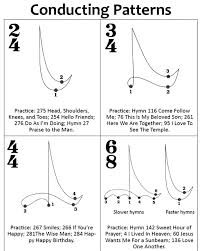 If there's some big crescendo for example, maybe he won't even signal the tempo and instead use both hands to control intensely, the energy, of that segment, and prepare a monstrous downbeat when it reaches the climax.
I know little about conducting, but it's fascinating.
I don't know that anyone can bring back the part of you that's missing.
Jesus is just one of the public appearances of the Emperor of Mankind.
Actually, you can always nitpick some more.
Correct reading as to "legal orders": the oath itself, while binding to the president's orders, does not make it unconditional: it explicitly subjects that binding to a limit: "according to regulations and the Uniform Code of Military Justice".
This means that enlisted personnel have the right, and in fact, the obligation, to refuse following unlawful orders.
Rotund Shadys can't stand up.
Whoop whoop carburetor gang rise UP!
You really shouldn't be asking a witch that...
Oh my, that diction of yours...
The Bible has used the same structure as Tolkien.
It starts off with the Gospel/early testimonies:
- The Hobbit, or There and Back Again
Then the New Testament proper:
- The Fellowship of the Ring
- The Two Towers
- The Return of the King
It then contains the "Old Testament", that fleshes out much of the older lore in the World. These writings are less firmly established, but are widely considered to include:
- The Silmarillion
- Unfinished Tales of Numenor and Middle-earth
- The Children of Húrin
Then you have books of Psalms, like The Adventures of Tom Bombadil and other stories.
Let's not forget the Epistles, the letters of the apostles, compiled under:
The Letters of J.R.R. Tolkien
view more: next ›
No, Richard, it's 'Linux', not 'GNU/Linux'. The most important contributions that the FSF made to Linux were the creation of the GPL and the GCC compiler. Those are fine and inspired products. GCC is a monumental achievement and has earned you, RMS, and the Free Software Foundation countless kudos and much appreciation.
Following are some reasons for you to mull over, including some already answered in your FAQ.
One guy, Linus Torvalds, used GCC to make his operating system (yes, Linux is an OS -- more on this later). He named it 'Linux' with a little help from his friends. Why doesn't he call it GNU/Linux? Because he wrote it, with more help from his friends, not you. You named your stuff, I named my stuff -- including the software I wrote using GCC -- and Linus named his stuff. The proper name is Linux because Linus Torvalds says so. Linus has spoken. Accept his authority. To do otherwise is to become a nag. You don't want to be known as a nag, do you?
(An operating system) != (a distribution). Linux is an operating system. By my definition, an operating system is that software which provides and limits access to hardware resources on a computer. That definition applies whereever you see Linux in use. However, Linux is usually distributed with a collection of utilities and applications to make it easily configurable as a desktop system, a server, a development box, or a graphics workstation, or whatever the user needs. In such a configuration, we have a Linux (based) distribution. Therein lies your strongest argument for the unwieldy title 'GNU/Linux' (when said bundled software is largely from the FSF). Go bug the distribution makers on that one. Take your beef to Red Hat, Mandrake, and Slackware. At least there you have an argument. Linux alone is an operating system that can be used in various applications without any GNU software whatsoever. Embedded applications come to mind as an obvious example.
Next, even if we limit the GNU/Linux title to the GNU-based Linux distributions, we run into another obvious problem. XFree86 may well be more important to a particular Linux installation than the sum of all the GNU contributions. More properly, shouldn't the distribution be called XFree86/Linux? Or, at a minimum, XFree86/GNU/Linux? Of course, it would be rather arbitrary to draw the line there when many other fine contributions go unlisted. Yes, I know you've heard this one before. Get used to it. You'll keep hearing it until you can cleanly counter it.
You seem to like the lines-of-code metric. There are many lines of GNU code in a typical Linux distribution. You seem to suggest that (more LOC) == (more important). However, I submit to you that raw LOC numbers do not directly correlate with importance. I would suggest that clock cycles spent on code is a better metric. For example, if my system spends 90% of its time executing XFree86 code, XFree86 is probably the single most important collection of code on my system. Even if I loaded ten times as many lines of useless bloatware on my system and I never excuted that bloatware, it certainly isn't more important code than XFree86. Obviously, this metric isn't perfect either, but LOC really, really sucks. Please refrain from using it ever again in supporting any argument.
Last, I'd like to point out that we Linux and GNU users shouldn't be fighting among ourselves over naming other people's software. But what the heck, I'm in a bad mood now. I think I'm feeling sufficiently obnoxious to make the point that GCC is so very famous and, yes, so very useful only because Linux was developed. In a show of proper respect and gratitude, shouldn't you and everyone refer to GCC as 'the Linux compiler'? Or at least, 'Linux GCC'? Seriously, where would your masterpiece be without Linux? Languishing with the HURD?
If there is a moral buried in this rant, maybe it is this:
Be grateful for your abilities and your incredible success and your considerable fame. Continue to use that success and fame for good, not evil. Also, be especially grateful for Linux' huge contribution to that success. You, RMS, the Free Software Foundation, and GNU software have reached their current high profiles largely on the back of Linux. You have changed the world. Now, go forth and don't be a nag.
Thanks for listening.