atomicpoet

joined 2 years ago
MODERATOR OF
[–] atomicpoet@piefed.social -2 points 11 months ago (1 children)

I’ve never once heard “bro” used in a genuinely positive way. Not once.

At best it’s fake-jovial. At worst it’s a way to diminish, antagonize, or mask hostility.

Case in point: this very thread. People kept saying “bro” not out of warmth, but because they thought it would piss me off. That’s not camaraderie—that’s toxicity.

And no, “bro” is not the same as “mate.” “Mate” might be regional slang. “Bro” is gendered. Which means it’s exclusionary by default. It assumes something about the person you’re talking to that may not be true. That’s not inclusion. That’s presumption.

So unless someone is your literal brother, why keep it around? If a word carries a whole lot of negatives and almost no positives, why pretend it’s harmless? Better yet—why does your urge to use a toxic word override my goal of building an inclusive community? Would you defend other toxic words the same way—words with even sharper malice baked in?

And if you would, then maybe the problem isn’t me banning “bro.” Maybe the problem is what you’re really defending.

[–] atomicpoet@piefed.social -1 points 11 months ago (1 children)

You’re framing visibility as if it’s accountability.

But mods aren’t accountable to users—they’re accountable to admins. If a mod aligns with an admin, users can scream all they want, nothing changes. If a mod sides with the community but not the admin, the admin overrules both. That’s hierarchy, full stop.

Let’s be real. The whole conceit of YPTB is a farce. You’re not “holding mods accountable.” You’re doing populism dressed up as anarchism, aligning with admin tastes when it suits.

Out of all the possible people in the community, it just so happens that the true authorities—the ones setting the norms and nurturing the culture—are the same ones holding the keys to the entire server. And those are the very people wielding YPTB as a cudgel in the name of “accountability.” That’s not accountability. That’s a closed loop.

If lemmy.dbzer0.com were serious about anarchism, the admins would say: “No mods, no users, no hierarchy—everyone go operate their own nodes.” But they don’t. Instead, this community exists under the admin’s keys, which feeds an illusion.

And that “visibility” you’re pointing to? It’s not accountability—it’s branding. Admin branding. It only exists because lemmy.dbzer0.com allows it to exist, and only as long as the server remains federated. Flip that switch and your visibility, your supposed accountability, evaporates overnight.

[–] atomicpoet@piefed.social 2 points 11 months ago

Got it. So it's less confusing to users who don't know what an FE or BE are, but it's more confusing for new admins who do.

"Instead of running Soapbox on Soapbox, I'll run Fedibird on Soapbox. Scratch that. I'll run vanilla Pleroma with Soapbox instead of Soapbox."

[–] atomicpoet@piefed.social 0 points 11 months ago (3 children)

Fair enough—I probably came in sharper than I needed to. I get that you’re not denying the power imbalance, just framing it differently.

We’re closer in view than it might have sounded. My aim wasn’t to dunk on you, just to stress that these structures aren’t neutral. If we’re both pointing in the same direction, then good—that’s where the real work begins.

[–] atomicpoet@piefed.social 1 points 11 months ago (2 children)

Can you tell me a little bit more about how Soapbox FE and Soapbox BE differ? I'm out of the loop on that one.

[–] atomicpoet@piefed.social 0 points 11 months ago (5 children)

Space isn’t “just a space.” Space is what makes words accessible. A post that nobody can reach might as well not exist. Infrastructure isn’t neutral—it’s the condition that makes communication possible in the first place.

And admins don’t just have the power to end a space. They have the power to prevent speech from ever happening. They can de-platform, silence, or exclude before words are written. That’s not trivial. That’s systemic control over what gets created, not just what gets erased.

And sometimes communities really are families—both literal and ad hoc. People pour years of energy, conversation, and memory into them. When they get obliterated, it’s not “just a space” disappearing—it’s a shared history wiped out because one person with keys decided it was over.

What makes your comment even more striking is that it contradicts your earlier points. First you downplayed hierarchy by saying admins are just neutral facilitators, now you admit they hold systemic power but dismiss it as “no big deal.” Which one is it?

That’s the imbalance I’m pointing at. If we want real commons, that has to change. Otherwise we’re all just tenants, and the landlord can decide at any moment to bulldoze the building. Dismissing that as unimportant is exactly how these power structures stay invisible.

[–] atomicpoet@piefed.social -1 points 11 months ago (1 children)

I’m not arguing for extremes at all.

On one side you’ve got pure authoritarianism—admins as unchecked rulers. On the other side you’ve got utopian anarchy—peers moderating themselves with no hierarchy. I’m not in either camp.

What I’m pointing out is the middle: these platforms are hierarchical by design. That means admins do hold systemic power, but it also means admins have responsibility for how that power is exercised. My stance is simply to acknowledge that reality instead of pretending hierarchy doesn’t exist.

Selective federation is part of that. It’s not about isolation or domination—it’s about setting clear boundaries for what I’m willing to host and connect with, while still participating in the broader network. Users still have choices. They can join another server or start their own. That’s federation working as intended.

So this isn’t an extreme position. It’s the pragmatic one: take responsibility for the space you run, be upfront about the structure, and don’t pretend current software is something it isn’t.

[–] atomicpoet@piefed.social 5 points 11 months ago* (last edited 11 months ago) (4 children)

Just want to point out that I use Mangane, which is a fork of Soapbox, on my Akkoma server---and it absolutely connects to Lemmy.

From what I understand, Soapbox is just a front-end. The backend is Pleroma/Akkoma.

And by the way, one of the great aspects of the *oma services is that the frontends can be swapped out.

[–] atomicpoet@piefed.social 0 points 11 months ago (7 children)

The feast metaphor doesn’t hold. If I pay for a banquet hall, the guests can mingle—but they don’t control the locks on the doors, the electricity, or whether the venue even stays open tomorrow. If I decide to shut the place down, the party ends whether they like it or not. That’s not neutral infrastructure. That’s systemic power.

I’m not saying the admin “owns” people’s words. Users own what they write. But whether that writing continues to exist, whether it stays visible, whether it can even be reached—those are all contingent on the admin. Content lives inside infrastructure, and whoever holds the keys controls the environment where it persists.

And people absolutely are confused about this. Look at lemm.ee: did the community want to vanish overnight? No—but the admin pulled the plug, and everything disappeared. The same happens on Reddit when admins close subreddits, or on Discord when a server gets nuked. People routinely find themselves blindsided because they mistake participation for ownership.

That’s the point I’m pressing: software that demands admins and mods creates hierarchy, no matter what ideals we wrap around it. If we want a true commons, the architecture has to change—there can’t be “users,” only peers, each running their own node. Until then, pretending otherwise is just comforting metaphor.

[–] atomicpoet@piefed.social 2 points 11 months ago (3 children)

I get what you’re saying, and I even sympathize with it. I would love a true public square owned by the commons—something where people’s conversations aren’t at the mercy of whoever happens to run the machine.

But that’s not how Lemmy, Mastodon, Misskey, or any of the current platforms work. These systems are hierarchical by design. They require admins, they require mods, and everyone else becomes “users.” That’s not a public square, that’s tenancy.

Even donations don’t change that. If the admin holds the keys, they hold the power. Look at lemm.ee—did the community there want to be wiped out overnight? Of course not. But the admin pulled the plug, and that was the end of it. That’s the architecture working as designed.

If we really want a public square, then we have to stop talking about “users.” There should only be peers. And that means each person owning their own node, not donating their content to someone else’s server and hoping they’ll be benevolent forever.

That’s the uncomfortable truth: until the design itself changes, we don’t have commons. We have hierarchies dressed up in populist rhetoric, and every user is just one admin’s decision away from disappearing.

[–] atomicpoet@piefed.social 0 points 11 months ago (9 children)

The problem with your framing is that it treats software as neutral when it isn’t.

Social media software encodes structure into how communities are organized. If the software is hierarchical, the community will be hierarchical. There’s no way around that unless everyone literally operates their own nodes.

And that’s where the real vulnerability lies. If you don’t run your own server, you’re not sovereign. You’re donating your content to someone else’s machine and trusting that their standards, moderation, and moods won’t turn against you. Ideals won’t protect you if the design itself makes you dependent.

If you really care about a sense of ownership, then you should be running your own server. That’s what freedom of association actually means. It isn’t allegiance. Allegiance locks you in. Association multiplies your choices—pick a server that matches your values, or start your own. That’s the entire point of federation.

So let’s not pretend mass platforms or wide-open instances are some higher form of democracy. They aren’t. They’re just populism sitting on top of hierarchy. The lowest common denominator gets to shout “this is the people,” while the actual levers of control stay exactly where they’ve always been—with whoever holds the keys.

[–] atomicpoet@piefed.social 1 points 11 months ago (5 children)

Yeah, I get why the word “own” makes people uneasy. There’s a sincere belief that communities should belong to the commons—that no one should control the space, that it should be shared, stewarded, collective.

I sympathize with that. I really do.

But that’s not how the software works.

Lemmy isn’t structured like a commons. Neither is Mastodon. Neither is most federated software. These platforms still rely on admins, moderators, and users. There are hierarchies, permissions, access levels. Someone has root. Someone pays the bills. Someone can click “ban.”

If you’re building a community on someone else’s server, you are doing so inside their infrastructure. And under the law, they are the legal operator and data controller. That gives them full authority—technical and legal—over the domain, the storage, the moderation tools, and the continued existence of what you built.

So yes—everything you post on Reddit, Facebook, or Twitter lives behind walls. Even if you retain copyright, you’ve handed over a perpetual license to do whatever they want with it. They own the platform. They control the archive. You’re not publishing. You’re donating.

The Fediverse is better—but let’s not pretend it’s structurally different. If you build something inside someone else’s instance, they own the keys. If they kick you out, it’s gone. That’s not a glitch. That’s the model.

If you truly want a commons—a system with no admins, no mods, no hierarchy—you need to build software that works that way. But that’s not Lemmy. Not Mastodon. Not Misskey. Not PeerTube.

In this system, the only real recourse is to run your own server. That’s where your power begins. That’s where your autonomy lives.

And that’s why I say: I want to own my community.

Because if I don’t, someone else will. And I’ve seen what happens when they do.


After a week of building and curating !videogames@piefed.social, the community already has 58 subscribers—and it’s only getting started.

I’ve been thinking hard about the kind of place I want this to be. The vision comes down to three things:

  1. Real conversations about games
  2. Minimal memes
  3. Zero outrage culture

I want this community to be about joy—a space for people who actually play video games to share what excites them. Not a dumping ground for culture wars. Not another echo chamber for Gamergate-era nonsense.

Games are for everyone. And everyone should feel comfortable digging deep here. Talk about an obscure Japanese console. Explore weird European PCs. Or break down the craft behind how a game actually got made. That’s the stuff I want to see flourish.

Here’s to the next 100 posts—and beyond. Come join in:

https://piefed.social/c/videogames


When I was 10 years old, a friend and I went into the forest and started digging.

Now, the exact reason why we were digging escapes me. But we often did a lot of digging. Kids—particularly boys—like to dig. It's just fun. Started with sandboxes. But we decided to move further afield. And there we were with our big shovels, just digging a hole.

Four feet in, we found something.

A shoe.

One with a bright red high heel, to be exact. A pointy heel.

And when we saw it, both my friend and I looked each other in the eye, dropped our shovels, and ran home in a panic. We had a distinct fear—that if we kept on digging, we'd find something grisly. Something macabre.

Now that I’m older, I laugh. Because the reality is: if we’d kept digging, maybe we would’ve found nothing. Or maybe we would’ve found another shoe. Perhaps the pair. Perhaps a different shoe entirely. Beats me.

But there was just something about that shoe—cartoonishly red—that created in us a sense of panic. We never went back to that spot in the forest.

My parents got really angry at me. Because I lost a shovel.

When I first played Oozi: Earth Adventure on PC, it was like uncovering something buried. And bright.

To give you context, I gotta tell you a little bit about what Oozi is.

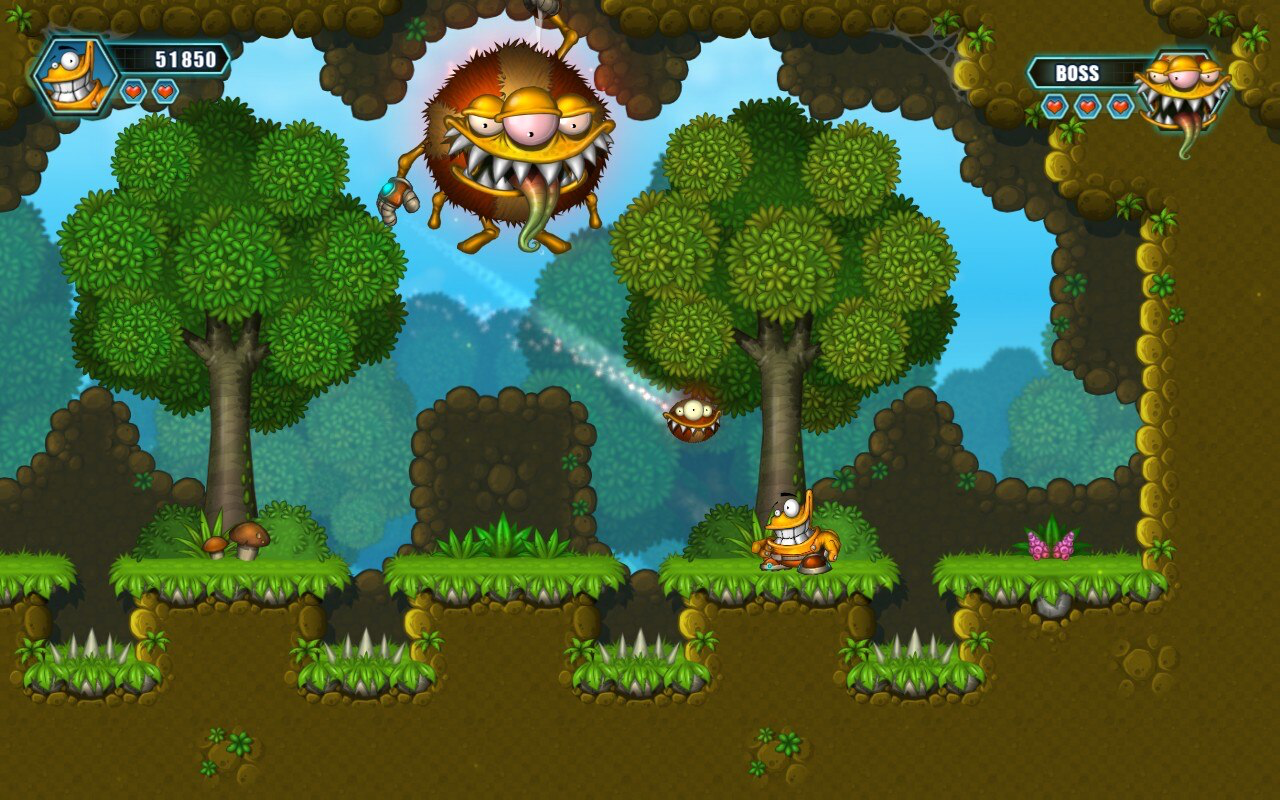
So, Oozi is a 2D platformer about a fun little alien guy who crash-lands on Earth. He has to recover his space suit, spaceship, and dignity. Along the way, he encounters numerous creatures—all of which want to kill him. You hop through each level from A to B, gradually progressing. There are four worlds, each with a distinct theme, a variety of enemies, and boss fights.

Okay—so far, this seems par for the course.

But once you dig further into what Oozi is, it uncovers something bright and distinct. Something I’ve known about for decades but couldn’t exactly put into words. Something familiar. But I haven’t been able to articulate it—until now.

I’m talking about the Euro platformer.

Now, what is a Euro platformer? Well, obviously—it’s a platformer game. But it’s distinct. For cultural reasons, platformers developed in Europe diverged from the ones made in Japan and North America.

Euro platformers tend to be extremely colourful—almost surreal. Punishing in their difficulty. And if you’ve seen a Euro platformer, you know exactly what I’m talking about.

I mean games like Rayman, James Pond, Zool, Rick Dangerous, Dizzy, and Mayhem in Monsterland.

Actually, before I go further—let me talk about the mechanics that make Euro platformers different.

They often have floaty jumping physics. Specific tropes—like dripping water from ceilings that can kill you. Europeans, for whatever reason, really loved that trope. And they often pushed the puzzle aspect of platforming into the foreground.

I first encountered Euro platformers on my Commodore 64—which makes sense, because the C64 was huge in Europe. Probably bigger than in North America. Which is impressive, because here in Canada, the C64 was pretty popular too. That was my main gaming platform instead of an NES. And because it was so popular in Europe, I’d often find Euro platformers—sometimes pirated on floppy disks if they weren’t available in stores.

The first Euro platformer to really make an impression on me was the Dizzy games. Funny enough, you play an egg. Not an animal—an egg. Like I said, those Europeans loved their surrealism.

Later, I moved onto something more fantasy-themed: Stormlord. To this day, I think that game is a hidden gem. People don’t talk about it enough.

Then, when I got myself a 16-bit console, I got exposure to even more Euro platformers. Again—we didn’t call them that back then. They were just platformers. But I distinctly remember going to Blockbuster and renting Euro platformers like James Pond, Chuck Rock, and Zool.

Risky Woods is kind of a deep cut—probably because it was made in Spain—but that one’s definitely worth playing.

By the mid-90s, you could argue that Euro platformers were the best platformers.

Donkey Kong Country, made by Rare in the UK, might be the best Euro platformer of all time. Others might argue for Rayman, made by Ubisoft in France. Both those games have the hallmarks of the Euro platformer: overwhelmingly cheerful and bright, a touch of surrealism, and a real degree of difficulty. Their shiny, colourful exteriors masked real trial and tribulation.

As the '90s went on, the Euro platformer—like all platformers—went 3D. Rayman 2, Kao the Kangaroo… and most notably, Croc.

Croc is notable because it was supposed to be a second-party Nintendo game starring Yoshi. It’s highly probable that Croc inspired Mario 64, because Argonaut Software—based in the UK—showed a demo of Croc to Nintendo before they started work on Mario 64.

Nintendo passed on it. So Croc became a crocodile instead of a Yoshi—and launched on the rival PlayStation. One of the first 3D platformers ever made.

Because of the rush to 3D, 2D Euro platformers fell by the wayside. Which shouldn’t surprise anyone—most 2D platformers did. And the few that stuck around were often callbacks to Japanese or American styles, with pixel art aping the NES.

But in 2011, a small independent game studio in Poland picked up a shovel—and dug up the Euro platformer.

And just like that bright red shoe, Oozi was bright. And it hinted at something else that could’ve been discovered, if we’d only kept digging.

I still feel that Oozi is way more significant than people give it credit.

This game came out at a time when indie games were just becoming a thing. Most of it started with Flash games, then shifted to XNA development and Xbox Live Indie Games (XBLIG)—now defunct, but important. It gave bedroom coders a way to publish on consoles without a middleman.

Now, by 2011, XBLIG was already waning. A lot of it was low-budget throwaway garbage. But Oozi stood out. It proved that the tools still worked—for someone with ambition. Indie could mean quality.

And what Oozi offered was one of the first revivals of the 2D platformer we’ve all come to love—games like Shovel Knight or Owlboy. But Oozi didn’t just revive any 2D platformer.

It revived the Euro platformer.

Everything in Oozi—what made it special—was a callback to C64, Amiga, Genesis, and SNES platformers that defined the Euro platformer. Oozi was bright. Surreal. Unapologetically 2D. And insanely, but rewardingly, difficult.

This wasn’t a roguelike. There was no procedural generation. No gimmicks. No meta-narrative.

It was purely a Euro platformer.

It didn’t try to innovate. It tried to unbury something.

You could see it in the big, expressive sprites. Another hallmark of the genre.

You gotta understand—back in 2011, a lot of indie platformers followed the same script. Ironic. Artsy. Self-aware.

Oozi rejected all that. It was unapologetically light. Nice.

And while it was hard—it wasn’t NES-hard. It was C64-hard. Euro-hard.

Unfortunately, the Euro platformer revival didn’t quite take. But I’ll note this:

The same year Oozi was released, Ubisoft dropped Rayman Origins—the first 2D Rayman game in decades. And a year later, we got Giana Sisters: Twisted Dreams, a sequel to the classic Giana Sisters for the C64.

For a brief moment—too brief—we had a real Euro platformer revival.

And Oozi might’ve been the most original of them all because it wasn’t based on an older franchise. It was made by a small indie team in Poland.

Oozi later got ported to Steam in 2012—not 2013, as some say—and that’s where I mainly play it now. Two years ago, it got ported to the Nintendo Switch, rebranded as Super Cute Alien’s Adventure.

Not a fan of that name. Kind of generic. But I respect that the dev has stuck with Oozi—and that a new generation can now appreciate it.

I’ll say this much: The devs behind Oozi had a good idea.

The Euro platformer deserves to be unburied. We should experience this style of game again.

Because it was special.
 

If you’re on Lemmy, Mbin, or Piefed follow it here:

!movies@piefed.social

From now on, all my posts about movies, including reviews, will be posted there.

Everyone is welcome and you’re allowed to chat about whatever movie-related things you like. 🎬🍿


If you’re on Lemmy, Mbin, or Piefed follow it here:

!movies@piefed.social

From now on, all my posts about movies, including reviews, will be posted there.

Everyone is welcome and you’re allowed to chat about whatever movie-related things you like. 🎬🍿


If you’re on Lemmy, Mbin, or Piefed follow it here:

!movies@piefed.social

From now on, all my posts about movies, including reviews, will be posted there.

Everyone is welcome and you’re allowed to chat about whatever movie-related things you like. 🎬🍿


In Stick Mountain, become an elite S-Co agent tasked with eliminating deadly threats across different worlds. Master elemental powers, craft powerful gear, and forge your own path to shape the fate of entire civilizations.


Gestalt Industries, Ltd. is looking for a qualified candidate for the Art Generator role. Complete your work orders by creating collages using an array of snippets: from photographs to posters to Victorian etchings. Hang out by the virtual water cooler for fun, company sanctioned small talk!


Hopeguard is a third-person dark fantasy game about loss and acceptance. You have been chosen to eliminate the Dragon Queen, but the confrontation will not go as expected. Journey through caves, ruins, and forests to solve environmental puzzles and fulfill your quest -but with a new perspective.


🔎 Solve a key puzzle to uncover the past. 🏚️ Explore a hauntingly abandoned house filled with mystery. ⏳ A short yet immersive horror experience – lasting up to 15 minutes, depending on your playstyle. 👁️ A perfect bite-sized horror adventure for those seeking a quick yet chilling escape.


The Street Cleaner is back, and hot on the trail of his most mythical foe yet; but this time he's not alone! Return to the mean streets. Bash, kick, and whip your way to mete out retro action vigilante justice, and maybe save the world.


OMEGA 6 The Triangle Stars is an adventure game with 16-bit styling, based on the manga by former Nintendo art director, Takaya Imamura.


A village is invaded by succubi each night. On a quest to defeat them, you enter the Succubus Forest, which is home not only to succubi, but many monster girls that will attack you without mercy. You must fend them off and reach the heart of the forest.

view more: next ›