Don't forget to stock up on Rooster of Barcelos towels when you visit Portugal

(yes, that's the same rooster in Nando's logo)
Don't forget to stock up on Rooster of Barcelos towels when you visit Portugal
(yes, that's the same rooster in Nando's logo)
You can now jump to a CSS custom property's definition from within the var() function in style rules.
On clicking the arrow here:

You get jumped to where it's defined, and it's briefly highlighted.

The events tooltip in the Inspector now shows a badge besides custom events, making it easier to differentiate them from built-in events.
I think it's the "User-defined" badges I circled:

The silent keys part were a disappointment, it is way louder than the previous one (had cherry MX silent keys). However, the rest is pretty nice.
Did you try O-rings? They dampen the sound of the keycap hitting the base of the keyboard.
https://www.gloriousgaming.com/en-eu/products/glorious-mx-o-ring-switch-dampeners
Maybe it won't matter with those switches, but they also helped with the switch actuation of my MX Blues. I noticed some high-pitch sound from the springs, and that also got dampened.
To note that there is one positive type of gentrification that has appeared in Portugal. In the interior there are many small villages that are mostly empty and which have been a target for some richer immigrants.
Hotels and Airbnbs too, it's not an issue when most of the houses are empty anyway.
Funny you call it magic, what actually does the conversion is Imagick.
In my project I have it integrated in the upload process. You upload a PNG/JPG and it does its thing. Since it's written in PHP (my project), and PHP has an extension to call Imagick, I didn't need to write any complicated code.
You can see on this page if your programming language of choice has any integration with Imagick.
But there's always the command line interface. Depending on your process it may be easier to create a script to "convert all images in a folder", for example.
but 2KB vs 200KB is paltry on even a terrible connection in the 2000s).
You still need to resize the images and choose the right ones (even if only for the device's performance).
So we might as well do that small extra step and add conversion to the process.
What I really wish is that we could get more browsers, sites, and apps to universally support more modern formats to replace the overly bloated terribly performing and never correctly pronounced animated formats like GIF with something else like AVIF, webm, webp (this was a roughly ~60MB GIF, and becomes a 1MB WEBP with better performance), or even something like APNG…
Isn't that the users' fault? And of the websites for allowing those huge GIFs.
Apparently browsers have supported MP4 for a long time.
Even using the highest compression levels, barely any difference. Not worth it
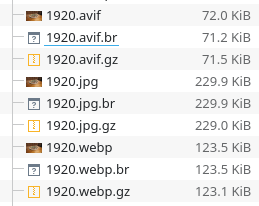
If I understand correctly gzip, brotli and similar are best used to compress text.
Font files also shouldn't be compressed. A TTF file compresses a bit, but a WOFF2 file will be even smaller than that (and WOFF2 also doesn't compress well). So might as well use WOFF/WOFF2
For most of the images that I tried you can only see differences with the images side by side. It's really subtle.
I do have one example for which my config must be bad, compresses a lot but introduces a lot of noise
In case you still can't load the image, for the largest width the JPG file has 229.9KB, WEBP has 123.5KB, AVIF has 72KB.
I'm working on a project which generates images in multiples sizes, and also converts to WEBP and AVIF.
The difference in file size is significant. It might not matter to you, but it matters to a lot of people.
Here's an example (the filename is the width):

Also, using the <picture></picture> element, if the users' browsers don't support (or block) AVIF/WEBP, the original format is used. No harm in using them.
(I know this is a meme post, but some people are taking it seriously)
MultiViewer (which is an unofficial program, mind you) does support Linux, but you need to download the installer manually to install and update.
Other than that it works great
Yes. From their v0.0.1 blog post: