MapleEngineer

joined 2 years ago
MODERATOR OF
1
submitted 2 years ago* (last edited 2 years ago) by MapleEngineer@lemmy.ca to c/homestead@lemmy.ca
 

Hello, everyone.

I am a mid-50s Canadian, married, with three kids (one is a step-kid.) My wife and I bought 16.5 acres of mature, second growth A2 land in Eastern Ontario 25 years ago. We are on the floor plain of the local small river and our land floods in the spring and is wet all year. We cut out a clearing to build our house and gardens and keep a few animals.

My wife keeps gardens with fruit trees, berries, flowers, and vegetables. Most years she has lots of plants to sell in the spring and vegetables to see at the local farmer's markets. This year has been challenging for a number of reasons so the range and number of vegetables she had planted is much lower.

We have a laying flock of chickens that ranges from 30 to 50 birds. I honestly have no idea how many birds are out there right now.

We do two batches, spring and fall, or White Rock meat birds each year. We have half or more of the meat birds inspected and processed at the local abattoir so that we can legally sell them and the rest we process ourselves. It's not my favorite part of farming but it has to be done.

We also do between 10 and 40 turkeys in a single batch each year. This year we have a mix of Bronze Orlopps and Mini Whites for a total of 18 birds. The turkeys end up too big for me to pluck with my plucker so we send them all out to the abattoir to be processed.

We have done pigs in the past and were planning to have a pair of pigs this year but the challenges that I mentioned above got in the way. Instead my wife's friend has taken in our pigs and is raising them for us. We will pay for the processing and they will keep one for their troubles.

1
submitted 2 years ago* (last edited 2 years ago) by MapleEngineer@lemmy.ca to c/soldering@lemmy.ca
 

When I first started soldering my parents bought me a (probably < $10 at the time) hobby soldering iron. That iron took a beating and was replaced with another hobby iron then another. I ended up with a hobby iron that I absolutely loved. It had a powder blue handle, a solid barrel (not rolled sheet) and was flared where the handle met the barrel. I used that iron for many years. I am not sure where it went. It may be in a box of tools somewhere or it may be gone for good.

I'm not sure exactly when I got my Weller WESD51 soldering station. It will have been between 15 and 20 years ago. At around $150 it was an expensive upgrade for me. That original station still sits on my desk and up until a few weeks ago was the only station on my desk.

image

I normally have an ETA (1.6 mm chisel) tip in the PES51. It meets most of my day-to-day soldering needs. I find that I can easily solder SMDs down to 0805, SOT23s, and SOICs with the ETA.

image

When I'm doing something like a QFP of TQFP I switch to a ETGW (2 mm beveled cup) tip. The ETGQ style Gullwing tip is the tip professionals use to hand solder chips with gullwing style pins.

Yes, this tip is a little bit oxidized.

image

I cleaned out the solder to show the cup in the photo. Immediately after I took this photo I fluxed and tinned the tip. It's all good and ready for the next time I use it.

image

I have a range of other tips that I use from time to time when they are appropriate. They include (upper left to right then lower left to right):

ETAA - a 1.6 mm bevel

ETL - a long, heavy 2 mm chisel

ETR - a long, light 1.6 mm chisel

ETT - a 0.6 mm conical

ETU - a 0.4 mm bevel

ETX - a 0.2 mm bent conical

TETS - 0.4 mm long conical

The projects that I've been taking in recently (I don't call them jobs because I often do them for free) have been more complex. I've had to desolder SMD electrolytic capacitors and I've been soldering 0.4 mm pitch TQFPs. I needed a soldering station with a bit more range.

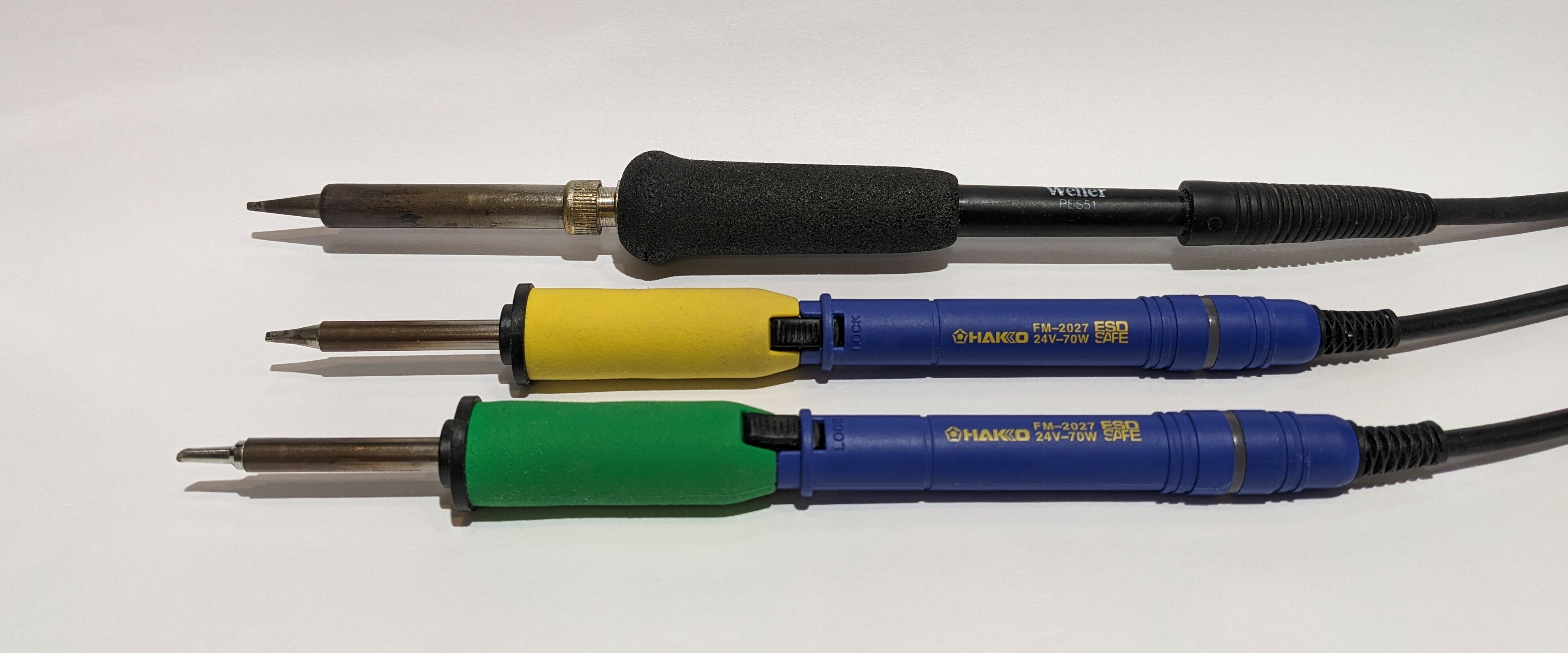
A few weeks ago my Hakko FM-203 arrived with the pair of FM-2027s you see in the cover photo. The green one is loaded with a T15-BCM2 which is a 2 mm beveled cup like the ETGW on the Weller and the yellow with a T15-D16 which is a 1.6 mm chisel like the ETA on the Weller.

I'm planning to add a FM-2022 tweezers at some point in the near future to help with those pesky SMD electrolytics.


I'll get to giving this community an icon and a banner tomorrow.

If you want to propose something, feel free.

I'm open to sharing modding duties with someone who is like minded.


Do you have a back yard? Are there chickens in it? Then this community is for you!

I made the mistake of buying my wife "just four chickens" for mother's day a few years ago. That became 8. Then 20. Then 300. DON'T DO IT! IT'S A TRAP!

If you've already fallen into that trap and have questions, come on over. If you've been keeping chickens for years, come on over. If someone else's chickens are in your back yard and you don't know what to do, COME ON OVER!

We'll talk about chickens, we'll talk about eggs, we won't talk about which came first, we'll talk about feed, and care, and everything that goes along with keeping chickens. There will be pictures. There will be recipes. There will be...well...that probably just about covers it.

Anyway...

Backyard Chickens

!backyardchickens@lemmy.ca

Backyard Chickens

You may also be interested in !homestead

EDIT

There have been a couple of questions, "What about my ducks?" and "What about my parrots?"

The Fediverse is small. There probably aren't enough people interested in each type of bird to start their own communities. For now, everyone is welcome. Turkeys, geese, quail, Guineas, fucking Emus. Come on in. Pet birds, too. We'll take everyone. The community will be focused on chickens but everyone is welcome. As the sub-communities grow they will naturally migrate (heh) to their own communities but we will have given them care and comfort while that happened.


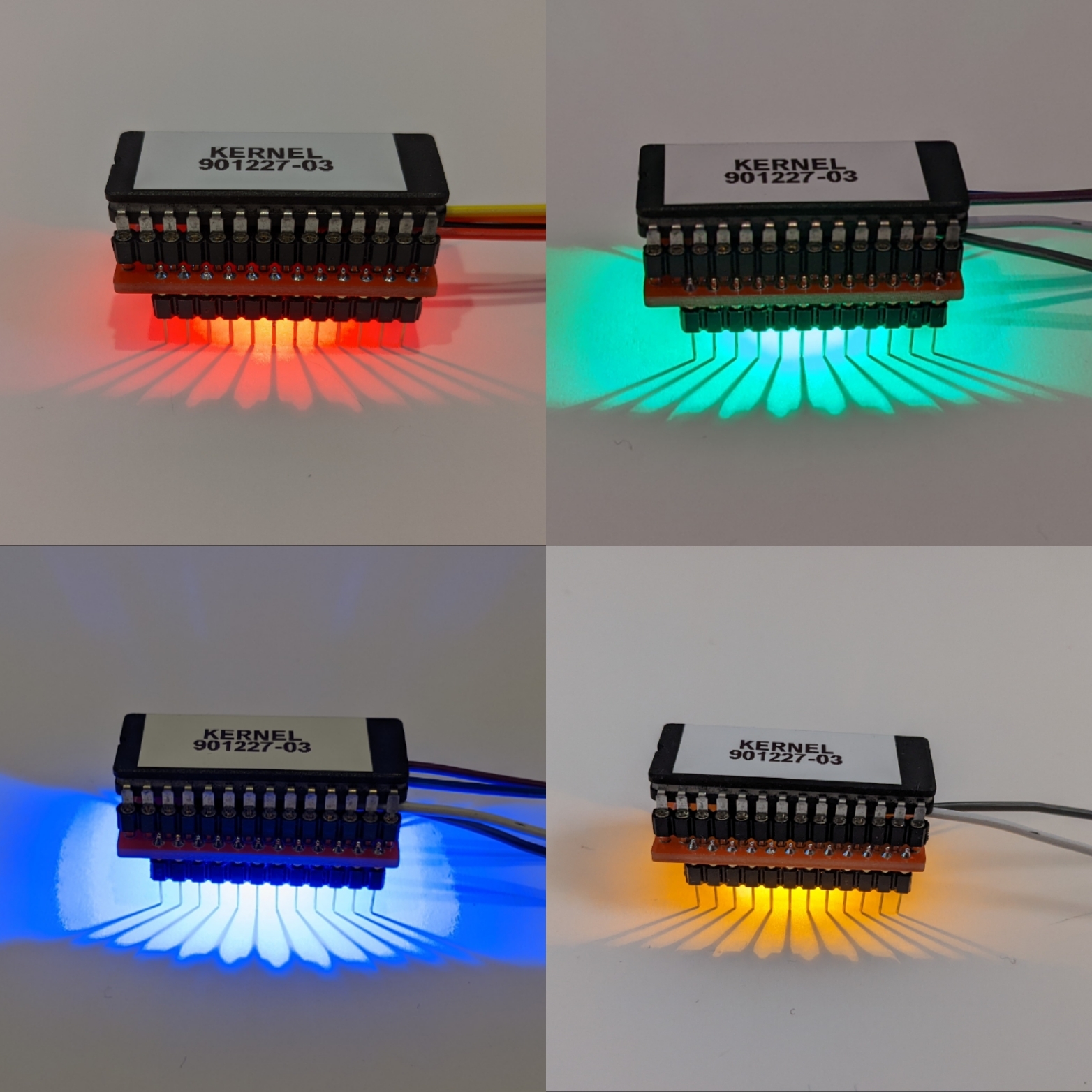
I was building a ROM switching adapter so that I could use modern 27256 ROMs in the 2332 and 2364 footprints on the Commodore 64. I decided to add an LED and resistor to the bottom for mood lighting. When I started adding LEDs of different colors it turned pretty sexy pretty fast.

The latest iteration of this adapted has the microcontroller right on the adapter under the 27256. It handles switching the address lines, choosing between 2332 and 2364, and runs the RESET and EXROM lines. I have a pin left that I could use to run a WS2812 programmable RGB LED.


cross-posted from: https://lemmy.ca/post/1079017

Continued from Part 1.

image

Once we were happy with the setup Lulu started welding. Here she's welding the cross bars into place.

image

We've taken a bit of a leap forward at this point. The floor of the fire box is welded in, we've installed the back of the fire box, and the cross bars for the rear baffle are welded into place.

In the next version of this evaporator I plan to bring an air feed in under the baffle at the back so that I can push air in under the first grate. This rear wall of the fire box is solid.

image

In this photo we've added the framing for the fire bricks on the back wall of the fire box and are test fitting couple of fire bricks, one at each end.

image

We used a big piece of cardboard to make a template for the left half of the rear baffle. The oil tank has lots of indents and curves to work around.

image

We traced the cardboard template onto a piece of steel sheet and cut it out. The fit wasn't bad but there was going to be some gap filling to do.

I think that in retrospect I would have used treaded rod and a turnbuckle to close some of this gap for welding. I'll do that next time and take pictures.

image

We made the sides of the baffles out of multiple pieces of sheet because that's what we could cut out of the other tank. We used the same process here, drilling holes so that we could weld the sheet to the cross bars.

image

There was lots of welding and lots of grinding to do to get the rear baffle installed but we got it done.

image

These two cross bars behind the top frame cross bar we saw earlier will support the chimney connector. Note the circular cutouts for the chimney ring.

image

The hole in the rear deck lines up with the circular cutouts in the cross bars.

image

The chimney ring sits above the hole on the rear deck and we welded everything together.

image

We careful when you're using zip cut disks. They have no respect for work gloves or fingers.

image

I spent too much time producing this paper template for the point where the leg meets the tank. We wrapped the paper around the tube, clamped the tube in place, then scribed the connection with a block of wood and a Sharpie. I then spent time working with scissors to improve the fit.

Next time I do this I will build the jig that you see in the next photo and scribe the connection with the leg clamped in the jig.

image

This large rectangular jig sits on the tank and holds the legs in place for welding. We were able to tap the jig to adjust it to make sure that it was level in relation to the tank and that the legs were therefore plumb.

image

We marked the tank and did some weld prep.

image

Next, we tacked the legs and the long axis gussets. The legs on the old evaporator were flimsy. These ones would not be.

image

We then removed the jig, used carboard to design and cut the short axis gussets, tacked them in place, and welded the leg and gussets.

image

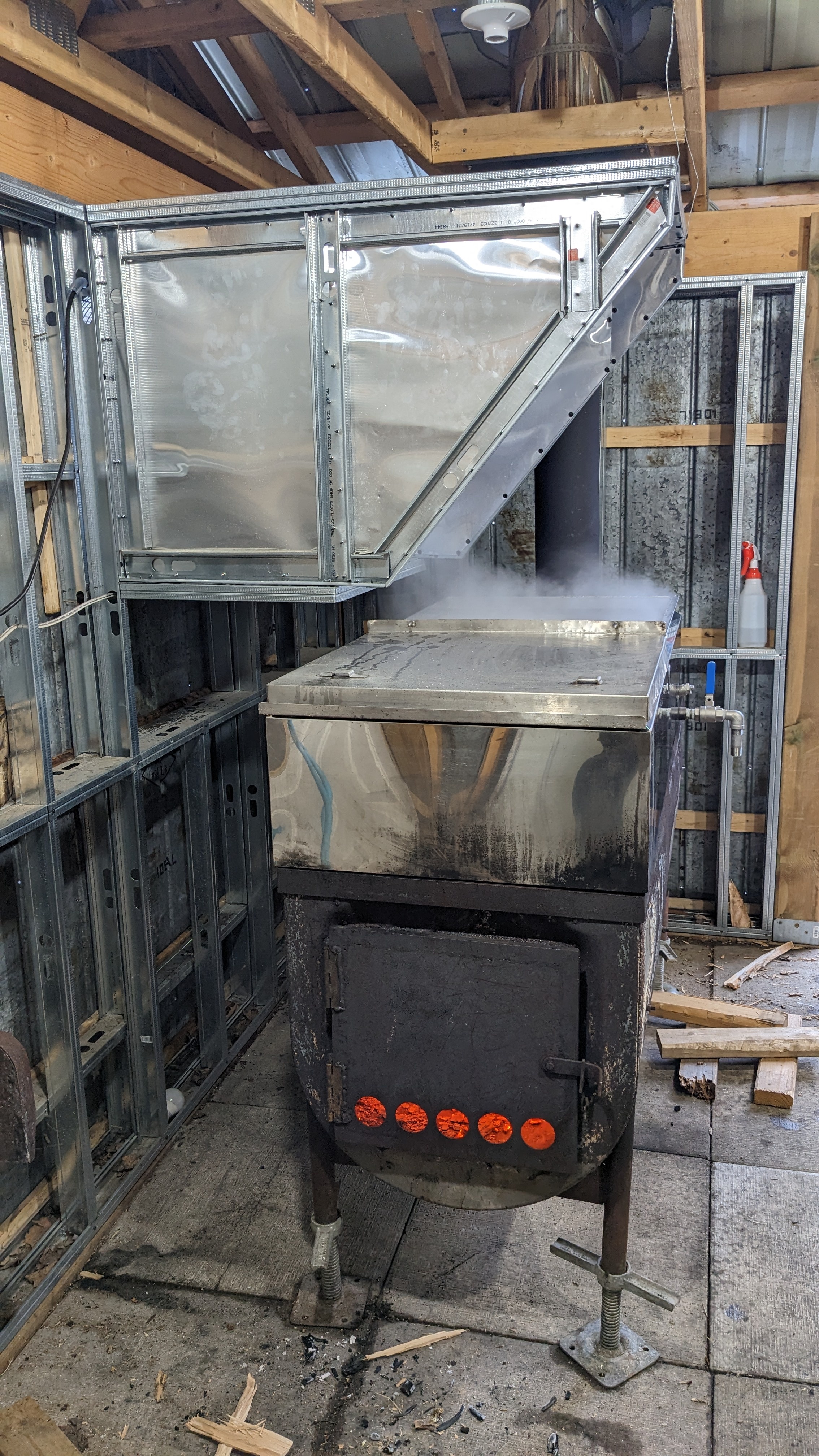
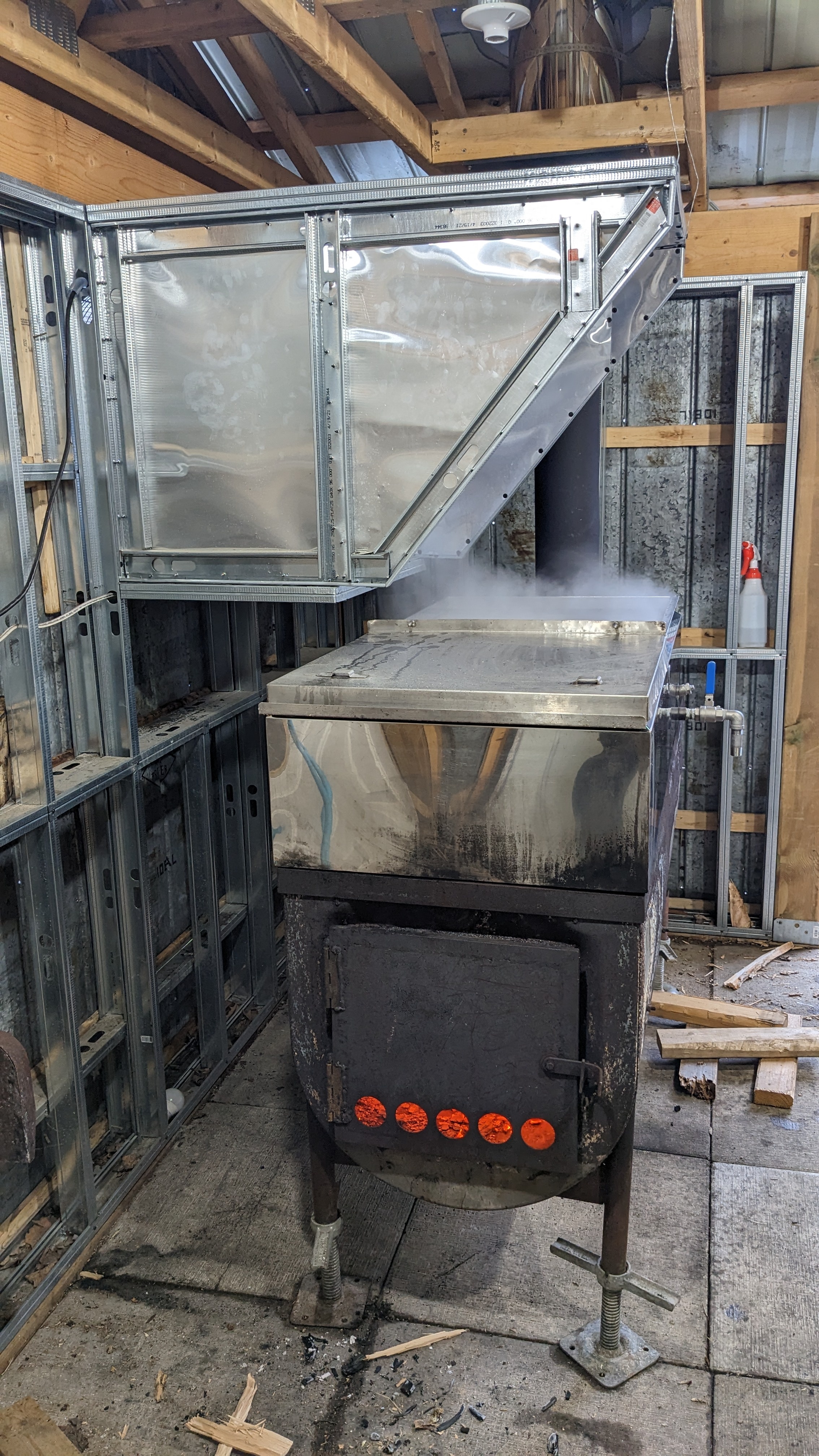
Now we could finally get it up on its feet. This is, I believe, the greatest improvement over the old evaporator. Using the screw type scaffold jack feet allows me to level the evaporator on uneven ground or an uneven floor. Even in my new sugar shack the ground moves a bit in the spring. Being able to kick the handles and bring it back into level easily is amazing. I had to shorten the legs a bit but that was easily done with a cutting disk on the grinder as they were hollow. Solid ones would be harder to cut but the hollow ones work fine for this application.

You can see in this photo that we have started to tack together the fire grate. It's made of 1 1/2" x 1/4" bar and 2" x 2" x 1/4" angle.

image

A closer look at the tacked grate.

In the next version I will weld bar onto the open side of the angle to add additional strength. With differential heading from the fire the grate warped.

image

The door is a frame of 1" x 1/2" steel channel with a field of steel sheet. The hinges are trimmed down and welded to the door frame and the frame of the door.

image

I glued wood stove gasket into the channel frame on the door to keep the smoke in. The chimney drafts enough air that smoke doesn't home out the vent holes.

image

We built the door handle and closure out of some scraps of steel that I had in my scrap bucket.

This was a great build and Lulu and I had a lot of fun. There are LOTS more photos that I didn't include here. If you're interested in any specific aspect of this build or have any questions please feel free to ask or comment.


cross-posted from: https://lemmy.ca/post/1079003

This is going to be a long post. I will likely have to break it up into parts. So this is Part 1.

In the late winter of 2019 my hand, Lulu, and I built a new oil tank evaporator.

(You can click on the images to see higher resolution versions.)

This is my original evaporator. My wife bought it from a local guy about four years before. It worked ok but I wanted to make improvements.

image

Note that the door doesn't fit well and the legs are the original oil tank legs which are intended to sit on a concrete floor and not be moved. The body of the evaporator is completely open so I had to pile concrete blocks and piece of steel in there to deflect the heat toward the bottom of the pan.

image

The pan was steel, folded and soldered and it leaked and was hard to get clean. The hardware was mostly brass and was tenuously connected to the pan.

image

Lulu (L) and I (R) set out to make improvements.

image

This is the oil tank that will become the body of our evaporator (and later the body of the evaporator and replaced and improved on this one.

PLEASE NOTE: Cutting an oil tank or any container which has contained flammable liquid will KILL YOU. This is NOT something that you should try unless you know exactly what you're doing. Seriously, it will explode and it will fuck you up.

image

We used welding magnets and aluminum angle to draw a line around the middle of the tank. I think cut the tank in half. (Read the warning above. I'm not going to tell you how I did this. If you don't know how to do it safely get help or ask someone who does know how to do it safely to do it for you.)

image

It was getting late when we finished cutting the tank in half so this photo is a bit dark.

image

We built a frame out of 2" x 2" x 1/8" steel angle. Here we have the long sides clamped to the top of the tank, squeezing the sides straight so that we can measure the length of the required short pieces. The sides of the tank bow out once it is cut in half. You don't want to squeeze it so hard that the side bows in. Just look at where the angle hits the tank and make sure that it's touching the tank along it's full length.

image

We cut the long and short pieces on the dry cut saw then prepared the corners. We used right angle welding corner clamps to hold them in alignment while we welded them.

image

Once the corners were welded we did some grinding. So much grinding. When you're an amateur welder the angle grinder is your friend. My hand had never welded before coming to stay with us so she did a lot of learning on this project. I let her do a lot of the welding then came along behind her and did some grinding and touch ups where necessary.

image

We laid out for, measured, and cut a 2" x 1/2" flat bar door frame.

image

Next, we cut and welded on the first of three cross bars in the top frame. This one is upside down compared to the other two. This one is the back edge of the pan. Behind it is the read deck where the chimney connector will be.

image

This little Cub Cadet/Yanmar tractor acted as our welding table for the project. Here you can see the top frame with the rear cross bar. Note also the interrupted weld around the outside bottom of the top frame. The inside of the top frame is continuously welded.

We didn't install the other two cross bars at this point because they would have been in our way as we did the interior welding.

image

We marked and cut the door opening in the end of the tank.

image

Then we welded in the door frame. The welds are ugly but we're amateurs.

image

In this photo we're working on how we're going to attach the half fire bricks to the evaporator. We decided on some 1 1/2" x 1 1/2" x 1/8" angle at the top and bottom with two pieces of the same angle welded back to back with 1/4"-20 studs to attach it to the wall to retain the bricks where they meet.

image

This was the retainer bar that we built. We slipped the fire bricks into the upper and lower angles then slipped this bar in between the two courses of bricks and bolted it to the side the tank.

image

In this photo we're doing a fit up to see where the holes need to be drilled for the retaining bar and where the lower angle needs to be welded on.

image

In this photo we have the lower angle welded in and are just testing to see how the whole setup works. It works well.

image

Next, we started to build the back and bottom frames of the fire box. The plan was to build a baffle at the back of the first box to direct the heat up and a baffle across the back of the tank to hold the heat against the bottom of the pan.

image

We cut these three pieces of angle to set the floor even with the bottom of the door to make it easy to drag out the coals and ashes when the boil was done.

This is one of the things that I am going to fix in the next evaporator build. I should have set the floor down the thickness of a half fire brick so that the floor of the evaporator was protected. The heat of the fire built directly on the floor of the fire box caused it to warp.

image

Most of the flat steel you see in this build came from another oil tank that we cut up as we needed pieces.

Please reread the warning about cutting oil tanks at the beginning of this post.

image

Here you can see the piece we cut out of the tank above to use as the floor of the first box. We did some cutting and grinding to get a decent fit.

image

We drilled a series of holes to line up with the middles of the cross bars so we could weld the sheet onto the cross bars.

image

Everything was dry fit together so that we could make adjustments before we started welding. We ground back the plate a bit at the ends of the cross bars so we could wend the cross bars to the tank well.

Continued in Part 2.


Continued from Part 1.

image

Once we were happy with the setup Lulu started welding. Here she's welding the cross bars into place.

image

We've taken a bit of a leap forward at this point. The floor of the fire box is welded in, we've installed the back of the fire box, and the cross bars for the rear baffle are welded into place.

In the next version of this evaporator I plan to bring an air feed in under the baffle at the back so that I can push air in under the first grate. This rear wall of the fire box is solid.

image

In this photo we've added the framing for the fire bricks on the back wall of the fire box and are test fitting couple of fire bricks, one at each end.

image

We used a big piece of cardboard to make a template for the left half of the rear baffle. The oil tank has lots of indents and curves to work around.

image

We traced the cardboard template onto a piece of steel sheet and cut it out. The fit wasn't bad but there was going to be some gap filling to do.

I think that in retrospect I would have used treaded rod and a turnbuckle to close some of this gap for welding. I'll do that next time and take pictures.

image

We made the sides of the baffles out of multiple pieces of sheet because that's what we could cut out of the other tank. We used the same process here, drilling holes so that we could weld the sheet to the cross bars.

image

There was lots of welding and lots of grinding to do to get the rear baffle installed but we got it done.

image

These two cross bars behind the top frame cross bar we saw earlier will support the chimney connector. Note the circular cutouts for the chimney ring.

image

The hole in the rear deck lines up with the circular cutouts in the cross bars.

image

The chimney ring sits above the hole on the rear deck and we welded everything together.

image

We careful when you're using zip cut disks. They have no respect for work gloves or fingers.

image

I spent too much time producing this paper template for the point where the leg meets the tank. We wrapped the paper around the tube, clamped the tube in place, then scribed the connection with a block of wood and a Sharpie. I then spent time working with scissors to improve the fit.

Next time I do this I will build the jig that you see in the next photo and scribe the connection with the leg clamped in the jig.

image

This large rectangular jig sits on the tank and holds the legs in place for welding. We were able to tap the jig to adjust it to make sure that it was level in relation to the tank and that the legs were therefore plumb.

image

We marked the tank and did some weld prep.

image

Next, we tacked the legs and the long axis gussets. The legs on the old evaporator were flimsy. These ones would not be.

image

We then removed the jig, used carboard to design and cut the short axis gussets, tacked them in place, and welded the leg and gussets.

image

Now we could finally get it up on its feet. This is, I believe, the greatest improvement over the old evaporator. Using the screw type scaffold jack feet allows me to level the evaporator on uneven ground or an uneven floor. Even in my new sugar shack the ground moves a bit in the spring. Being able to kick the handles and bring it back into level easily is amazing. I had to shorten the legs a bit but that was easily done with a cutting disk on the grinder as they were hollow. Solid ones would be harder to cut but the hollow ones work fine for this application.

You can see in this photo that we have started to tack together the fire grate. It's made of 1 1/2" x 1/4" bar and 2" x 2" x 1/4" angle.

image

A closer look at the tacked grate.

In the next version I will weld bar onto the open side of the angle to add additional strength. With differential heading from the fire the grate warped.

image

The door is a frame of 1" x 1/2" steel channel with a field of steel sheet. The hinges are trimmed down and welded to the door frame and the frame of the door.

image

I glued wood stove gasket into the channel frame on the door to keep the smoke in. The chimney drafts enough air that smoke doesn't home out the vent holes.

image

We built the door handle and closure out of some scraps of steel that I had in my scrap bucket.

This was a great build and Lulu and I had a lot of fun. There are LOTS more photos that I didn't include here. If you're interested in any specific aspect of this build or have any questions please feel free to ask or comment.


This is going to be a long post. I will likely have to break it up into parts. So this is Part 1.

In the late winter of 2019 my hand, Lulu, and I built a new oil tank evaporator.

(You can click on the images to see higher resolution versions.)

This is my original evaporator. My wife bought it from a local guy about four years before. It worked ok but I wanted to make improvements.

image

Note that the door doesn't fit well and the legs are the original oil tank legs which are intended to sit on a concrete floor and not be moved. The body of the evaporator is completely open so I had to pile concrete blocks and piece of steel in there to deflect the heat toward the bottom of the pan.

image

The pan was steel, folded and soldered and it leaked and was hard to get clean. The hardware was mostly brass and was tenuously connected to the pan.

image

Lulu (L) and I (R) set out to make improvements.

image

This is the oil tank that will become the body of our evaporator (and later the body of the evaporator and replaced and improved on this one.

PLEASE NOTE: Cutting an oil tank or any container which has contained flammable liquid will KILL YOU. This is NOT something that you should try unless you know exactly what you're doing. Seriously, it will explode and it will fuck you up.

image

We used welding magnets and aluminum angle to draw a line around the middle of the tank. I think cut the tank in half. (Read the warning above. I'm not going to tell you how I did this. If you don't know how to do it safely get help or ask someone who does know how to do it safely to do it for you.)

image

It was getting late when we finished cutting the tank in half so this photo is a bit dark.

image

We built a frame out of 2" x 2" x 1/8" steel angle. Here we have the long sides clamped to the top of the tank, squeezing the sides straight so that we can measure the length of the required short pieces. The sides of the tank bow out once it is cut in half. You don't want to squeeze it so hard that the side bows in. Just look at where the angle hits the tank and make sure that it's touching the tank along it's full length.

image

We cut the long and short pieces on the dry cut saw then prepared the corners. We used right angle welding corner clamps to hold them in alignment while we welded them.

image

Once the corners were welded we did some grinding. So much grinding. When you're an amateur welder the angle grinder is your friend. My hand had never welded before coming to stay with us so she did a lot of learning on this project. I let her do a lot of the welding then came along behind her and did some grinding and touch ups where necessary.

image

We laid out for, measured, and cut a 2" x 1/2" flat bar door frame.

image

Next, we cut and welded on the first of three cross bars in the top frame. This one is upside down compared to the other two. This one is the back edge of the pan. Behind it is the read deck where the chimney connector will be.

image

This little Cub Cadet/Yanmar tractor acted as our welding table for the project. Here you can see the top frame with the rear cross bar. Note also the interrupted weld around the outside bottom of the top frame. The inside of the top frame is continuously welded.

We didn't install the other two cross bars at this point because they would have been in our way as we did the interior welding.

image

We marked and cut the door opening in the end of the tank.

image

Then we welded in the door frame. The welds are ugly but we're amateurs.

image

In this photo we're working on how we're going to attach the half fire bricks to the evaporator. We decided on some 1 1/2" x 1 1/2" x 1/8" angle at the top and bottom with two pieces of the same angle welded back to back with 1/4"-20 studs to attach it to the wall to retain the bricks where they meet.

image

This was the retainer bar that we built. We slipped the fire bricks into the upper and lower angles then slipped this bar in between the two courses of bricks and bolted it to the side the tank.

image

In this photo we're doing a fit up to see where the holes need to be drilled for the retaining bar and where the lower angle needs to be welded on.

image

In this photo we have the lower angle welded in and are just testing to see how the whole setup works. It works well.

image

Next, we started to build the back and bottom frames of the fire box. The plan was to build a baffle at the back of the first box to direct the heat up and a baffle across the back of the tank to hold the heat against the bottom of the pan.

image

We cut these three pieces of angle to set the floor even with the bottom of the door to make it easy to drag out the coals and ashes when the boil was done.

This is one of the things that I am going to fix in the next evaporator build. I should have set the floor down the thickness of a half fire brick so that the floor of the evaporator was protected. The heat of the fire built directly on the floor of the fire box caused it to warp.

image

Most of the flat steel you see in this build came from another oil tank that we cut up as we needed pieces.

Please reread the warning about cutting oil tanks at the beginning of this post.

image

Here you can see the piece we cut out of the tank above to use as the floor of the first box. We did some cutting and grinding to get a decent fit.

image

We drilled a series of holes to line up with the middles of the cross bars so we could weld the sheet onto the cross bars.

image

Everything was dry fit together so that we could make adjustments before we started welding. We ground back the plate a bit at the ends of the cross bars so we could wend the cross bars to the tank well.

Continued in Part 2.

1
submitted 2 years ago* (last edited 2 years ago) by MapleEngineer@lemmy.ca to c/soldering@lemmy.ca
 

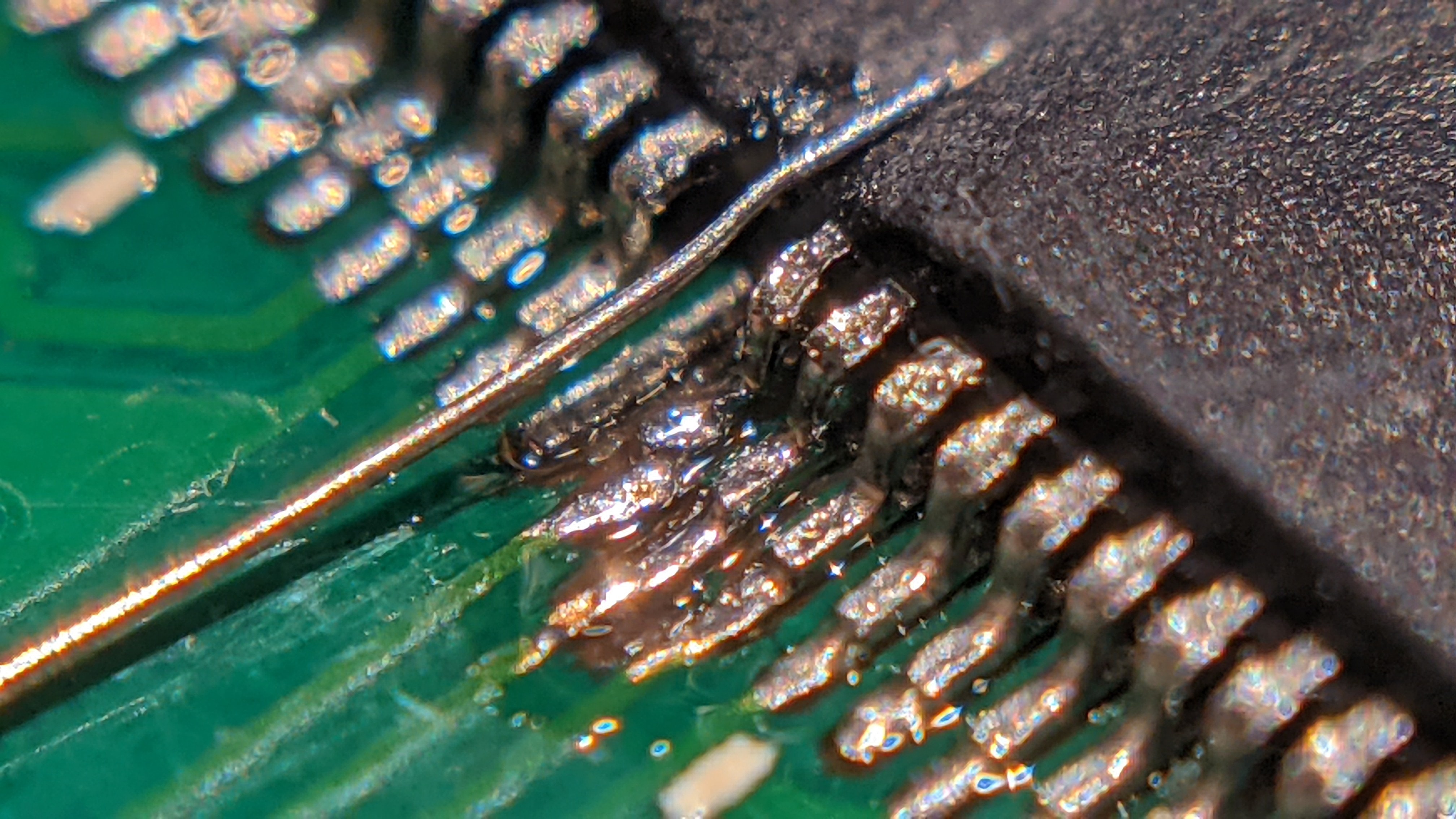
This was an interesting repair. The little company that I work with discovered that one of the pins on the TQFP was not pulled out to the header on the breakout board. They needed that pin so they hired someone to desolder it, lift it, and solder a wire on the to cut the trace to one of the header pins and bring the wire out to it.

Unfortunately, the guy they hired to do the work messed it up pretty bad. You can soo the three pins to the right of this repair are damaged. He broke the pin that he was working on clean off the package. They gave it to me to try to save.

First, I rescued the damaged pins as best I could. Then I filed down the edge of the plastic package until I exposed the lead inside and soldered a 0.1 mm bodge wired onto it. I took that wire out to the pin on the header.

This is not an elegant repair but it got them back in business while they waited for a replacement BoB to arrive. I think they are still using this BoB for their development.

I do these fine repairs under an Olympus SZ40 microscope with a ring light.

image

I always wanted an optical soldering microscope but could never justify the cost. I found this one in a microscope shop in Montreal for $200. For that price I couldn't not buy it.


I was working on a number of projects that used the ProMini as the microcontroller. I was irritated by the lack of shields specifically for the ProMini.

First, I designed a board that I called my ProMini Sheid Carrier which had a power supply, an RTC, some LEDS, a place to plug in one of those cheap, Chinese breadboard power supplies, and connectors for a regular UNO style shield.

image

(Click the pictures for a higher resolution version.)

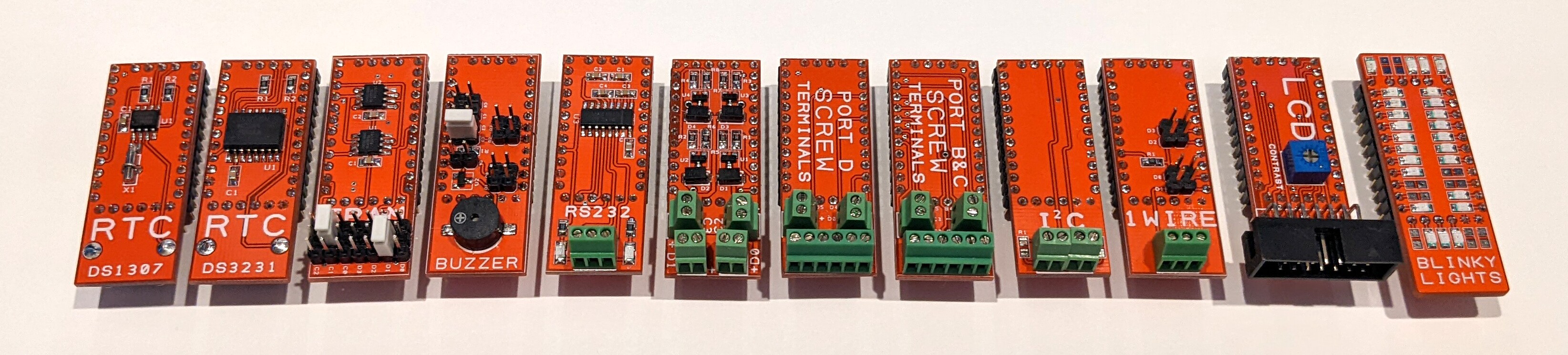
What I really wanted, though, was shields designed specifically for the ProMini.

So...I designed them.

In the cover photo are (from left to right):

DS1307 Real Time Clock with Battery Backup DS3231 High Precision Real Time Clock with Battery Backup Dual FRAM (or other memory with the same pinout) Buzzer RS232 Transistor Driver Port D Screw Terminals Port B & C Screw Terminals I^2^C 1 Wire LCD with Contrast (ETTeam Connector) Blinky Lights

At first I made them stackable, like UNO shields...

image

but that looked stupid.

So I designed a ProMini Backplane board that would carry them.

image

The backplane includes 6 slots. The boards can go in any slot but the PSU slot has a couple of extra pins to bring down regulated 5V and 3.3V for the screw terminals and jumpers to select which regulated voltage goes to the Vcc line. The ProMini slot next to the PSU slot has a jumper to disconnect Vraw from the ProMini so it can be powered by the regulated supply voltage of your choice. The board also includes a 6-pin ICP slot and they can be daisy-chained together to add slots.

I had a lot of fun designing all of these boards and putting them together.

I put together these kits for my kids. They include one of each board, a breadboard, a USBasp, a programming cable, some Dupont wires, a 1602 LCD and LCD cable, and a little homemade button pad and strip of 8 LEDs with resistors.

image


This isn't fancy but it's my comfort food. My family has been making this and calling it macaroni since before I was born. It's a super simple recipe that I cook mostly in the winter. Across the Midwest US this is known as (American) Goulash.

I start with 1 Kg (2 lb) ground beef, a large onion, 600 g (4 cups) of macaroni elbows (or other unit pasta), two 798 ml (27 oz?) cans of crushed or diced tomatoes, dry basil, dry oregano, garlic powder, salt, and the secret ingredient, ketchup.

I dice up the onion, heat up a deep frying pan, add a bunch of butter (30 ml, 2 T), and toss in the onions frying them until they start to caramelize. Then I add in the ground beef and fry it until there is no more visible red and I think it's mostly cooked. Next I add in all of the diced/crushed tomatoes, a palm full (seriously, that's how I do it...maybe between 15 ml and 30 ml (1T and 2T) each of dry basil and dry oregano, around 5 ml (1 t) of garlic powder, and around 10 ml (2 t) of salt. Finally, I add a good squirt of ketchup (maybe...250 ml, 1 c). I stir it up, bring it to a simmer, and turn the heat down to hold the simmer.

Next, I boil the elbows until they are al dente. When the elbows are ready I drain them and shake the colander to get rid of as much water as possible then dump the elbows into the sauce and mix. From there it goes straight into bowls.

Between you and me, I think it's actually better the next day fried in a frying pan with butter but that's just me...and my father...and my son.

view more: ‹ prev next ›