
Crossposted from https://fedia.io/m/science_memes@mander.xyz/t/4559012
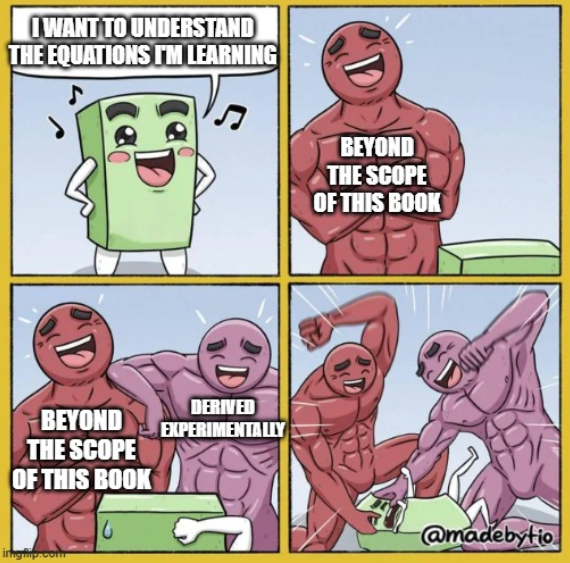
Maybe engineering was a mistake.
Post memes here.
A meme is an idea, behavior, or style that spreads by means of imitation from person to person within a culture and often carries symbolic meaning representing a particular phenomenon or theme.
An Internet meme or meme, is a cultural item that is spread via the Internet, often through social media platforms. The name is by the concept of memes proposed by Richard Dawkins in 1972. Internet memes can take various forms, such as images, videos, GIFs, and various other viral sensations.
Laittakaa meemejä tänne.
Crossposted from https://fedia.io/m/science_memes@mander.xyz/t/4559012
Maybe engineering was a mistake.
This was my biggest struggle with algebra. I could follow directions and solve the 50 repetitive problems. I just found it boring. Nobody would,or could explain what the purpose of the equations was. What it represented in reality. So to me it felt pointless and I just wouldn't do it.
I'm a licensed chemical engineer and mentoring junior engineers is what I enjoy most about being an engineer. If there's anything in particular you're looking for explanations of, I'm happy to help. If it's not in my scope, I'll do my best to learn it and explain it.
Please sir, what the hell do differentials do?
For the record you're presumably asking about derivatives (or, for the process, differentiation). A differential is just an infinitely small (infinitesimal is the term) change in some quantity. With that in mind, differentiation is how you take a function and get its rate of change (distance to speed is the usual example). You do this by essentially—and this is a theme with calculus—taking an approximation and making it so precise as to be exact. Specifically you take a small part of the curve and find its average rate of change, which is just the amount of change in the function divided by the amount of change in the independent variable. This is again an approximation, but if you make the part of the curve really really small the approximation becomes really really good until it's no longer an approximation. It's really just generalizing the idea of a slope to functions that aren't straight lines. This is what the mathematical definition of differentiation lim_∆x→0(∆f/∆x) means.
Does that make sense?
Exactly this.
If you're wondering why they're useful, an example from my discipline is removing heat from a chemical reaction. You mix some ingredients together, stir for 2 hours, and you get a product. By combining the derivatives for the rate of reaction (how fast does A+B -> C) and the heat of reaction (how much energy does the reaction release), you can calculate how much cooling you need to prevent a runaway reaction that takes out half the neighborhood.
And don't forget the "exercises" where the author of the book does not know the solution, either.
I once had the pleasure of asking one of these authors about this, and he just said "well no one has the time to derive solutions for all these exercises".
Good thing his job is automated now rite? 😂
Try asking on engineering advice forums where you'll learn that they're sick of idiots like you not understanding and how you should just give up because obviously this just isnt for you.
we made them up
Reminds me of when I tried to learn c++