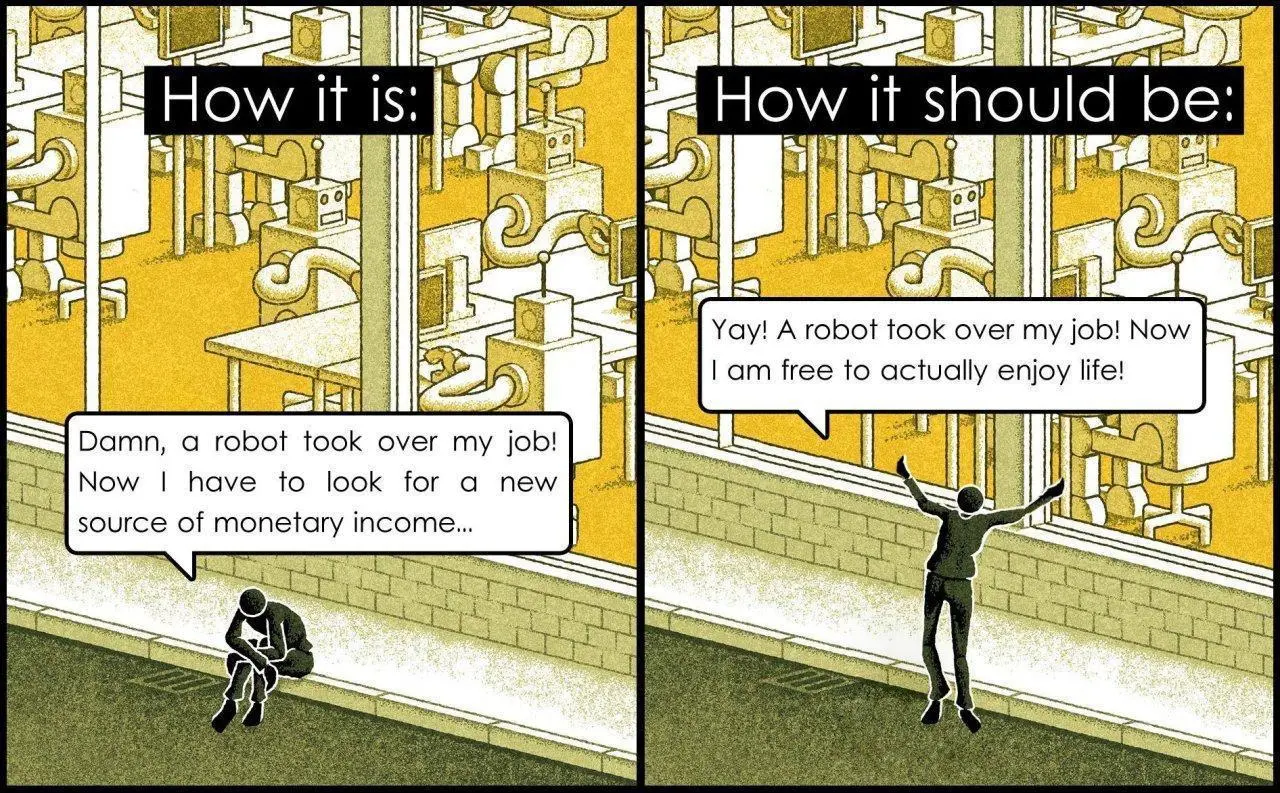
TL;DR:
Automation erodes the base of the labor market faster than new roles emerge, while our current economic system depends on human labor as the primary source of income distribution.
Solution ideas:
In the short term, mitigate the effects of automation-driven job loss through mechanisms like automation taxes and universal basic income.
In the long term, move toward a system where access to basic needs is decoupled from labor entirely, as human work loses its role as the primary source of value distribution.
Long version:
I am a robotics reaearcher working in the field of cognitive systems, the lemmy-wide beloved AI. From my point of view we are at a crossroads: one path leads to a robotic utopia, the other to a dystopia.
The near-future reasons are mainly of socio-economic nature: AI powered robots will replace more and more jobs that are low on the required job-skill hierachy and iteratively improve over time with regard to costs as well as capabilities. And the speed of this developments is increasing.
While some may embrace it since this frees capacities such that people can seek positions that require higher qualification, I think that this will not be the case, because I suspect we have something that I would call a "job pyramid". At the broad lower end we have many jobs available that require only low skills. As we look further towards the top, the availability of jobs becomes more scarce as the qualification level rises.
"It is lonely at the top": not everyone can become a CEO, a professor, or take some other high ranking position, because there are not enough openings available.
At the same time, robots and AI devour the lower end of the pyramid more and more, kicking people out of the level where they would've gotten a job and throwing them into an existential crisis.
I need to emphasize that my "job pyramid" perspective is just a hypothesis and I did not have the time yet to conduct thorough research on this to see whether this is actually justified. It also does not consider other market dynamics such as the evolution of new or small market segments that could result from the economic pressure. (I suppose though that the options are too limited in that regard as well.)
An additional failure mode (ignoring access to education) is that people are not just motivated enough by money in order to take on the education necessary to get those high qualification positons. Otherwise most of us would probably try to become tech CEOs for example and we just don't see that happening. This is apparent already at an academic level: most people do not pursue higher education at universities or alike. That's a systematic incompatibility with how humans actually tic. They are not just simple economically optimizing agents, since human motivation and actions are much more multi-faceted. Therefore, "just reskill upwards" is not a universal solution.
We have long crossed the threshold where robots became cheap to build, deploy and maintain and much more efficient, safer as well as cheaper than human labour. And that's what the capitalists see: they do not really see a marvellous new technology that improves the lifes of everyone and leads us into a world where nobody would have to work. They see cheap work force.
From a business point of view this is fair game, even if ethically questionable.
So how do we get out of this? If robots and AI steal more and more of the jobs that humans would've done, job openings becoming scarce, and financial pressure starts affecting more and more people in an increasingly worse manner, what can we do?
From my point of view: we need to move towards a post-scarcity society in this regard.
Currently, labour only has value because it can not be replaced easily. But the devaluation of work will continue. Also, even though it currently looks like a meaningful path for more and more companies to pursue increasing the amount of automation in the short term, this will sooner or later rebounce: if people don't get enough money, they can not pay for goods and services, which will lead to those companies loosing profits, which will lead to less people being able to afford a basic living and so on.
To fix this temporarily, we could, for example, impose an automation tax on companies: determine the amount to which a company could be automated and then impose a tax proportional to the amount they were actually automated. If we allow purposing specific taxes, we could use this automation tax to finance a universal basic income. Starting with those people who are not able to make a living due to an increasingly automated society. This tax should strike a balance to still allow making it attractive for companies to go for automation and stay competitive.
However, this is only a temporary solution, because in the long term, this leads to the same issues I already described before.
I am convinced that the core issue is an inherent incompatibility of advancements in robotics and AI with a capitalistic society. And for as long as this is the case, there is a creeping doom approaching, leading to a long period of a dystopia where the few keep getting richer while the many will struggle for life. We already have this issue without automation in our society today.
Wealth re-distribution might help, money is only meaningful if it is being kept in circulation. But I suppose this is also just a bandaid fix.
We need to move to a state of things, where living a basic life is granted and virtually free of charge. To get there the above solution ideas can help. But ultimately, we will probably need communist robots to open the path towards the utopic future. Someday nobody has to work, but is free to pursue their happiness and unfold their potential, even if it is working on something in the end anyway. But no one would have to fear not getting basic needs met. Everyone could get shelter, enough food and so on. (We are wasting insane amounts of food anyway already today. Isn't that cruel?) That is the future I am dreaming of.
But one thing is certain: robotics and AI will continue to develop and the momentum increases. It has come to stay, one way or the other. It is not some basic technology that makes only few jobs obsolete, it will keep distorting the labour market more and more in the future. So we will have to deal with it.
I have been saying this for what feels like half an eternity and advocating for legislation worldwide to develop new laws and structures in order to deal with this, because we are missing crucial time and are already starting to see how wrong this can go, if we do not act accordingly.
Thanks for coming to my TED talk.