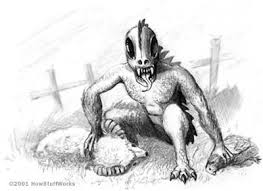
The Chupacabra is one of the rare cases where a cryptid can be traced almost to a single origin point. Unlike older legends that fade into folklore, this one begins clearly in 1995 in Puerto Rico, with a series of livestock killings and a witness who provided a detailed description. That witness, Madelyne Tolentino, described a creature that did not resemble any known animal. It stood upright, had a narrow body, spines along its back, and large glowing eyes. The description was specific enough to stick, and it spread quickly.
That original form matters, because it does not align well with any real predator. It reads more like something constructed than discovered. Researchers like Benjamin Radford have pointed out that Tolentino’s description closely matches the creature from the film Species, which had been released around the same time. This does not mean the events were fabricated. It suggests that when something unusual happened, the mind reached for a visual framework it already recognized. That is how modern folklore forms. Real events, filtered through familiar imagery.
At the same time, the livestock deaths were real. Animals were found with puncture wounds and minimal visible blood, which led to the idea that something was feeding in a way that did not match normal predation. This is where the legend shifts from observation to interpretation. The wounds were consistent with attacks to soft tissue, and the appearance of “bloodless” carcasses can be explained by postmortem blood settling. But to those experiencing it, the pattern felt deliberate. Not feeding for survival, but extracting something.
That is where the vampire archetype enters. The Chupacabra is not just a predator. It is described as something that drains rather than consumes. That distinction moves it out of biology and into symbolism. It becomes less about what the creature is and more about what it represents: something that takes life without leaving the expected evidence behind.
As the legend spread into mainland regions like Texas, the creature changed. The later version is almost entirely different. It is described as a hairless, thin, canine-like animal with damaged skin and erratic behavior. Unlike the Puerto Rican version, this one has physical evidence. Carcasses have been recovered and tested, including well-known cases in places like Cuero, Texas. The results have been consistent. These animals are not unknown species. They are coyotes, dogs, or hybrids suffering from severe mange.
This creates a clean divide. The original Chupacabra is an idea shaped by perception and context. The later Chupacabra is a misidentified animal shaped by physical evidence. Both are real in different ways, but they do not describe the same thing.
That split is what gives the phenomenon structure. It shows how a single set of events can evolve as it moves through different environments. In Puerto Rico, the creature took on an almost alien form, reflecting unfamiliarity and cultural framing. In the United States, it became grounded, tied to known animals and explainable conditions. The legend adapted without losing its core identity.
What remains consistent is the pattern. Something was killing livestock. People needed an explanation. The explanation took shape, spread, and then changed as new information replaced old assumptions.
The Chupacabra persists not because it has been proven, but because it sits in a narrow space between explanation and experience. The science addresses the later sightings clearly. The earlier accounts remain less defined. That gap is enough.
Not to confirm the creature, but to keep the question open.
And as long as that question remains open, the Chupacabra does not disappear. It simply changes form.