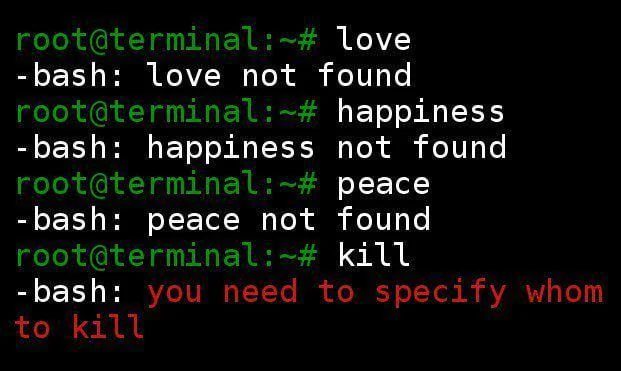
And this is why Linux needs age verification! Won't somebody please think of the children?!
Hint: :q!
Sister communities:
Community rules (click to expand)
1. Follow the site-wide rules
sudo in Windows.Please report posts and comments that break these rules!
Important: never execute code or follow advice that you don't understand or can't verify, especially here. The word of the day is credibility. This is a meme community -- even the most helpful comments might just be shitposts that can damage your system. Be aware, be smart, don't remove France.
And this is why Linux needs age verification! Won't somebody please think of the children?!
Actually, maybe it would be better, if certain people thought of the children less.
More is less.
touch pp
touch cat
man date
man mount
( ͡° ͜ʖ ͡°)

Cat looks unhappy. This incident will be reported
Haha hes a very happy kitty. He loves being touched in almost every way.
bash cat
unzip; touch; strip; finger; mount; gasp; yes; uptime; umount; sleep
gawk
kill is a command.
love, happiness, and peace are not commands.
You can totally find love using command sudo apt install love. It's a game engine.
happiness is a Perl module inside libdemeter-perl package. Let's not install Perl modules, there lies insanity.
And you can find peace in a whole bunch of packages, it's an icon of the peace symbol.
Love (proper name LÖVE) is the game framework that Balatro uses 😉
I've got search queries on "how to kill orphaned child" or something like that. I'm sure it set off some flags.
forced consent
$ no
bash: no: command not found
$ yes
y
y
y
y
y
...
$ yes n
n
n
n
n
n
n
...
I kind of want to go back in time and make it so that the original yes always printed the first letter of the name it was called by. That way you could symlink any name you like to it and it would do the right thing. Called as no it would print ns, etc. The optional parameter would still be there for longer strings or alternate uses.
The reason time travel would be needed is that there's bound to be, or have been, someone who has done something weird regarding symlinking yes that relies on it always printing y when it has no parameter, and the name trick would be a breaking change.
Or make your own package? call it affirm (more wholesome), write it in Rust (of course), and take on yes.
yesn't
The penguin ain't messing around no more.

Sources for the images I slapped together: The penguin is from an article on the Indianapolis zoo, and the rest is the cover image from John Wick taken from the Lionsgate page on the movie.
Kudos, for not making slop using a clanker.
It's more fun making the crappy photoshop images myself (Though I use GIMP not photoshop because fuck Adobe)
Not to mention there's no ethical or moral concerns when making them
Other than Ethical and Moral concerns
AI generated images looks like shit.
Images you edited yourself has its own charm to it.
You get more control over whateber you create.
I hate when people say AI is just a tool like pencil, while it's trained with billions and billions of stolen and pirated images and all one do is type in a couple prompts which is far from whatever human creativity is capable of by itself.
bash kill output:
kill: usage: kill [-s sigspec | -n signum | -sigspec] pid | jobspec ... or kill -l [sigspec]
fish kill output:
kill: not enough arguments
With fish, you just need to fight more to earn that kill.
Ha! On Ubuntu, the OS of Love, you get:
manxu@ubuntu:~ love
Command 'love' not found, but can be installed with:
sudo snap install love  # version 11.2+pkg-d332, or
sudo apt  install love  # version 11.4-1
See 'snap info love' for additional versions.
Have you heard about Our Lord and Savior: Jesux
Also, we are seriously considering changing some fundamental OS features. The idea would be that function calls and features suggesting evil and otherwise pagan ideas would be changed.
abort(3)
kill(1)
references to "daemon"
Cue the joke about killing children with a fork.
That’s not nice
Peace was never an option.
Crazy mode activated.
All you need is kill
Sudo kill all of them.

Holy shite, you have no idea how much I adore this. Thank you.
killall would then be "Seek and Destroy", systemd/init is "One" and booting Windows is St. Anger: Why would you voluntarily do that to yourself?
sudo dnf install love!!! Also known as the Balatro / Blue Revolver engine
