Introduction
During the early Cold War, several governments secretly conducted experiments to understand how biological weapons might behave in real-world conditions. One of the most controversial British programs was Operation Cauldron, a covert biological warfare test carried out in 1952 off the coast of Scotland.
The purpose of the operation was to study how dangerous pathogens might disperse through the air over open water and whether such agents could infect people or animals exposed to airborne clouds. The experiment became particularly disturbing decades later when declassified documents revealed that a civilian fishing vessel unknowingly sailed directly through the test area.
The incident raised serious ethical questions about Cold War military research conducted without public knowledge.
⸻
Cold War Biological Warfare Research
Following World War II, governments across the world began investing heavily in research related to chemical and biological weapons. Military planners feared that future wars could involve attacks using infectious diseases or toxic biological agents.
In the United Kingdom, this research was largely conducted at Porton Down, a government research facility responsible for studying chemical and biological defense technologies.
Scientists at Porton Down sought to understand how airborne pathogens might spread under different environmental conditions, including over oceans and coastal areas. This research led directly to the planning of Operation Cauldron.
⸻
Location of the Tests
Operation Cauldron was conducted in waters off the northwest coast of Scotland, near the island of Lewis and Harris, particularly near the port of Stornoway.
The area was chosen because of its remote location and the presence of relatively controlled maritime traffic. Despite the region’s isolation, fishing vessels still occasionally passed through the waters where the experiments were conducted.
This would later become one of the most controversial aspects of the operation.
⸻
The Biological Experiment
During the tests, scientists released aerosolized clouds of pathogens into the air. The main organism used in the experiment was Yersinia pestis, the bacterium responsible for plague.
Rather than using insects as carriers, the bacteria were dispersed as fine airborne mist clouds, either from sprayers or specialized dispersal devices. The goal was to simulate how a biological weapon might spread if released from a ship or aircraft.
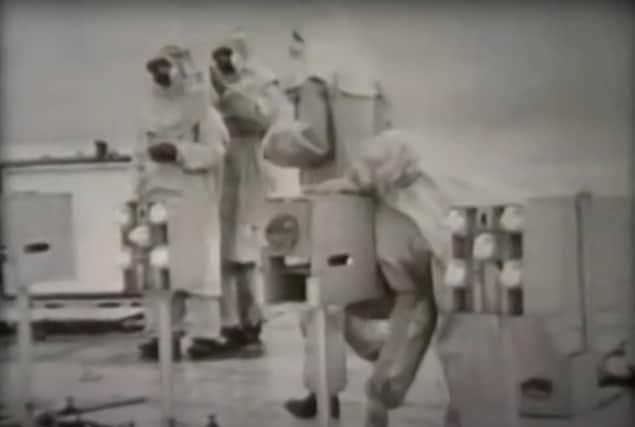
To study the effects of the aerosol cloud, researchers placed animals such as monkeys and guinea pigs in cages on floating pontoons positioned downwind from the release site. Scientists then observed whether the animals became infected after exposure to the airborne bacteria.
The experiment was designed to determine whether biological agents could effectively infect targets through inhalation, a form of transmission known as pneumonic infection.
⸻
The Carella Incident
During one phase of the operation, an unexpected and alarming event occurred.
A civilian fishing trawler named Carella, operating out of Fleetwood in Lancashire, unknowingly sailed directly through one of the biological test clouds.
The vessel had 18 crew members on board, none of whom had any idea that they had passed through a cloud containing plague bacteria.
Rather than warning the crew, the British government chose to maintain secrecy.
According to declassified records, the Royal Navy discreetly monitored the trawler for weeks afterward, prepared to intervene if any of the crew began showing symptoms of infection. The authorities feared that revealing the experiment could expose the classified research program.
Fortunately, none of the crew members became ill.
Scientists later suggested that environmental conditions such as salt in the sea air or ultraviolet radiation from sunlight may have weakened or destroyed the bacteria before they could infect the crew.
⸻
Related Biological Tests in Scotland
Operation Cauldron was not the first biological warfare experiment conducted by the United Kingdom in Scotland.
Earlier, during World War II, British scientists had carried out anthrax weapon tests on Gruinard Island.
Anthrax spores released during those tests contaminated the island so severely that it remained unsafe for decades. The British government declared the island quarantined until a major decontamination effort in the late 1980s finally made it safe again.
Following Operation Cauldron, British researchers continued similar experiments under Operation Hesperus in 1953, which involved testing other pathogens such as Francisella tularensis, the bacterium responsible for tularemia.
⸻
Secrecy and Later Revelations
For many years, the details of Operation Cauldron remained classified. Information about the experiment only became public decades later when government documents were declassified in the 1980s and 1990s.
When the story emerged, it sparked widespread debate about the ethics of Cold War-era biological research. Critics argued that exposing civilians to potentially deadly pathogens—even unintentionally—without their knowledge was deeply irresponsible.
Supporters of the program argued that the experiments were conducted during a period of intense geopolitical tension, when governments feared that biological weapons might be used against them.
⸻
Ethical Questions and Legacy
Operation Cauldron has since become an example frequently cited in discussions about the ethics of military experimentation. The incident illustrates how secrecy during the Cold War sometimes allowed dangerous research to proceed without public oversight.
The near-miss involving the Carella trawler has remained one of the most unsettling aspects of the program. Had the environmental conditions been slightly different, the outcome might have been far more serious.
Today, international agreements such as the Biological Weapons Convention of 1972 prohibit the development and stockpiling of biological weapons.
⸻
Conclusion
Operation Cauldron represents one of the more controversial episodes in the history of Cold War biological warfare research. Conducted in secrecy and involving the release of aerosolized plague bacteria near civilian waters, the experiment highlights the risks and ethical dilemmas associated with military research programs during periods of global tension.
Although no one was ultimately harmed during the tests, the incident serves as a reminder of how close civilian populations sometimes came to unknowingly becoming part of dangerous experiments.