
this post was submitted on 14 Feb 2026
123 points (98.4% liked)

pics

27130 readers
590 users here now

Rules:

1.. Please mark original photos with [OC] in the title if you're the photographer

2..Pictures containing a politician from any country or planet are prohibited, this is a community voted on rule.

3.. Image must be a photograph, no AI or digital art.

4.. No NSFW/Cosplay/Spam/Trolling images.

5.. Be civil. No racism or bigotry.

Photo of the Week Rule(s):

1.. On Fridays, the most upvoted original, marked [OC], photo posted between Friday and Thursday will be the next week's banner and featured photo.

2.. The weekly photos will be saved for an end of the year run off.

Weeks 2023

Instance-wide rules always apply. https://mastodon.world/about

founded 2 years ago
MODERATORS
 

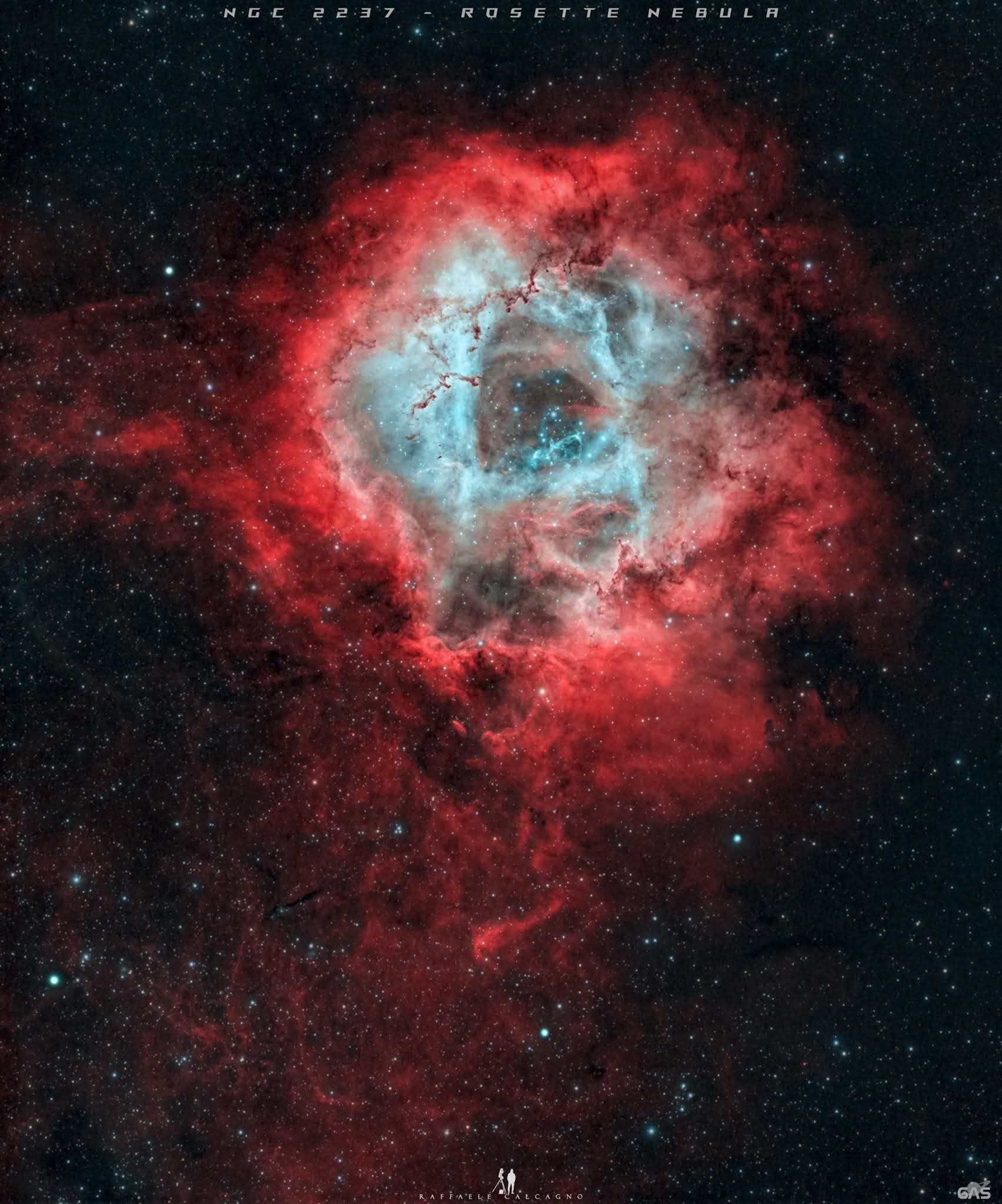
Pictured is a loving look at the Rosette Nebula (NGC 2237): a cosmic bloom of bright young stars sitting atop a stem of glowing hot gas. The rose’s blue-white speckles are among the most luminous stars in the galaxy, with some burning millions of times brighter than the Sun. Their stellar winds sculpt the famed rose shape by pushing gas and dust away from the center. Though only a few million years old, these massive stars are already nearing the end of their lives, while dimmer stars embedded in the nebula will burn for billions of years to come. The vibrant red hue comes from hydrogen gas, ionized by the ultraviolet light from the young stars. The rose’s blue-white center is color-mapped to indicate the presence of similarly ionized oxygen. The Rosette Nebula reminds us of the beauty and transformation woven into the fabric of the universe.

Source: NASA.
top 4 comments
sorted by: hot top controversial new old
[–] ameancow@lemmy.world 1 points 13 hours ago* (last edited 13 hours ago)

While you cannot see the color of most nebula, as the scales are too large and the distances too vast to really get vibrant wavelengths your human eyes can see, it is worth noting that "red" would be one of the more common nebula colors if you could actually see them, and in fact when you do a long-exposure of many nebular they come out red because of ionized hydrogen, the most common gas in the universe.

[–] spittingimage@lemmy.world 1 points 18 hours ago (1 children)

Nebulae are like Rorschach ink blots.

...anyone else see a furby burning in hell?

[–] ZoopZeZoop@lemmy.world 2 points 15 hours ago

I see an enucleated eyeball.

[–] CathyBikesBook@piefed.zip 0 points 20 hours ago