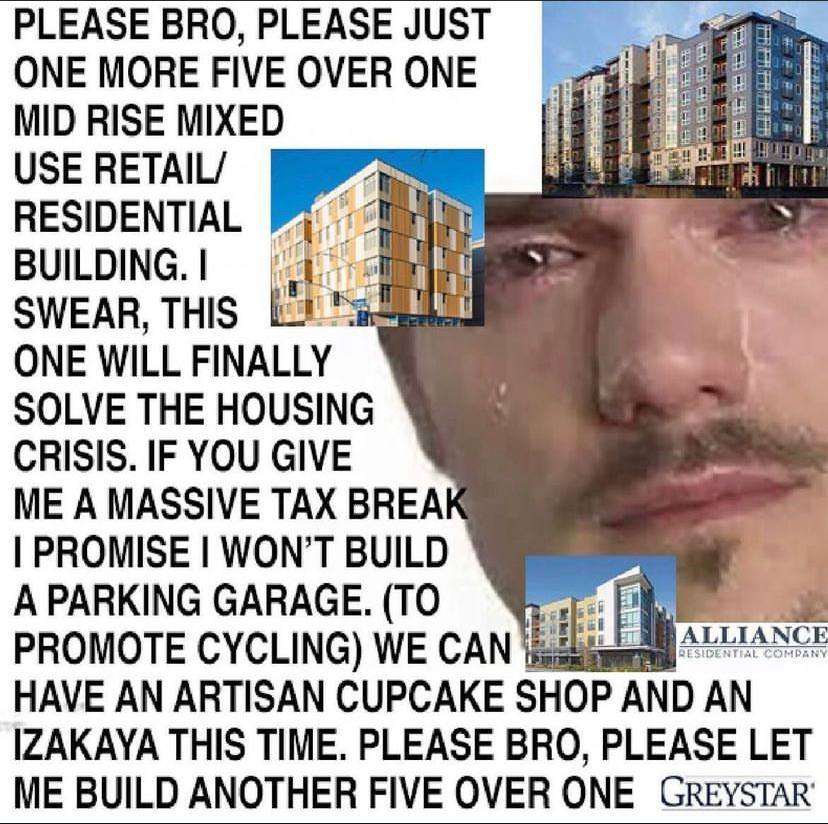
People who think you can solve the housing crisis without removing or greatly diminishing landlords, house flipping, investors, and people profiting off of a necessary and inherently limited necessity, do not understand economics.
Behavior rules:
Posting rules:
NSFW: NSFW content is permitted but it must be tagged and have content warnings. Anything that doesn't adhere to this will be removed. Content warnings should be added like: [penis], [explicit description of sex]. Non-sexualized breasts of any gender are not considered inappropriate and therefore do not need to be blurred/tagged.
If you have any questions, feel free to contact us on our matrix channel or email.
Other 196's:
People who think you can solve the housing crisis without removing or greatly diminishing landlords, house flipping, investors, and people profiting off of a necessary and inherently limited necessity, do not understand economics.
I got a coworker who started flipping houses. Went all in and just finished posting her third house for sale. They got a second(third?) job to can pay the mortgages/loans until they sell. It's been 4 months and they've dropped the price to be competitive. I think they’re gonna lose money after all this is said and done. Which couldn't happen to a more deserving person. They're the reason bosses are cracking down on us for every single thing. They aren't sleeping and keep fucking up. Fuck these leaches
Yeah if you're going to flip houses you shouldn't be buying liveable units to upscale, you should be buying nearly derelict buildings nobody would want and fixing them up to be comfortably inhabitable. Your highest cost shouldn't be the mortgage
Quite frankly, you shouldn't be doing that either.
If someone wants a building a certain way, they can pay to make it that way. If you pay to make it that way and then sell it to them at a profit, you are not really providing them with anything, you're just taking a profit and giving them a not-quite-right renovation they now have to deal with.
In the grand scheme of the system, it would be far better if your profit ended up going to other people who could instead use it to pay for a better renovation that they actually want.
Not true at all.
You're providing the service of doing all that installation and restoration. You should be compensated for your efforts. You can do that work a lot more efficiently when you're not beholden to a specific client's needs or wants, you just want to get another affordable home onto the market.
We have a severe lack of homes that are affordable for people who work most of the time and don't have the time or the savings to restore a home themselves, but might have the savings to make a down payment on a completed restored home. Not everyone has the same means, and we should be using our side hustle to help the world we live in, not hurt it.
You're providing the service of doing all that installation and restoration. You should be compensated for your efforts. You can do that work a lot more efficiently when you're not beholden to a specific client's needs or wants, you just want to get another affordable home onto the market.
Providing a shittier product that fits a clients' needs worse so that you can profit is not efficiency.
We have a severe lack of homes that are affordable for people who work most of the time and don't have the time or the savings to restore a home themselves, but might have the savings to make a down payment on a completed restored home. Not everyone has the same means, and we should be using our side hustle to help the world we live in, not hurt it.
Again, no. You are not helping anyone when you invest in the housing market and try and make a profit off a limited commodity. All you are doing is driving up the prices with your profit seeking and making it harder for people to afford a down payment.
You're not investing in the housing market by buying bottom-of-the-barrel, derelict homes that no investor or resident would ever buy. Those buildings have fallen out of what could be considered housing, and you're restoring them to use.
This is the same argument as saying nobody should buy old broken watches to restore, for example.
Also, driving up the prices??? You're ADDING to the supply curve without touching the demand curve at all. Any theory of economics shows that prices will decrease when you do that. You have zero idea what you're talking about
No house flipper is buying bottom of the barrel derelict homes that no one would ever want because those are hard to flip.
If you're truly saving a property that's literally sitting abandoned and unused and falling apart without you being there and restoring it, then yes, you are providing a service. If you're instead just buying a fixer upper that literally any starting couple might want, then no, you're not.
i.e. house flippers do not increase supply because by and large they do not buy out-of-market assets and restore them to in-market assets, they buy low in the market assets and try and flip them as cheaply as possible into slightly higher in the market assets.
So we agree then
I think we disagree in that I know of virtually zero house flippers who engage in the practice you describe of buying out of market houses.
Every single house flipper I know buys a house that some young starting couple would be happy to buy and renovate themselves. Though that maybe a difference of markets given that where I'm at there are basically no out of market houses because every property is too expensive too abandon like that.
I think the key is that unless you're already a general contractor, you're a speculator. There exists people fixing shitholes to be livable, but those guys margins come from the fact that they already are in the remodeling business and can fix it for cheaper. I've worked with both types in building supply.
Yes, if you have some process efficiency, like you're a GC who knows exactly how to fix it up as nicely and efficiently as possible because you already have a crew of workers in the area or something then you might actually be providing a service.
But even in that case you might not be if you do a shitty job renovating and drive up the price more than the value you provide. If you say, cover up structural or water damage but make the house look nice and new, you may still be doing a net disservice to society by making someone else both pay more for the house and then pay even more to fix your mistakes later, then if they had been able to buy it cheaply and fix it up themselves.
Plus there's always the added cost that if a GC designs something a certain way, the eventual homeowner may still want it a different way, which then still doubles the overall cost when you have to redo a decent renovation.
It's why the overall effect of house flipping is generally to drive up home prices unnecessarily, when you examine it at a systemic level.
tbh, their funtion isn't all that objectionable. Mixed use buildings are cool and good, actually. But the fact that they're made of cardboard and duct tape, look like ass, and are signifiers of gentrification are what suck about them.
As an example, large Japanese cities go extremely hard on mixed use buildings and are very livable despite their crazy density.
Yeah these 5 over 1s really ruin the neighborhood character of my suburban strip mall state highway hell.
Leave them as derelict auto body warehouses tyvm.
Well, they’re building three in one go in my urban area. And they’re fucking up my neighborhood. The whole neighborhood is lower rise buildings and prewar apartment buildings, so they have character. And then they knocked down a grocery store to put up these three ungodly ass warts.
They did a bunch of them near where I used to live. The problem with these (and really all unplanned high density housing) is that while their intent is to create walkable communities (a great idea in itself), they ignore the reality that most people are going to commute to a job, and they create the nastiest traffic bottlenecks ever. They're not bad when they're located next to a major highway with preplanned egress/ingress, but many of these halfwit developers will plop them with an entrance exit on an already busy 4 lane road and wonder why everything is all wacko.
I thought the idea of the post was the pictured buildings are far too small and we need much larger apartment buildings.
A desire for single-family homes (protecting suburb character) or no change (leave the warehouses) would be something else entirely.
Did I miss something?
Climate-wise, 5-10 story buildings are the most efficient, and they are plenty dense enough to support a good level of public transport service etc. It's probably not desirable to go much bigger except in the most constrained areas.
Source for them being more efficient than taller buildings?
I live in the bay area, and wish we had more mixed zone housing. But then I see it in action in other cities and see they end up crazy expensive. So I'm not sure if it helps anything at all. Does anyone know of this actually helps or hurts?
My gut tells me they're expensive because they offer a set of benefits that otherwise similar units don't. Until they become more the norm than a stand out, they'll probably be more expensive. I've 0 data, again just what my gut says.
Actually it's just price fixing and no ownership that's doing it.
[stares directly into the camera]
Yes.
Replace all single family homes with mixed use commie blocks. Send your strongest cops, they won't be enough.
These aren't commie blocks, and they usually aren't replacing single family homes. They're most problematic when replacing older multi unit buildings, because they're taking low income housing and replacing it with housing only upper income people can afford (plus a couple low income units to say that they're trying). And they get tax breaks to do this gentrification, after years of neglecting the upkeep on the older buildings it's replacing.