225
"I want my software to stay out of my way and only update when I say to"
also me the moment an update releases for anything:
(media.kbin.earth)
KDE is an international technology team creating user-friendly free and open source software for desktop and portable computing. KDE’s software runs on GNU/Linux, BSD and other operating systems, including Windows.
If you encounter a bug, proceed to https://bugs.kde.org/, check whether it has been reported.
If it hasn't, report it yourself.
PLEASE THINK CAREFULLY BEFORE POSTING HERE.
Developers do not look for reports on social media, so they will not see it and all it does is clutter up the feed.
At least this is still you choosing when to update
yeah, I just thought it was funny that ive been checking literally daily since I switched to Linux.
I struggle to only update once a week. I'd update daily if it weren't such a waste on the servers.
Its Wednesday and I'm fiending for my Friday update.
Do you have to restart? I'm finding that Fedora (KDE or not) is usually very restart happy.
Fedora updates the kernel and other packages that get loaded into memory at boot time more frequently than other non-rolling distros, which of course necessitates more frequent restarts.
So it is just because they do more when upgrading if I understand you correctly (actually these restarts are daily occurrence)?
They are saying that boot related packages (kernel, etc.) are being work on more frequently than other booting-required distros.
They might be spending their time on other things or whatever. Just that fedora is focusing that direction, heavily and regularly for quite a while. I'd say especially since 42 not that i have any history beyond 40. I came from a place I despised but couldn't find one that worked as well and stably til i got to trying Fedora. I did, like a decade ago or more, but it wasn't like it is now to me then.
Nah I dont restart unless its a massive update of tons of core packages
On fedora that is? Because "my" fedora want to install system stuff only during restart (if updated from app at least).
You can toggle that off in the menu if youre on KDE. I'm on nobara though not fedora so maybe its different.
Where exactly do I find that setting? But I fear it won't work with fedora.
Settings > software update > apply system updates . set it to immediately
When I first started using Fedora I hesitated to turn this setting on because, to me, it sounds like it's going to install stuff automatically without asking. I feel like it's badly named and confusing. Now I suspect they named it poorly on purpose because they really want people to restart to install updates.
they did because live patching has a lot more that can go wrong so they made the name reflect that risk. ofc you should get to choose so the setting is there.
its in the software updates page, I think its behind a button at the top
It's where @Fizz@lemmy.nz suggested. Thanks both, I've set it to immediately and first update went without restart. Fingers crossed.
I don't think Debian has ever asked me to restart after an update.
Meanwhile here's me updating shit once a month at most nowadays.
Thats better. Once a month is good.
It's choice vs force.
I like that on Linux I can install the updates and know that the ones that require a restart will just be ready the next time I restart at my leisure. And if I don't feel like restarting right away, it won't nag me about it and maybe just restart on its own if it decides I've put it off for too long.
And I can't believe my previous "solution" to that was to give ms even more money for win 10 pro (to get access to the paywalled settings) only to still feel like ms thought it was their computer that they allowed me to use.
exactly my thoughts. I'm in control here but it also does stuff the way that makes sense on its own whenever I dont mess with it.
And soon(tm) we'll have wayland session restore when we do restart!
never really got the point of that kind of stuff but looking at the demand I'm glad its getting added (eventually) since everyone else clearly wants it.
I just want my software to leave me the fuck alone and update automatically. Why is this so difficult?
There's probably an option in your distro to automatically install updates, but it's annoying when that happens when you're in the middle of something or if they require restarts
As much as I hate to praise Windows, that's why they have "update and shut down" when there are updates available.
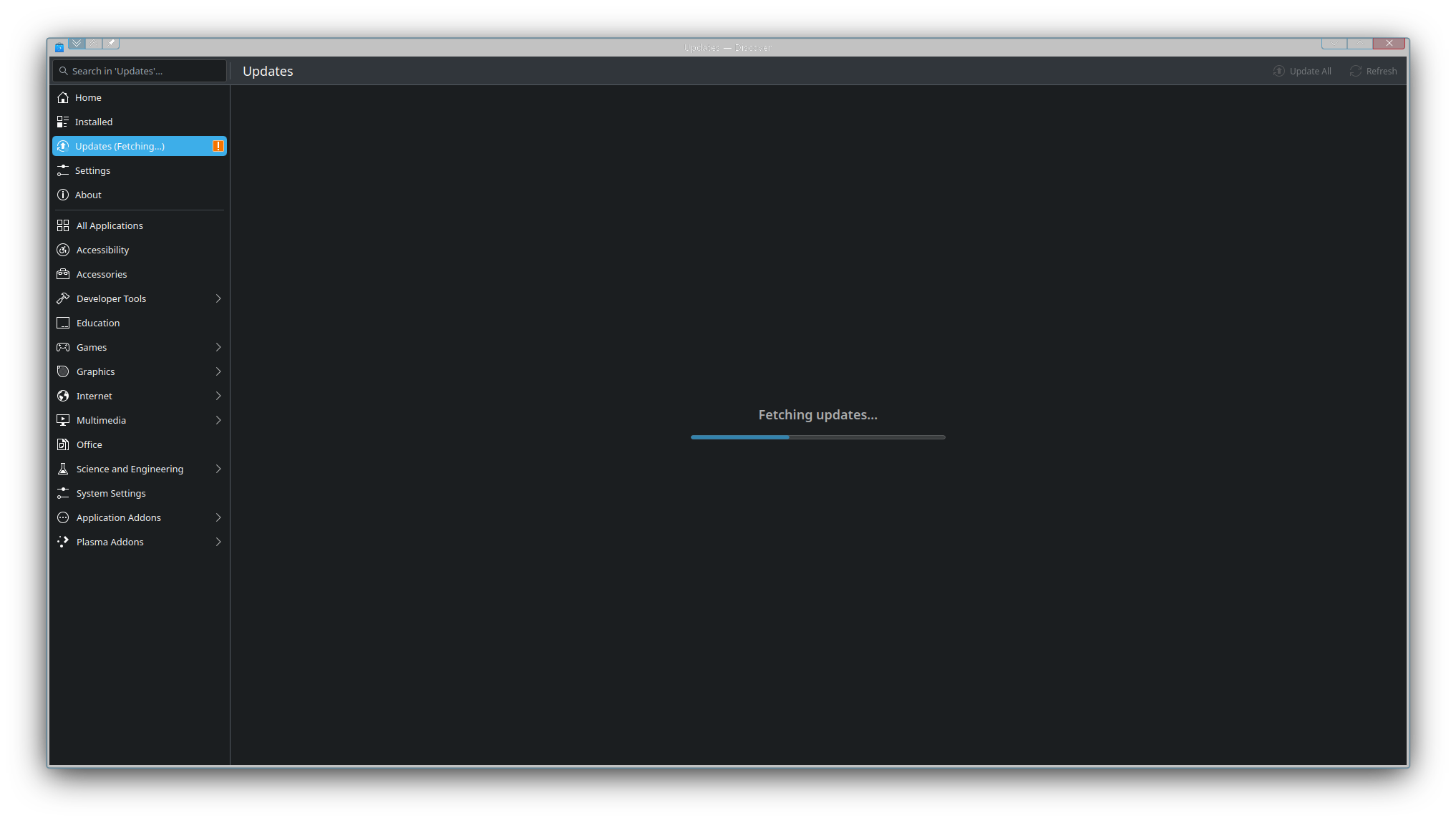
This is a thing in all KDE distros I know. Once Discover downloaded them, they will be installed on next shutdown / reboot.
Have not gotten this feature to work on Fedora, seems nice if it would work automatically
Never seen it. And KDE nags me incessantly about updates.
You can change the update notification frequency somewhere in settings. Pretty sure you can disable it too.
The problem is not that it nags me, the problem is that it expects me to manually approve updates.
I believe there's a setting either in Discover (the KDE "app store") in the main plasma settings (somewhere in the "updates" section? That might be somewhere else, I don't remember) that will automatically install updates without you needing to approve them.
And there's also a setting that will wait to install them until the next boot. When I had that setting on, it only added maybe 10 seconds to my startup time when I needed to apply something like a kernel update.
There is. It doesn't do anything.
yay --noconfirm && poweroff
I think you may have glossed over the "automatically" part.
Never actually shuts down for me. Always have to shutdown manually after the update.
Not really going to debate the efficacy, just the concept.
Kubuntu at least also has this option!
Theres an option in Fedora KDE but it has never worked for me for some reason…?
Same.
I'm pretty sure it's a KDE setting somewhere as there are settings for everything.
Thanks man 👍
Sorry for not being more helpful, I do almost everything on the command line..
I think it's called muon, or these days discovery, maybe.. there you should be able to configure auto updates
But it's such an excitement!
Automatic updates don't give you the pleasure to see what changed and update and test new features out
When you run sid and update some times 7 times in a day 😁
Restarting is good for a computer's health, right? I think my Kubuntu laptop is the only machine in my house that averages less than two weeks of uptime
yes, iirc the general advice is to restart like once a week. its not a huge deal if you wait a little longer (two is fine) its just a guideline.
My CachyOS (Arch) desktop gets rebooted somewhat often because it suggests I reboot after some upgrades. I guess it's kernel upgrades, but I'm not sure which do and don't trigger that recommendation. Nor do I really know how important it is lol.
@unknown1234_5 I want my software to be updated in the background but limited to using only 10% of any resource (bandwidth, CPU etc) while doing so.
I can always set it to automatic somehow, but I never saw those utilities offering a maximum download speed or CPU/Disk utilization setting in any distro.