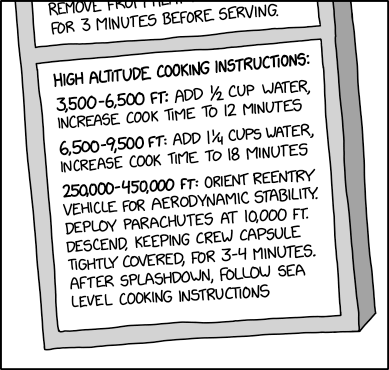
xkcd #3187: High Altitude Cooking Instructions
Title text:
1,300,000-1,400,000 ft: Ask a crew member to show you how to use the ISS food warmer.
Transcript:
Transcript will show once it’s been added to explainxkcd.com
Source: https://xkcd.com/3187/
A community for a webcomic of romance, sarcasm, math, and language.
xkcd #3187: High Altitude Cooking Instructions
Title text:
1,300,000-1,400,000 ft: Ask a crew member to show you how to use the ISS food warmer.
Transcript:
Transcript will show once it’s been added to explainxkcd.com
Source: https://xkcd.com/3187/
The higher altitude, the lower the atmospheric pressure, and the lower the boiling point of water. At 3300, you were down to 207°f. I used to work at a restaurant at 8k feet and we were down to a boiling point of 195, which was enough to make things like, say brownies, noticeable dryer if you didnt compensate for the extra water boiling off durrong cooking.
We actually had a fancy oven for pastry that you could set the pressure inside of, allowing us to cook things as though at sea level.
I don't know how much that is in the Boiling Water system
Meant to leave that context for for our metric friends, but my post was getting long so I shortened it. In Fahrenheit, water boils at 212°f and freezes at 32 at 1 atmosphere. (Sea level) the conversion rate is 1.8°f=°c (after subtracting those 32 'extra' degrees)
So at 207, his boiling point is only 5°f (3.33°c) lower than at sea level. Whereas where i was cooking, it was closer to 10°c - enough to considerably dry out anything baking for a decent amount of time, and throw a lot of baking chemistry off (anything leavening with baking soda, etc changes, and breads risk colapsing although that's less about the h2o, and more about the pressure iirc)
7k here, I really need to invest in a pressure cooker.