this post was submitted on 22 Oct 2024
-3 points (48.9% liked)
Linuxsucks
380 readers
83 users here now
For knowledge and awareness about what using Linux is really like and pointing at its cultish toxic community. We also cover FOSS /FLOSS failures, and issues with GPL since it relates to Linux. Moderation is heavy handed to appeal to our target users.
Rules:
- FOSS (especially GPL) advocates and Linux (specifically GNU/Linux) evangelists aren't welcome (GNU Hurd will count as Linux). -We ask that you block us and we will perma-ban for violations of this rule.
- Try to stay on topic (that is LINUXSUCKS!). No bashing other OSs or each other. We aim for a cohesive non-toxic community with the interest of cautioning people / would be victims from Linux. At our discretion, we will remove what we consider pollution.
- Moderators run the sub, not the users. It's not democratic, and we don't care how you think it should be run. -Feel free to make and run your own community.
- "Not your Billboard" -Over-represented companies will have positive posts removed and appropriate bans may be issued. -Those companies included so far will be Valve/Steam/Proton, Google, and Brave (browser).
Linux/FOSS can damage hardware or firmware
Linux running servers isn't a brag
Is Linux Running Games Near Windows Performance Impressive?
Wasted Ram on Different Toolkits and Distro-Agnostic Packages in Linux
Critical ISS Systems do NOT run Linux
Abandoned Software is Dangerous (and common on Linux)
FOSS Devs Quit and Sellout on Unappreciative Userbase
Firmware Flashing is Riskier on Linux
Linux Community Toxicity Ties Directly into Inferiority Complex Psychology
How Linux Stores Browser Passwords is a Security Issue
The Psychology of Conspiracy Thinking
Rabid LiGNUxers Ignorantly Get Angry at Devs
Does Linux Dominate SuperComputers? -Yeah, but So What!
founded 2 years ago
MODERATORS
you are viewing a single comment's thread
view the rest of the comments
view the rest of the comments
Ye, some people just want to game and not care. Windows can do that, linux can't. And the market share is nowhere near what it needs to be to be a viable option.
Maybe for a small studio that can pick up the crumbs of the market, but no major studio benefits much from supporting linux
My out of the box set up process for getting a Steam Deck playing games was significantly simpler and less time consuming than with a Windows PC.
So linux absolutely can 'just game', even more straightforwardly than a Windows machine.
As for not being viable... you're saying that checking a few boxes in a your dev panel to make it so your next build supports approximately 5% of the market that you previously did not... that this has no major benefits ...
I mean... 5% more potential marketshare availability isn't major, but for approximately 0 additional cost seems, this seems like a no brainer, obvious benefit to me.
The ACs and Proton handle working on linux.
Proton is not paid for or developed by these studios.
Thats the magic of Proton, it functionally ports everything designed for Windows automatically, at no cost to the game studio.
The ACs already include linux/proton compatibility in their agreements with the game studios... they don't need to pay them more for supporting it.
This isn't like the game studios have to 'port' a game to linux, like the immense cost of porting a console game to PC, back before most game engines just had an 'export to whatever architecture' functionality.
This is 'We can choose to increase our potential player base by about 5%, for essentially 0 expenditure, but nah, fuck that, who wants a free buff to sales?'
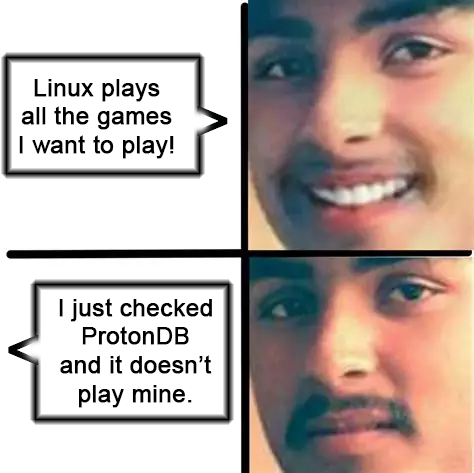
If you can "just game" then you wouldn't need a database just to check if your game might run at all
The point I am making is not that linux can perfectly run every game. Obviously it cannot.
The point I am making is that for many popular online games, the only reason that this is the case is because many game studios just don't bother to click a few options, which would cost them basically nothing.
... Anyway on a Steam Deck its super simple, the compatibility grade is just right there in the screen for looking at and potentially buying the game, simple color codes.
... Compared to a Windows PC where you'll need to check your hardware specs against the min and optimal specs and basically just guess how well you can run it.
Steam Decks, like consoles, all have the same hardware, so its a unified experience, simplified.
Anyone who has played PC games on Windows knows that you're probably gonna have to do research to figure out how to build or upgrade your rig to be able to play any given game at the fidelity and frame rate you want, which is significantly more time consuming, complex and disparate than looking at a single, built-in-to-your-gaming-device color grade that lets you know what to expect in 2 seconds.
Personally, I can't tell you how many times I've bought a PC game for Windows and oh oops, turns out the min specs are functionally unplayable, turns out the advertised graphics at a stated hardware level was false advertising, etc, etc.
Meanwhile, almost everything in my Steam Library works on a Steam Deck, with the most major exceptions being online multiplayer games that just refuse to enable their Anti Cheat to allow the game to run.
I wish it was that simple. Checking that box does not alleviate the extra work supporting an entire extra platform. One of such is doing to testing to give you that ez pz steam deck stat.
Also, those pc specs not working for you? That's a you problem, learn how to use a pc or join the console peasants
... When a game dev team/studio licenses usage of EAC, Battleye, or Denuvo, they are provided access to dev tools.
In those dev tools, they just need to select a few options (click a few boxes) to enable their game build to be compatible with the linux/proton versions of those AC systems.
These 3 ACs are on record stating, 3 years ago, that they already developed support for this, and all that game devs have to do is indicate that they want to use these features that they have already developed, support, and are included when licensing their use for a game.
This is typically why a game studio, or any software developer really, works out some kind of licensed usage agreement for many elements of pre existing code: It does a thing they want to be able to do, and does it more cost effectively than said studio developing their own solution in house.
... But I've already explained most of this to you multiple times.
As for pc specs... I've been building custom PCs since before 9/11. I've been modding all kinds of Windows games since 2003. I've done contract work for MSFT for a few years after I graduated University.
I understand how PC specs work, how gaming, and coding, on Windows PCs works.
I am attempting to illustrate how the ability to 'just game', on a Windows PC, is nowhere near as straightforward as you are implying it is.
But anyways, your responses have become increasingly bad faith and/or indicative of poor reading comprehension, so you're either not interested in, or capable of meaningful discussion, so I won't be entertaining you any further.
You can grab standard libraries and turn on features in software products. That does not mean it's set-and-forget. If it was, it would make my job a lot easier.
Build yourself a decent pc then if you know how it works, and yours doesn't perform as it should. Hint hint, mine have always done their job great even below the minimum specs of most games. It just takes some fine tuning