this post was submitted on 24 May 2026
1546 points (99.2% liked)
Work Reform
16408 readers
603 users here now
A place to discuss positive changes that can make work more equitable, and to vent about current practices. We are NOT against work; we just want the fruits of our labor to be recognized better.
Our Philosophies:
- All workers must be paid a living wage for their labor.
- Income inequality is the main cause of lower living standards.
- Workers must join together and fight back for what is rightfully theirs.
- We must not be divided and conquered. Workers gain the most when they focus on unifying issues.
Our Goals
- Higher wages for underpaid workers.
- Better worker representation, including but not limited to unions.
- Better and fewer working hours.
- Stimulating a massive wave of worker organizing in the United States and beyond.
- Organizing and supporting political causes and campaigns that put workers first.
founded 2 years ago
MODERATORS
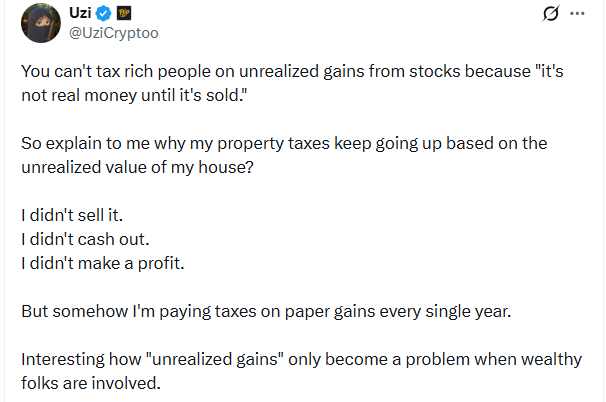
This was an interesting point I hadn't thought of before, so I wanted an alternate perspective since a Twitter meme is a little one sided, think of it what you will:
The system should take more of a cut, if that’s the argument we are going with.
Also? A new realization event should be defined: collateralization. When you take out loans against the value of your stock/bond/whatever holdings, you are realizing gains from those assets - you wouldn’t have gotten the line of credit otherwise.
People argue that this would prevent homeowners for taking equity lines of credit for improvements but that’s easily remedied by the collateral not being a real asset.
This is a pure red herring. County property assessors are a thing. We already have systems in place to address this concern.
Also of interest: Taxes aren't paid on stock buybacks which is why they became popular.
They’re not taxed because they used to be illegal and they shouldn’t ever be taxed because they should be made illegal again.
Should probably do both for when they inevitably become legal again.
If it’s good enough for weed at the federal level I guess it’s also good enough for cash.
Because that used to be illegal so there was no need to tax it
Yeah, that's sort of the whole point of the post. If I buy a stock for $1 today and still it for $10 tomorrow, I pay taxes on the gains tomorrow.
If I buy it for $10 today and sell it for $1 tomorrow, I claim it as a loss.
If I buy a house for $100k yesterday, I'm paying taxes on $400k property today, and $900k tomorrow. Even if tomorrow I sell it for $200k.
Funding schools by highly localized tax isn't universal. The US adopted it to make sure less affluent areas have worse schools. I believe the UK does similar things, but they also want marked differences between public and private school alumnus.
And most importantly: relentless lobbying by the wealthy to get rid of those taxes.
source on the size of the effects of lobbying vs flight risk?
I would like to agree with you, its just very not-obvious which influence dominates.
For most of our history, real estate was wealth. You needed property to grow crops, mine resources, build a factory, or do any kind of venture that would make money. It's only in the 20th century that we really start having a significant amount of wealth in stock markets that couldn't be directly traced to a physical asset. The robber barons figured that was a good excuse to stop taxing their wealth.
The main issue is that, once you have enough value in stock, you can take loans out against it, thus extracting the value of the stock without actually having to sell the stock.
Let's just say they won't pay with money seems to be their current position