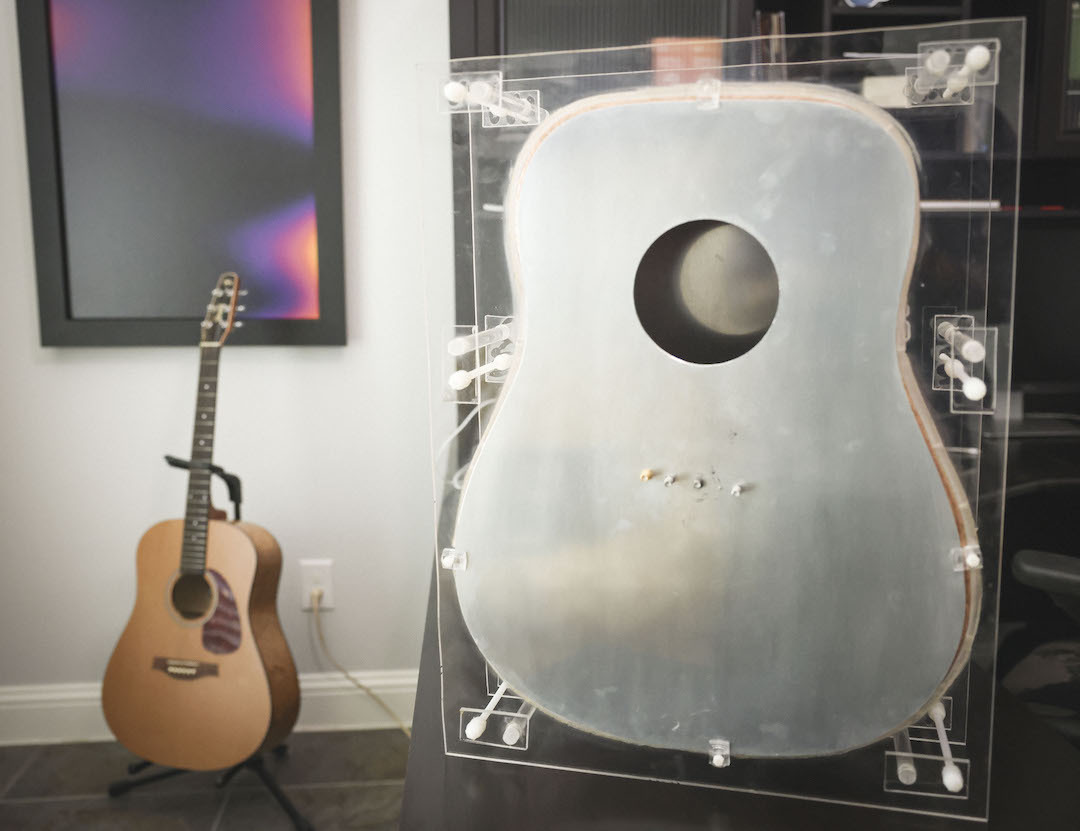
I created a new kind of guitar that y'all may be interested in. The photonic guitar uses the resonance of electricity and light to create music in the same way an acoustic guitar uses the resonance of vibration and acoustic waves. I started research on this instrument as a physics undergrad and focused on the topic for my Ph.D. After graduating, I spent time doing space science research for government agencies like NASA and the DoD. I quit being a professor a few years ago so I could resume research on my photonic guitar. We can't hear this instrument directly, for a variety of reasons, so I've created a plugin that utilizes measurements of these instruments to recreate their musical output as an effect for electric guitars. While the photonic guitar shares the same kind of physical foundation as an acoustic guitar, the photonic guitar is capable of a broader array of musical effects. I've linked to a demo of an electric guitar, played through the photonic guitar plugin, and connected to the drive channel on a fender amp. The photonic guitar pushes the existing distortion into a new regime. https://cosmicstudio.io/wp-content/uploads/2026/02/Demo-2-Master_1.mp3
Can you elaborate a little more on the instrument. It's electricity resonating in a coaxial cable and length changes the note? Why does that affect the speed of playing? We also can't move at the speed of sound (I know it's much slower than electricity but still much faster than humans) but we're able to play a guitar that works on sound principles.
Sure, I can try. Let’s back up a bit. First, I made the photonic guitar the same size and shape as an acoustic guitar so we’d get a similar physical response. While many resonance equations are typically written as a function of frequency it is really the size of the wave relative to the object that physically matters. Since the speed of light is roughly a million times faster than sound, the frequency range where light is the same size as the sounds we hear is a million times higher. 20 Hz - 20 kHz sound waves becomes 20 MHz - 20 GHz light waves.
The second part is the time response of a musical instrument can be described by ADSR, attack, decay, sustain, and release. Attack is the initial response of the instrument to a new note which then decays into the instruments sustained response as the note is held. Eventually the response ends, or releases. Suppose I measure an acoustic guitar’s ADSR at a particular frequency. While this would typically be expressed in time, it is physically more descriptive to express each portion of ADSR relative to the period, or the time for one cycle, of the test frequency.
We know acoustic guitars are good for music so a photonic guitar with the same ADSR as an acoustic would also be good for music. Let’s just consider one part, sustain. Suppose the sustain for an acoustic is 1000 periods at our test frequency. The photonic guitar equivalent wave at the same size has a frequency a million times higher, thus the time of a 1000 period sustain is a million times shorter. 1 second of music in our time is equivalent to 1 millionth of a second in photonic guitar music time.
So you've constructed the photonic guitar and you're able to play it, but the pitch is up about 13 octaves and it has functionally no sustain? (Edit: and that makes us unable to hear any playing.) Is there any way to refract the signal or something to make it travel a longer distance inside the same space?
And one other curiosity, how do you play it? How do you "pluck the string"?
And thanks for chatting, this is wicked interesting!
We can’t hear the photonic guitar because the music it creates is in the form of light waves. In absolute frequency the waves are also pitched high compared to our audio range. In musical terms though they are the same pitches and octaves as produced by an acoustic instrument. We can’t see the photonic waves either as the frequencies are too low for that. Plus the visual range doesn’t even cover an octave. The timescales are also too short so there’s a variety of reasons.
The ADSR was my attempt to use a physical example to motivate why the timescales are shorter for the photonic guitar. The photonic guitar has plenty of sustain relative to the timescales that its physical size sets.
You can use dielectric type materials to vary the wave speed within the photonic guitar.
Strings are plucked using an electrical impulse. This sucker’s electrical.
In practice though the instrument is played by using math and guitar measurements.
Thanks for the questions.
If you can get it to an electric signal, why can't you just put it through a transformer that would allow it to plug into a guitar amp?
Edit: would a transformer be able to change the octave?
It is in general possible to bridge between the two but requires custom and specific hardware.