NASA

1569 readers
7 users here now

Anything related to the NASA (National Aeronautics and Space Administration); the latest news, events, current and future missions, and more.

Note: This community is an unofficial forum and is unaffiliated with NASA or the U.S. government.

Rules

  1. Be respectful and inclusive.
  2. No harassment, hate speech, or trolling.
  3. Engage in constructive discussions.
  4. Share relevant content.
  5. Follow guidelines and moderators' instructions.
  6. Use appropriate language and tone.
  7. Report violations.
  8. Foster a continuous learning environment.

founded 3 years ago
MODERATORS
1
2


Article textJeff Foust

5–6 minutes

WASHINGTON — NASA has selected for development a space science mission that will study how space weather interacts with Earth’s atmosphere.

NASA announced June 18 that the Dynamic Atmosphere-Ionosphere Explorer, or DAPHNE, mission will proceed into the next phase of development, with a launch planned for no earlier than 2029.

DAPHNE was one of three concepts selected by NASA for study in 2024 for a mission concept called Dynamical Neutral Atmosphere-Ionosphere Coupling, or DYNAMIC, that was recommended by the heliophysics decadal survey in 2013 to examine the coupling between regions of the atmosphere and space weather.

DAPHNE will fly two identical satellites equipped with three instruments, dubbed MIGHTI, FUVI and PLATO. They will study conditions such as composition, temperature and winds in the thermosphere, a region of the upper atmosphere.

“Scientists have long studied how space weather affects Earth, but much less is known about how Earth’s lower atmosphere affects the upper atmosphere and space weather,” said Aimee Merkel, a researcher at the University of Colorado’s Laboratory for Atmospheric and Space Physics, or LASP, who is the principal investigator for the mission, in a statement. “DAPHNE will fill this major gap in scientific understanding and help answer long-standing questions about how Earth interacts with our sun.”

NASA did not disclose an estimated cost for DAPHNE but noted the DYNAMIC program has a cost cap of $250 million, excluding launch. A formal cost estimate will come at a confirmation review in 2027. Partnering with LASP on the mission are BAE Systems and the Naval Research Laboratory.

NASA bills the mission as part of a broader effort to understand space weather, with applications beyond Earth. “As NASA sends astronauts beyond Earth’s magnetic protection to the moon, Mars and beyond, DAPHNE will join the NASA science fleet strategically located across the solar system to provide data that will help mission planners predict and mitigate the effects of space weather for the benefit of all,” said Nicky Fox, NASA associate administrator for science, in a statement.

The selection of DAPHNE comes a month after NASA announced a revised strategy for its heliophysics division, one that puts a greater emphasis on the applications of research to society.

“We really want you to focus not only on the foundational science and the transformational science, on that critical innovation that only NASA can provide, but also connecting it to the applications, connecting it to the end users,” Joe Westlake, director of NASA’s heliophysics division, said at an online town hall meeting May 20.

“Can we clearly articulate how this discovery will eventually protect our power grid or our GPS or astronauts? Is the research applicable, or is it some niche science that only serves as sort of a single subdiscipline?” he said.

That shift, he said, involves going from research siloed in specific missions and disciplines to “strategic purpose themes” that he said will create “bigger, broader capabilities and science findings.” The division will also go from “curiosity-driven investigations” to “outcome-driven research.”

“We’re trying to push our researchers, push our science, into meaningful outcomes,” he said. “Instead of having randomly spread research across our activities, trying to drive it into a more strategic framework so that we can achieve the scientific outcomes that were asked for in the decadal survey.”

He and other division officials said that may affect how it solicits proposals for future missions, but they did not go into details during the town hall.

“Whether you’re somebody who embraces change or somebody who thrives in the routine, there is a shift that is coming,” Westlake said. “We have, as heliophysics, defined our community, but now we get to define what it means to everyone, what it means to society.”

3


"NASA's Earth Observatory brings you the Earth, every day: images, stories, and discoveries about the environment, Earth systems, and climate."

4


Article textJeff Foust

5–7 minutes

Swift Pegasus

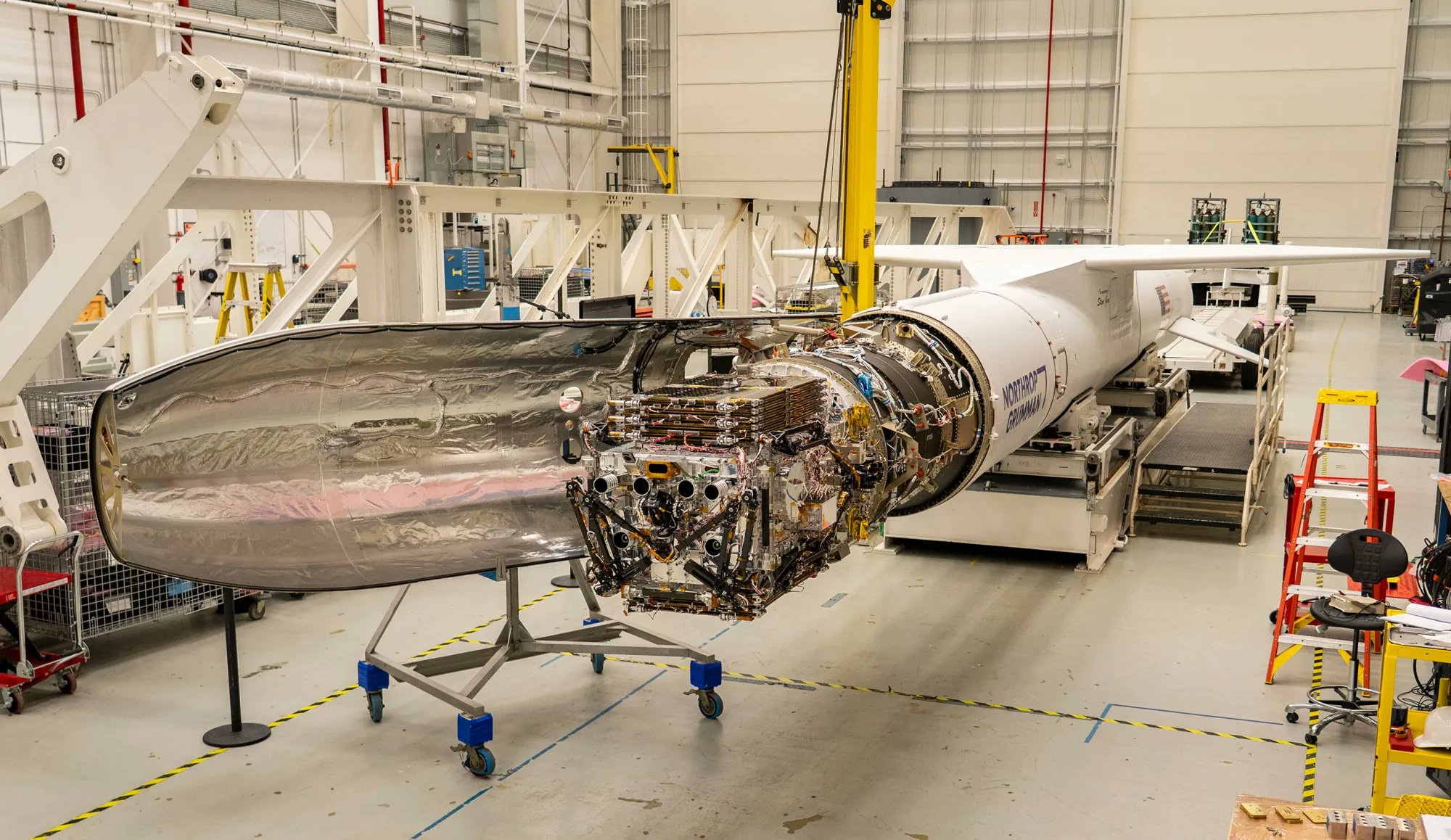
Katalyst Space’s Link spacecraft was recently installed on the Pegasus rocket that will launch it in late June on a mission to raise the orbit of NASA’s Swift gamma-ray observatory. Credit: NASA

WASHINGTON — A high-risk mission to raise the orbit of a NASA astrophysics spacecraft is set to launch later this month after less than a year of development.

Link, a spacecraft developed by Katalyst Space Technologies, is scheduled to launch June 27 on a Northrop Grumman Pegasus XL rocket. The air-launched vehicle will operate out of Kwajalein Atoll in the Pacific Ocean.

Link is designed to approach and then grapple NASA’s Neil Gehrels Swift Observatory, a gamma-ray observatory in low Earth orbit. The orbit of that spacecraft, launched in 2004, has been decaying due to atmospheric drag and could reenter as soon as late this year. Link will raise Swift’s orbit, allowing it to continue operations for years to come.

NASA selected Katalyst last September to develop Link under a $30 million contract. While the reboost mission has yet to launch, officials said simply getting to this point was a success.

“I have to be honest, no one thought it was going to be possible. No one thought we would get as far as we’ve already gotten today,” said Shawn Domagal-Goldman, director of NASA’s astrophysics division, at a June 17 briefing at NASA’s Wallops Flight Facility, where Link was integrated with the Pegasus rocket.

He credited both the teams at Katalyst and Northrop for being ready to launch quickly, as well as those within the agency. “People didn’t think the agency itself could bureaucratically do something this fast, and yet we did.”

“Over the last nine months, we have gone from a clean sheet to a spacecraft that is currently integrated on a rocket on an airplane ready to go to Kwaj for launch,” said Kieran Wilson, principal investigator for Link at Katalyst. “This is an absolutely unprecedented development timeline.”

He credited the “exceptional urgency” NASA emphasized in the mission requirements. “When we set out, one of the very few requirements from the NASA team was, you must launch before it’s too late, and we have been able to meet that readiness timeline.”

Link must launch and reach Swift before that spacecraft’s altitude descends below 300 kilometers. Brad Cenko, principal investigator for Swift at NASA’s Goddard Space Flight Center, said Swift should reach that altitude in October based on current estimates of the spacecraft’s decaying orbit.

“At the moment we think we have several months where Swift will be at a sufficiently high altitude to give Katalyst folks a great chance to capture and boost us,” he said.

That capture and boost will be risky. Swift was not designed to be serviced and lacks grappling fixtures that Link could use. Link is also Katalyst’s first satellite servicing mission.

Wilson said the docking will be helped by the fact that Swift is still operational and can control its attitude. “Swift is an unprepared but cooperative partner in the rendezvous,” he said.

As Link approaches within tens of meters, Swift will maneuver in tandem, allowing Link to inspect potential capture locations and determine which are free of debris, such as crumbling multilayer insulation, that might interfere with grappling.

“We have primary, backup and secondary backup options for features that we believe are suitable for capture using our robotics,” he said. Link is equipped with three robotic arms that will attempt to attach to different points on Swift, but the reboost mission can proceed with only one arm attached to Swift.

He argued, though, that the risks of the capture and reboost were secondary to simply getting the spacecraft ready in time. “When we kicked off the program, I think everyone recognized the biggest risk would be that we weren’t ready to launch in time,” he said. “We have been able to retire that risk over the last few months by building, testing, getting ready to operate a spacecraft.”

“We’re confident that as long as we have a spacecraft that can function at a fundamental level, that gives us the freedom and flexibility to work through any issues that we find during rendezvous and the more challenging dynamical operations,” he added.

“From a programmatic standpoint, I consider this a success already just from the fact that we’re even going to try this,” Domagal-Goldman said.

He acknowledged there are risks remaining regarding Link’s ability to capture and reboost Swift, as well as uncertainties about space weather conditions that could accelerate Swift’s orbital decay and complicate the reboost effort.

“There still might be risks that we cannot control ahead of us,” he said. “I’m just deeply thankful that we’re even giving this a go.”

5
6
5
submitted 1 week ago* (last edited 1 week ago) by billionsandbillions@piefed.social to c/nasa@lemmy.world


"NASA satellites document how our world—forests, oceans, human landscapes, even the Sun—changes over months, seasons, and years."

#earth #space

7
8


Expand for full textStarting with some energy, and my inability to write brief updates, I am just extremely proud of the NASA crew, our industry, and our international partners. We are getting into a rhythm here at NASA. Earlier this year, setbacks put the Artemis II rocket back in the VAB for repairs, and we determined it was necessary to add another mission, Artemis III in 2027. Since then, we have unveiled the Ignition plans to build a Moon Base and nuclear-powered spaceships, launched a highly successful mission around the Moon, brought the crew home safely, and now watched the torch pass to Artemis III. There will be no shortage of major milestones to celebrate in the months ahead as we build the Moon Base and launch the Nancy Grace Roman telescope. I am beyond proud of the team and all the momentum and excitement around the space program.

I do want to take this moment to address two of the questions I have been seeing since the crew announcement.

Why are there no women assigned to Artemis III?

I have seen reactions ranging from disappointment to outrage. I have personally been to space twice with 50% female crews. My closest advisors and some of the smartest engineers I know are women. In our latest NASA leadership organization, nearly 50% of the Center Directors and Mission Directorate leadership are women. The last astronaut candidate class selected under this Administration was majority female because they were the best of the best, including one astronaut I previously went to space with.

In a world with so much controversy, I hope this can be a moment where we celebrate the astronauts selected, respect the integrity of the process, and recognize the extraordinary depth of talent across the entire corps. The crew selection does not involve any political appointees. The Astronaut Office assigns the crew that gives the mission the best chance of meeting its objectives, taking into account many factors, including the background and expertise of the astronauts, such as test pilot experience, development work on specific programs, and availability. For example, those raising this concern may not be aware of the pipeline of crews already preparing to launch to the Space Station, or those who have been undergoing lunar-specific training that would be a better fit for a future surface mission.

The Artemis III astronauts are experienced, qualified, and deserve to be celebrated for the mission they have been assigned, just as the crews that follow will be celebrated when their time comes. We have an extraordinary astronaut corps, and every mission and every crew is part of a larger campaign to get America back to the Moon and to build the future we all dreamed about as children.

What are the objectives for Artemis III if both landers will not be fully ready?

Coming off a highly successful lunar mission like Artemis II, it is not surprising that the bar is set high for Artemis III. I think it is important to understand how difficult and dangerous it is to land astronauts on the Moon. We have not done it in a very long time, and we want to draw from a past playbook for success. That means getting into a cadence of launching, learning, and rolling improvements into the next mission.

First and foremost, it is imperative for SLS to be flying with some frequency for operational currency and, honestly, safety. Earlier this year, it was very clear across NASA leadership that an additional mission was necessary in 2027. It is also imperative to gain interoperability data from rendezvous and docking with landers in Earth orbit. We do not need those landers that are still in development to be fully capable and certified for landing on the Moon on Artemis III, but we do need to test certain systems and controllability. Not to mention, we are moving quickly into a future where we do not require a single rocket to bring everything necessary for a mission to space, and as such, gaining experience with multi-launch campaigns and on-orbit assembly is directionally correct.

The Blue Origin test lander for Artemis III will incorporate many of the most important systems and subsystems that have not previously been operated by the provider, including ECLSS in a crew cabin, and other avionics. With SpaceX, they have demonstrated many of those capabilities continuously on Crew Dragon, but other controllability tests are important based on the negative-X axis acceleration that will be necessary when Starship undertakes the TLI burn to the Moon with a docked Orion.

After Artemis III, we will learn a lot and roll in further improvements, be that hardware, software, or procedural updates, as both providers undertake end-to-end uncrewed demonstrations to the surface in 2028, in advance of Artemis IV, where NASA astronauts will finally complete the grand return to the Moon.

As I said in my remarks yesterday, when Gene Cernan left the lunar surface on Apollo 17, he said, “We leave as we came, and, God willing, we shall return, with peace and hope for all mankind.” We are returning, and we are doing so with the fire carried forward from Apollo, the lessons learned from Artemis II, the crew of Artemis III, and all those who will follow. NASA will send the very best crews for the right missions. If the composition of our astronaut corps and our latest class of candidates says anything, it is that we have exactly the talent required to get the job done.

Godspeed Artemis III, and all those who will follow.

https://x.com/NASAAdmin/status/2064702792023879811

9
10


Article textJeff Foust

4–5 minutes

WASHINGTON — As NASA prepares an attempt to reboost an astronomy spacecraft in a decaying orbit, the agency is open to doing something similar for the Hubble Space Telescope, provided its operating costs can be reduced.

NASA announced June 5 that the Link servicing spacecraft built by Katalyst Space had arrived at the Wallops Flight Facility in Virginia. The spacecraft had been at Katalyst’s Colorado facilities for final preparations after completing environmental tests at the Goddard Space Flight Center last month.

At Wallops, NASA will integrate Link with the Northrop Grumman Pegasus XL rocket that will launch it. That launch is projected for later this month, although NASA has not announced a launch date.

NASA awarded Katalyst a $30 million contract last September to develop and launch Link. Once in orbit, it will rendezvous with and attach to NASA’s Neil Gehrels Swift Observatory, a gamma-ray observatory whose low Earth orbit is decaying because of atmospheric drag. Link will attempt to reboost Swift so that it can continue its observations.

The agency has acknowledged that this is a high-risk mission: Link will be Katalyst’s first mission, and Swift was not designed for on-orbit servicing.

“This has always been a long-odds effort. Any time you try to go from the boardroom to the launch pad in a year, you’re taking on a lot of risk, and we are here,” said Shawn Domagal-Goldman, director of NASA’s astrophysics division, during a June 1 meeting of the Astronomy and Astrophysics Advisory Committee.

NASA is doing it, though, because of the return on investment from extending Swift for a fraction of the cost of replacing it. “Also, we think it’s a good way to signal demand to the commercial community that we are here to do things like this when they do make sense from that ROI standpoint.”

That could include reboosting a much larger spacecraft, the Hubble Space Telescope, whose orbit is also gradually decaying. At an American Astronomical Society conference in January, Jennifer Lotz, director of the Space Telescope Science Institute, said models of its orbit provided a median reentry date of 2033.

Domagal-Goldman said the effort to reboost Swift offers a model for Hubble. “These reboost things are now not just available to us as an agency, but the costs are lower than I think I anticipated,” he said. “That does make that return on investment more enticing.”

One issue, though, is the high cost of operating Hubble. NASA spent $98.8 million on Hubble in fiscal year 2025, second only to the James Webb Space Telescope. “It was built in a different era, and it’s more costly to maintain and to get the best science out of it,” he said.

NASA’s Science Mission Directorate has been grappling with the costs of extended missions, and officials have discussed their desire to reduce costs to free up funding for new missions. Domagal-Goldman said NASA would need to find a way to reduce Hubble’s operating costs to make a reboost affordable.

“We are open to a reboost of Hubble,” he said. “So, we have to first figure out how we’re going to bring down the operations costs.” He did not say how much of a reduction in operating costs NASA was seeking.

If that is possible, he said, Hubble might be able to operate for many more years once its orbit is raised. “It could be a nice bridge to the Habitable Worlds Observatory,” the next large optical and ultraviolet space telescope NASA is developing for launch in the 2040s.

11
12


"NASA's Earth Observatory brings you the Earth, every day, with in-depth stories and stunning imagery."

#nasa #space #photography

13


cross-posted from: https://lemy.lol/post/66631015

Article textJeff Foust

5–6 minutes

WASHINGTON — NASA is working on a streamlined management approach for a nuclear electric propulsion demonstration mission the agency wants to launch in two and a half years.

NASA announced the Space Reactor 1 (SR-1) Freedom mission at its Ignition event in March. The mission would be the first flight demonstration of nuclear electric propulsion, with a nuclear reactor providing power to electric thrusters to send the spacecraft to Mars.

Unlike some other initiatives announced at Ignition, including a lunar base and proposed changes to support commercial space stations, NASA has provided few updates on SR-1 Freedom since the event, even though the agency said then it plans to launch the mission at the end of 2028.

At a June 2 meeting of the National Academies’ Aeronautics and Space Engineering Board and Space Studies Board, NASA officials said the agency discussed planning for SR-1 Freedom at a management council meeting the previous day.

“We talked through the intent to streamline the processes that we’re going through for the development” of the mission, said Lori Glaze, NASA acting associate administrator for exploration systems development. That involves remaining compliant with existing NASA project management requirements “and yet make sure we’re tailoring that to the needs to allow us to go faster.”

“We are, as an agency, very focused on trying to identify the barriers to going quickly and identify how we can try to speed up decision-making,” she added.

The rapid schedule for SR-1 Freedom is enabled by using existing hardware. The Power and Propulsion Element (PPE), the electric propulsion system built for the lunar Gateway, will be repurposed for the mission.

“It’s very far along in its development,” Glaze said of the PPE. “Yes, it will require some modifications, but we’re not starting from zero. We have a spacecraft.”

The nuclear reactor will also leverage existing designs for research reactors by the Department of Energy, although NASA has provided few details about it. “We are in very close collaboration with the Department of Energy,” she said, including modifying a memorandum of understanding between the agencies.

NASA has said little else about how the spacecraft will be built. Designs of the spacecraft released at Ignition show it will have a long truss separating the reactor from the rest of the spacecraft, as well as radiator panels for heat rejection.

SR-1 Freedom will transport to Mars SkyFall, a spacecraft that would deploy in the Martian atmosphere three helicopters based on the Ingenuity rotorcraft that accompanied the Perseverance rover.

“We’re trying to leverage as much as we can with as little new development as possible,” she said. “I know that’s a challenge and always sounds good on paper, but that’s the intent.”

The agency has not disclosed a cost estimate for SR-1 Freedom, and the mission was not included in NASA’s fiscal year 2027 budget request released a week and a half after Ignition.

Glaze did not disclose the projected cost for SR-1 Freedom at the National Academies meeting. She said the mission would make use of funding proposed in the 2027 request along with funds from last year’s budget reconciliation bill, which provided $2.6 billion for the Gateway.

“We’re in the process of looking through how we’re going to realign the resources we have to make sure they have what they need,” she said. The agency does not have a cost estimate for the mission yet, “but right now it all fits.”

Board members expressed some skepticism about the accelerated schedule for SR-1 Freedom, with one noting a two-year development timeline was more consistent with a cubesat. A review analogous to a preliminary design review is planned for the fall, she said, but noted that would be tailored to the streamlined management approach the agency is adopting for the mission.

“It is ambitious. It’s a challenge,” she said of the project and its schedule. “It doesn’t mean we’re going to be successful, but I can tell you we’re doing everything we can to meet the challenge.”

14
15
16


Article textJeff Foust

5–6 minutes

WASHINGTON — NASA has formally ended a Mars mission that has been out of contact for six months while the investigation into the spacecraft’s demise continues.

NASA announced June 3 the end of the Mars Atmosphere and Volatile Evolution, or MAVEN, mission when a review board concluded that the Mars orbiter was in an unrecoverable state after suffering some kind of anomaly in December.

Controllers last heard from MAVEN on Dec. 6, which was working normally as it passed behind Mars as seen from Earth. When it emerged 20 to 30 minutes later, NASA’s Deep Space Network (DSN) failed to detect transmissions from the spacecraft.

Efforts to restore contact in the weeks that followed were unsuccessful, said Mike Moreau, MAVEN project manager at NASA’s Goddard Space Flight Center, during a June 3 media call. That included using the DSN as well as the 100-meter radio telescope at Green Bank Observatory in West Virginia.

“Unfortunately, all of these efforts to reestablish communication with MAVEN were ultimately unsuccessful, and no telemetry or signal has been received from the spacecraft since Dec. 6,” he said.

Investigators, though, were able to recover a bit of telemetry from the spacecraft hours after the loss of contact as part of a radio science experiment to study the Martian atmosphere. “That data has been very helpful to the anomaly review team to try to provide at least some information about what happened,” he said.

Based on that data, investigators concluded that the spacecraft was rotating at an “unexpected rate” of 2.7 revolutions per minute, he said. The spacecraft, in normal operations, is inertially stabilized and not intended to rotate. That rotation deprived the spacecraft of solar power and drained its batteries over several hours, “rendering the spacecraft in an unrecoverable state.”

The investigation has yet to determine a root cause for the failure, and Moreau declined to discuss what leading potential causes are being studied. A final report by the review team is expected in a couple of months.

MAVEN launched in November 2013, entering orbit around Mars in September 2014. The spacecraft was designed to study the planet’s upper atmosphere and how it interacted with the solar wind, including how the atmosphere escapes into space.

“We now have a better understanding of atmospheric escape at Mars than at any other planet, including Earth,” said Shannon Curry, principal investigator for MAVEN at the University of Colorado’s Laboratory for Atmospheric and Space Physics.

MAVEN conducted other science as well, from the serendipitous detection of X-rays from a black hole binary system 9,000 light-years away to observations of the interstellar comet 3I/ATLAS months before the spacecraft was lost. “MAVEN science has had incredible implications for not just atmospheric evolution at Mars, but planetary science, heliophysics and even astrophysics,” she said.

The spacecraft also served as a communications relay between spacecraft on the surface and the DSN, along with other NASA and European Space Agency Mars orbiters collectively known as the Mars Relay Network. MAVEN played an outsized role in that effort, conducting 8% of the network’s relay sessions but handling 18% of the data returned, said Tiffany Morgan, director of NASA’s Mars Exploration Program.

Four other spacecraft — NASA’s Mars Odyssey and Mars Reconnaissance Orbiter, and ESA’s Mars Express and Trace Gas Orbiter — continue to serve as relays. “There’s been some small adjustments to rover operations,” said Greg Heckler, deputy program manager for capability development in NASA’s Space Communications and Navigation program, but no “science deficit.”

“There is a slight delay on occasion because we don’t have as many assets in view to getting our science data back,” Morgan said. “MAVEN was critical in returning science data versus operational data, but the Mars Relay Network is resilient enough at this point in time to accommodate, for the most part, the loss of MAVEN.”

The loss of MAVEN underscores the importance, officials said, of the Mars Telecommunications Network (MTN) mission. Last year’s budget reconciliation package included $700 million to fund a mission to handle communications for current and future Mars missions, with a requirement that it be launched by the end of 2028.

There is an “urgency” in getting MTN in service, Heckler said. “NASA establishing this infrastructure is going to be very important to continue science operations of the current missions there today, and then, of course, enable us to execute on these newer, bigger missions yet to come.”

NASA released the final request for proposals for MTN in May, with proposals due to the agency June 15. The agency said when it released the RFP that it expects to have the winning company under contract by Oct. 1.

MAVEN is currently in an orbit between about 200 and 4,000 kilometers in altitude. Moreau said the spacecraft should remain in orbit for 50 to 100 years before reentering. As part of mission closeout activities, he said the project will do a “long-term propagation” of the spacecraft’s trajectory so other missions can avoid any potential close approaches.

17


Article textJeff Foust

5–6 minutes

A concept presented by NASA March 24 called for the agency to procure a module attached to the ISS that could serve as the core of a commercial station. Credit: NASA

WASHINGTON — NASA is withdrawing a proposal to revamp its strategy for transitioning from the International Space Station to commercial stations, one that had been sharply criticized by the companies developing such stations.

In a June 1 statement, NASA press secretary Bethany Stevens said the agency was effectively abandoning a proposal to develop a new “core module” for the ISS that commercial modules could attach to.

NASA floated the proposal at its Ignition event in March, arguing that the market for commercial space stations had not developed as NASA had anticipated. The government-owned core module, the agency argued, could provide a bridge to standalone commercial stations.

“Though we have seen investor interest, there’s no independently verifiable market research indicating the economic viability of a commercial station that is only partially funded by NASA,” Dana Weigel, NASA ISS program manager, said at Ignition.

NASA issued a request for information seeking industry input on the core module concept along with the existing strategy to support development of stations through funded Space Act Agreements and contracts to purchase services from those stations. Industry officials made clear in interviews and public appearances that they used the RFI to express their opposition to the core module proposal.

“It was a surprise,” said Jonathan Cirtain, chief executive of Axiom Space, of the proposed core module in an onstage interview at the ASCEND conference May 19. “Adding that government-owned component wasn’t all that well received, at least by us.”

He and others argued that there was a market big enough to support one or more commercial stations when combining NASA and the other Western ISS partners, along with other national governments and the small but growing commercial interest in stations in areas like microgravity research and manufacturing.

“The PAM missions have proven that more and more nations that are not involved in the ISS are willing to fly astronauts,” said Max Haot, chief executive of Vast, in another ASCEND session, referring to private astronaut missions to the ISS. “The market is sovereign governments, and it’s a growing market.”

Marshall Smith, chief executive of Starlab Space, noted on the same panel that his company had turned in hundreds of pages of reports and analyses as part of its response to the RFI, making its case that there was a market for commercial stations. “I think that the market is there,” he said, a conclusion also based on customers the company has signed up for its station. “We’re 140% oversold for commercial space.”

Industry was also skeptical that a government-owned core module could be built quickly, extending the life of the ISS well into the 2030s.

“A government-owned module really means ISS 2.0,” Haot said. “We’re definitely manifesting that reason will prevail.”

Those companies’ arguments appeared to convince NASA. “Industry has provided extensive feedback making the case for a sustainable commercial market in which NASA is one customer among many, along with assurances regarding available transportation capabilities,” Stevens stated. “The industry position will now shape the path forward as NASA proceeds with the original commercial strategy.”

She said that NASA will work with companies “to refine flexible requirements and acquisition plans” with the goal of releasing a draft request for proposals later in the month.

Haot was among those who welcomed the announcement. “Thank you, @NASAAdmin, for the collaborative dialogue and for giving the commercial space station industry the opportunity to compete for NASA’s business and win the privilege of building the ISS successor for the U.S. and our allies,” he said in a June 1 social media post.

18
19
20
21
22
23


Article textJeff Foust

~3 minutes

WASHINGTON — The U.S. Senate confirmed Matt Anderson on May 18 as NASA’s deputy administrator, the second-in-command of the space agency.

The Senate voted 46-43 along party lines to confirm a group of nominees to various government positions, including Anderson as NASA deputy administrator.

Anderson, a retired Air Force colonel, was first nominated by the Trump administration in May 2025. The nomination was returned by the Senate at the end of the year after it did not act on it, and the White House renominated Anderson in January, about a month after Jared Isaacman was confirmed as administrator.

At a March 5 confirmation hearing, Anderson said he would work with Isaacman to advance a national space policy that calls for returning NASA astronauts to the moon by 2028 and establishing a lunar base.

“If confirmed, I will reinforce the culture of safety, accountability and transparency that Administrator Isaacman has recently outlined to NASA as well as the American public,” he said at the hearing.

He said that getting humans to the moon before China lands its first astronauts there was the “absolute highest priority” for the agency.

Anderson received bipartisan support at the hearing, and the committee voted 23-5 to advance the nomination to the full Senate on March 12.

“As deputy administrator, Anderson will help oversee NASA’s operations and strategic initiatives as the agency works to deliver on President Trump’s National Space Policy and strengthen America’s leadership in space,” NASA said in a statement after the Senate confirmed Anderson.

With Anderson’s confirmation, NASA has filled two of its four positions that require Senate confirmation. The White House does not have active nominations for the other two positions, chief financial officer and inspector general.

24


Article textJeff Foust

5–7 minutes

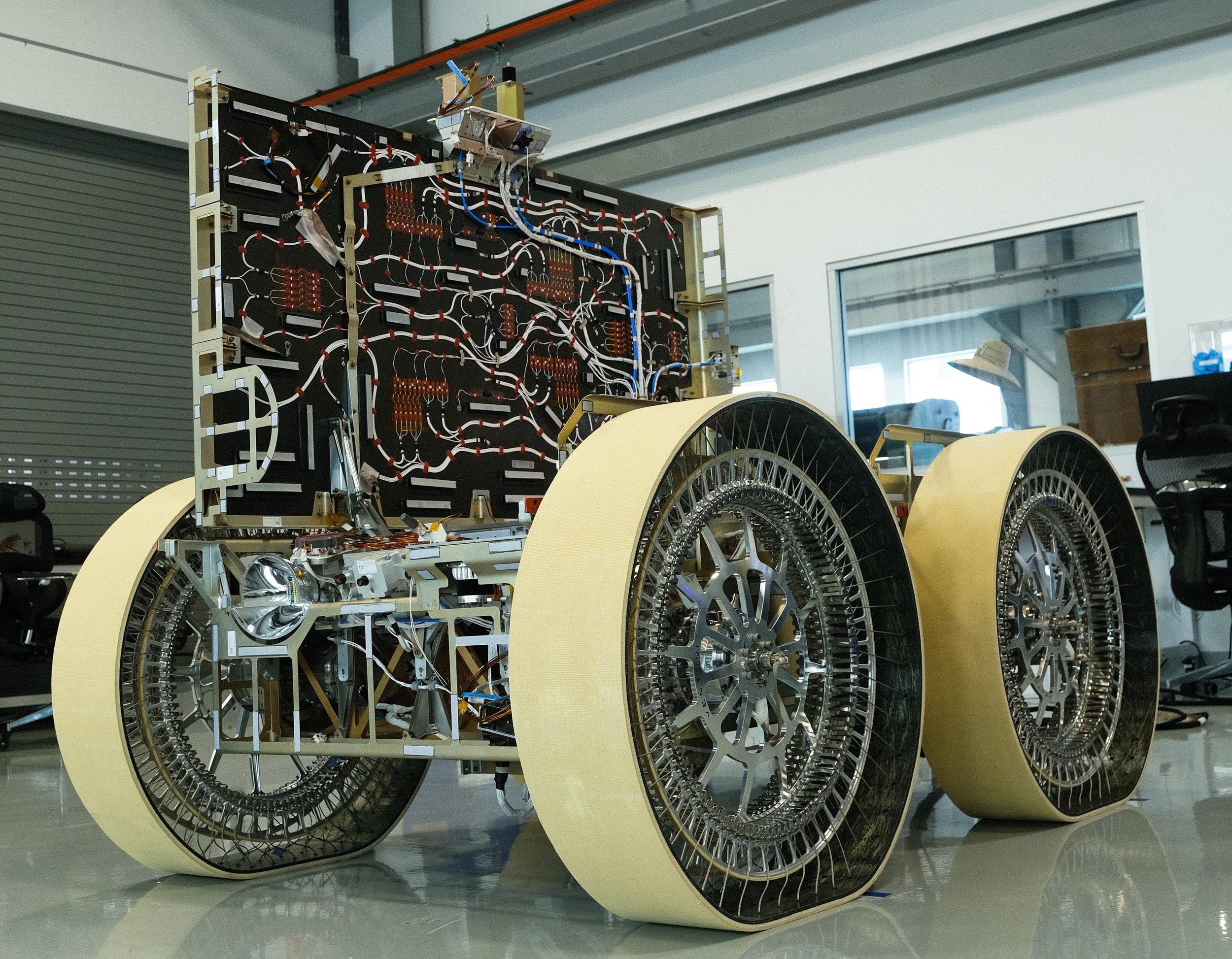
Astrolab’s FLIP rover is shown at the company’s headquarters in Hawthorne, California. FLIP will carry payloads from four NASA centers to the Moon’s south pole aboard Astrobotic’s Griffin-1 lander as part of NASA’s Commercial Lunar Payload Services initiative. The mission is slated for launch in late 2026. Credit: Astrolab

Astrolab’s FLIP rover is shown at the company’s headquarters in Hawthorne, California. FLIP will carry payloads from four NASA centers to the Moon’s south pole aboard Astrobotic’s Griffin-1 lander as part of NASA’s Commercial Lunar Payload Services initiative. The mission is slated for launch in late 2026. Credit: Astrolab

WASHINGTON — Astrolab’s first lunar rover will carry four NASA payloads on a mission planned to launch later this year.

Astrolab announced May 18 that it had reached agreements with four NASA centers to fly payloads on its FLEX Lunar Innovation Platform, or FLIP, rover scheduled to launch on Astrobotic’s Griffin-1 lander late this year.

NASA’s Ames Research Center is providing the Moon Exploration for Titanium with Active Lighting, or METAL, a camera and radiometer designed to identify helium-3 deposits in lunar regolith. METAL is being developed in partnership with Interlune, a company that previously announced plans to fly a helium-3 prospecting payload on FLIP.

The other payloads are a lunar retroreflector array from the Goddard Space Flight Center; the Lunar Dust level sensor and Effects on Surfaces, or LDES, payload from the Johnson Space Center to study dust-induced degradation of key spacecraft systems; and a lidar demonstration payload from the Marshall Space Flight Center.

Jaret Matthews, founder and chief executive of Astrolab, said in an interview that his company reached out to individual centers to see what payloads they had available for FLIP, particularly those “that were ready to go and fit the bill in terms of the science that we think was particularly helpful for future missions.”

The payloads are flying through nonreimbursable Space Act Agreements, with no money changing hands between NASA and Astrolab. That allowed the agreements to be negotiated faster, fitting into the schedule for completing FLIP in time to launch on Griffin-1.

“And it was out of a genuine interest to try to get some really good science out of this mission for NASA and for future moon base elements,” he added.

FLIP is effectively complete now, he said, and will soon begin environmental testing, including shock, vibration and thermal vacuum tests. Astrolab has previously done similar environmental testing on elements of the rover, giving the company confidence in the upcoming tests.

Matthews said Astrolab expects to complete the tests and have FLIP ready by the end of the summer for delivery to the launch site, where it will be integrated onto Griffin-1. That lander is slated to launch late this year on a Falcon Heavy from the Kennedy Space Center.

While Astrolab has been getting FLIP ready for flight, the company has also been busy updating a proposed rover for NASA’s Artemis lunar exploration campaign. Astrolab was one of three companies, alongside Intuitive Machines and Lunar Outpost, selected for NASA’s Lunar Terrain Vehicle, or LTV, program to develop a rover for future Artemis missions.

At NASA’s Ignition event in late March, NASA announced it would not select any of the proposals submitted last year by the three companies, asking them instead to provide revised concepts for a smaller, simpler rover that could be ready as soon as 2028. Those proposals were due to NASA on May 1.

One of the major changes, Matthews said, was that NASA was taking over responsibility for delivering the rovers to the moon, rather than allowing the companies to arrange their own delivery services. NASA put requirements on the mass and dimensions of the rovers so they could be flown on landers through the Commercial Lunar Payload Services contract.

“They defined the mass and volume in which we had to fit, and it was substantially smaller than what we were previously working with,” he said. “So, we did have to overhaul the design in quite short order to fit within the new bounding box.”

The company has not disclosed details about the design it offered to NASA, but Matthews said it retains some of the hallmarks of its earlier concept. “It will be recognizable as an Astrolab product, I would say.”

He said NASA informed the companies that the agency planned to make awards on May 22, a timeline other companies involved in LTV have stated. NASA wants the companies to have their rovers ready 18 months after the award.

“I think we’re well suited to do that because we just did it with FLIP,” he said, adding that many of the technologies for its LTV rover will be tested on FLIP. “That being said, LTV is going to require all of our focus to hit that schedule. It’s a super ambitious schedule.”

It’s similar, he said, to the schedule for the lunar rover used on the final three Apollo lunar landings, but that rover was far less complex than the LTV.

“I’m personally energized by the changes that came out of Ignition,” he said. “We don’t want to let NASA down, so we’re going to put our full focus on LTV and make it happen.”

25
view more: next ›