You're welcome! 🙂
A headman of performers asks the Buddha about a belief that those who entertain by distortion of truth are reborn among laughing deities. The Buddha explains that such a mind leads to hell, and even holding such a belief is wrong view, resulting in rebirth in hell or the animal realm.
Thus have I heard—At one time, the Blessed One was dwelling at Rājagaha, in the Bamboo Grove, the Squirrels’ feeding ground. Then Tālapuṭa, head of a group of performers, approached the Blessed One. Having drawn near and paid homage to the Blessed One, he sat down to one side. Seated, the headman Tālapuṭa said to the Blessed One:
“Venerable sir, I have heard it said, from the ancient teachers as well as the current and former teachers among performers (actors, dancers [naṭā]): ‘If a performer, in the theatre or a public arena, entertains and amuses people by distortion of truth, then with the breakup of the body, after death, he is reborn in the company of the laughing deities.’ What does the Blessed One say about this?”
“That’s enough, headman, let that be; do not ask me about that.”
For a second time, ․․․
And for a third time, the headman Tālapuṭa said to the Blessed One:
“Venerable sir, I have heard it said, from the ancient teachers as well as the current and former teachers among performers: ‘If a performer, in the theatre or a public arena, entertains and amuses people by distortion of truth, then with the breakup of the body, after death, he is reborn in the company of the laughing deities.’ What does the Blessed One say about this?”
“Surely, headman, I am not getting through to you when I say, ‘That’s enough, headman, let that be; do not ask me about this.’ But still, I will explain it to you.
In the theatre or a public arena, among beings who are not free from lust [1], who are bound with the bond of lust [2], a performer entertains them with enticing (arousing, tantalizing [rajanīya]) things that evoke lustful states even more strongly. In the theatre or a public arena, among beings who are not free from hatred (not free from ill-will [avītadosa]), who are bound with the bond of hatred [3], a performer entertains them with hatred-inducing things that evoke hateful states even more strongly. In the theatre or a public arena, among beings who are not free from delusion [4], who are bound with the bond of delusion [5], a performer entertains them with deceptive [6] things that evoke deluded states even more strongly. Thus, being intoxicated (besotted, proud, conceited [matta]) and negligent [7] himself, he promotes intoxication and negligence in others. With the breakup of the body, after death, he is reborn in the hell called laughter.
If, headman, he holds this view: ‘When a performer entertains and amuses people by distortion of truth, then with the breakup of the body, after death, he is reborn in the company of the laughing deities,’ then that is a wrong view on his part. For a person with wrong view, I say, there is one of two destinations: either hell or the animal realm.”
When this was said, the headman Tālapuṭa cried out and burst into tears.
“So I did not get through to you when I said, ‘That’s enough, headman, let that be; do not ask me about this.’”
“I am not crying, venerable sir, because of what the Blessed One said to me, but because I have been deceived, tricked, and misled by the ancient teachers as well as the current and former teachers among performers, who have said: ‘If a performer, in the theatre or a public arena, entertains and amuses people by distortion of truth, then with the breakup of the body, after death, he is reborn in the company of the laughing deities.’”
“Excellent, venerable sir! Excellent, venerable sir! Just as if one were to set upright what had been overturned, reveal (uncover [vivarati]) what had been concealed, point out the way to one who was lost, or hold up a lamp in the dark so that those with eyes could see forms — even so, venerable sir, the Dhamma [8] has been explained (illustrated [pakāsita]) by the Blessed One in many ways. I go for refuge to the Blessed One, to the Dhamma, and to the Saṅgha [9] of bhikkhus. May the Blessed One remember me as a lay follower who, from this day forward, has gone to refuge for life.”
---
[1] not free from lust [avītarāga] ≈ not free from desire, i.e. not an Arahant
[2] bound with the bond of lust [rāgabandhanabaddha] ≈ imprisoned by desire, held captive by passion, strong emotion, infatuation, obsession
[3] bound with the bond of hatred [dosabandhanabaddha] ≈ imprisoned by aversion, held captive by ill-will
[4] not free from delusion [avītamoha] ≈ not free from confusion, i.e. not an Arahant
[5] bound with the bond of delusion [mohabandhanabaddha] ≈ imprisoned by illusion, held captive by delusion
[6] deceptive [mohanīya] ≈ illusory, delusion-inducing
[7] negligent [pamāda] ≈ inattentive, careless, intoxicated
[8] Dhamma [dhamma] ≈ teachings of the Buddha that point to the nature of reality, the ultimate truth
[9] Saṅgha [saṅgha] ≈ The community of monks and nuns practicing in line with the Buddha’s teachings. In the broader sense, this is the community of disciples who have realized the noble path and fruition through the Buddha’s teachings
If one hasn't directly known the truth of rebirth, this topic can be put aside. One can see for absence of peace / serenity / tranquility in the here and now for a performer who is further evoking states of lust, hatred, and delusion through their performance.
cross-posted from: https://lemmy.world/post/33049926
The Buddha addresses a brahmin in verses who believes in purification through bathing in river.
At that time, the brahmin Sundarika Bhāradvāja was seated not far from the Blessed One. Then, the brahmin Sundarika Bhāradvāja said to the Blessed One: “But, does venerable Gotama go to the Bāhukā river to bathe?”
“Why brahmin, go to the Bāhukā river? What can the Bāhukā river do?”
“Venerable Gotama, the Bāhukā river is regarded as meritorious by many people. Venerable Gotama, many people go to the Bāhukā river to wash away the injurious actions [1] they have done.”
Then the Blessed One addressed the brahmin Sundarika Bhāradvāja in verse:
“Bāhukā and Adhikakka, Gayā and Sundarikā; Sarassatī and Payāga [2], and the Bāhumati river— Even if an immature [3] person were to plunge into them repeatedly, his dark deeds would not be purified.
What can the Sundarikā river do? What the Payāga or the Bāhukā do? For a person who is violent and has committed injurious actions, these rivers will not purify the evil-doer.
For the pure one, every day is a sacred festival [4], For the pure one, every day is an observance day [5]; For the pure one, whose actions are clean, His practice [6] always succeeds; Bathe here itself brahmin, establishing a refuge (safety, security [khematā]) for all beings.
If you speak no falsehood, if you do not harm living beings; If you do not take what is not given, having faith and are free from stinginess; What will going to Gayā do for you? for any well is your Gayā.”
When this was said, the brahmin Sundarika Bhāradvāja said to the Blessed One: “Excellent, venerable Gotama! Excellent, venerable Gotama! Just as if one might set upright what had been overturned, reveal (uncover [vivarati]) what had been concealed, point out the way to one who was lost, or hold up a lamp in the dark so that those with eyes could see forms, in the same way, venerable Gotama, the Dhamma [7] has been explained (illustrated [pakāsita]) by you in many ways. I go for refuge to the Blessed One Gotama, to the Dhamma, and to the Saṅgha [8] of bhikkhus. May I receive the going forth in the presence of the Blessed One Gotama, may I receive the full ordination.”
Then the brahmin Sundarika Bhāradvāja received the going forth in the presence of the Blessed One, he received the full ordination. Having recently received full ordination, the venerable Bhāradvāja, dwelling alone, secluded, diligent, with continuous effort, and resolutely, soon realized with direct knowledge, in this very life, the unsurpassed culmination of the spiritual life, for the purpose of which sons of good families rightly go forth from the household life to the homeless life, and having personally attained it, he dwelled in it.
He understood: “Birth is ended, the spiritual life has been lived, what had to be done has been done, there is no more coming to any state of existence.” And the venerable Bhāradvāja became one among the arahants [9].
[1] injurious actions [pāpakamma] ≈ harmful, bad, potentially evil intention or action
[2] Payāga [payāga] ≈ name of a holy bathing place, modern day Allahabad
[3] immature [bāla] ≈ lacking in discernment or good sense, child-like in understanding
[4] sacred festival [phaggu] ≈ This refers to the Phagguna month in the traditional lunar calendar, which corresponds roughly to February-March in the modern calendar. This is a significant time for spiritual observances and other purification practices.
[5] observance day [uposatha] ≈ Occurring on specific lunar days such as the full moon, new moon, and quarter moons, this is a time for renewing virtue, deepening practice, and purifying the mind.
[6] practice [vata] ≈ spiritual practice, duty, vow
[7] Dhamma [dhamma] ≈ teachings of the Buddha that point to the nature of reality, the ultimate truth
[8] Saṅgha [saṅgha] ≈ The community of monks and nuns practicing in line with the Buddha’s teachings. In the broader sense, this is the community of disciples who have realized the noble path and fruition through the Buddha’s teachings
[9] arahants [arahant] ≈ fully awakened ones, free from all mental defilements; worthy of offerings and veneration; also an epithet of the Buddha
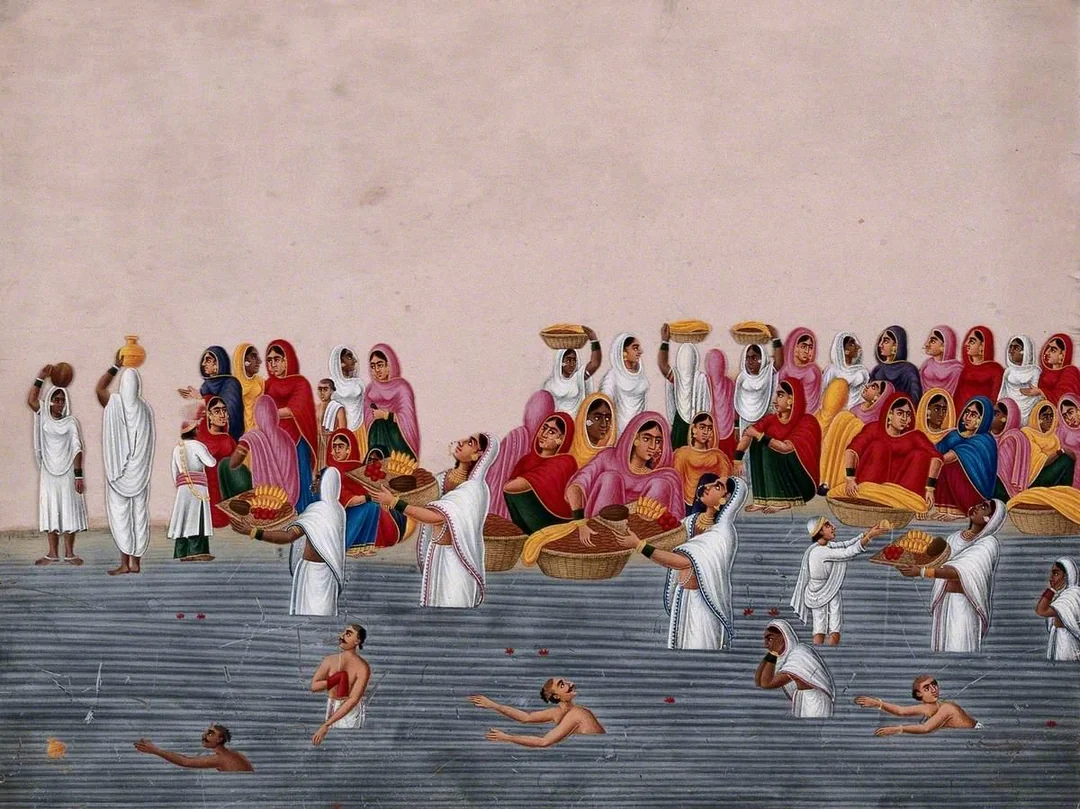
Picture: People Bathing and Praying in the Holy River Ganga, 19th century
The Buddha addresses a brahmin in verses who believes in purification through bathing in river.
At that time, the brahmin Sundarika Bhāradvāja was seated not far from the Blessed One. Then, the brahmin Sundarika Bhāradvāja said to the Blessed One: “But, does venerable Gotama go to the Bāhukā river to bathe?”
“Why brahmin, go to the Bāhukā river? What can the Bāhukā river do?”
“Venerable Gotama, the Bāhukā river is regarded as meritorious by many people. Venerable Gotama, many people go to the Bāhukā river to wash away the injurious actions [1] they have done.”
Then the Blessed One addressed the brahmin Sundarika Bhāradvāja in verse:
“Bāhukā and Adhikakka, Gayā and Sundarikā; Sarassatī and Payāga [2], and the Bāhumati river— Even if an immature [3] person were to plunge into them repeatedly, his dark deeds would not be purified.
What can the Sundarikā river do? What the Payāga or the Bāhukā do? For a person who is violent and has committed injurious actions, these rivers will not purify the evil-doer.
For the pure one, every day is a sacred festival [4], For the pure one, every day is an observance day [5]; For the pure one, whose actions are clean, His practice [6] always succeeds; Bathe here itself brahmin, establishing a refuge (safety, security [khematā]) for all beings.
If you speak no falsehood, if you do not harm living beings; If you do not take what is not given, having faith and are free from stinginess; What will going to Gayā do for you? for any well is your Gayā.”
When this was said, the brahmin Sundarika Bhāradvāja said to the Blessed One: “Excellent, venerable Gotama! Excellent, venerable Gotama! Just as if one might set upright what had been overturned, reveal (uncover [vivarati]) what had been concealed, point out the way to one who was lost, or hold up a lamp in the dark so that those with eyes could see forms, in the same way, venerable Gotama, the Dhamma [7] has been explained (illustrated [pakāsita]) by you in many ways. I go for refuge to the Blessed One Gotama, to the Dhamma, and to the Saṅgha [8] of bhikkhus. May I receive the going forth in the presence of the Blessed One Gotama, may I receive the full ordination.”
Then the brahmin Sundarika Bhāradvāja received the going forth in the presence of the Blessed One, he received the full ordination. Having recently received full ordination, the venerable Bhāradvāja, dwelling alone, secluded, diligent, with continuous effort, and resolutely, soon realized with direct knowledge, in this very life, the unsurpassed culmination of the spiritual life, for the purpose of which sons of good families rightly go forth from the household life to the homeless life, and having personally attained it, he dwelled in it.
He understood: “Birth is ended, the spiritual life has been lived, what had to be done has been done, there is no more coming to any state of existence.” And the venerable Bhāradvāja became one among the arahants [9].
[1] injurious actions [pāpakamma] ≈ harmful, bad, potentially evil intention or action
[2] Payāga [payāga] ≈ name of a holy bathing place, modern day Allahabad
[3] immature [bāla] ≈ lacking in discernment or good sense, child-like in understanding
[4] sacred festival [phaggu] ≈ This refers to the Phagguna month in the traditional lunar calendar, which corresponds roughly to February-March in the modern calendar. This is a significant time for spiritual observances and other purification practices.
[5] observance day [uposatha] ≈ Occurring on specific lunar days such as the full moon, new moon, and quarter moons, this is a time for renewing virtue, deepening practice, and purifying the mind.
[6] practice [vata] ≈ spiritual practice, duty, vow
[7] Dhamma [dhamma] ≈ teachings of the Buddha that point to the nature of reality, the ultimate truth
[8] Saṅgha [saṅgha] ≈ The community of monks and nuns practicing in line with the Buddha’s teachings. In the broader sense, this is the community of disciples who have realized the noble path and fruition through the Buddha’s teachings
[9] arahants [arahant] ≈ fully awakened ones, free from all mental defilements; worthy of offerings and veneration; also an epithet of the Buddha
Picture: People Bathing and Praying in the Holy River Ganga, 19th century
The Buddha explains the benefits of associating with virtuous persons and how the development of the seven awakening factors comes to be.
"Bhikkhus, those bhikkhus who are accomplished in virtue, collectedness, wisdom, liberation, and the wisdom and vision of liberation — I say that seeing such bhikkhus is of great benefit; listening to them is of great benefit; approaching them is of great benefit; attending upon them is of great benefit; recollecting them is of great benefit; and even going forth with [faith in] them is of great benefit. Why is that so? Because, bhikkhus, after hearing the Dhamma from such bhikkhus, one withdraws in two ways: by bodily seclusion and by mental seclusion. Dwelling thus secluded, one remembers and reflects on that Dhamma.
Bhikkhus, when a bhikkhu, dwelling thus secluded, remembers and reflects on that Dhamma, at that time, the awakening factor of mindfulness is aroused in him. At that time, the bhikkhu develops the awakening factor of mindfulness. At that time, the awakening factor of mindfulness reaches fulfillment through meditation in him. Dwelling thus mindfully, he examines that Dhamma with wisdom, investigates, and thoroughly reflects upon it.
Bhikkhus, when a bhikkhu, dwelling thus mindfully, examines that Dhamma with wisdom, investigates, and thoroughly reflects upon it, at that time, the awakening factor of investigation of phenomena is aroused in him. At that time, the bhikkhu develops the awakening factor of investigation of phenomena. At that time, the awakening factor of investigation of phenomena reaches fulfillment through meditation in him. For him, as he examines that Dhamma with wisdom, analyzing, and engaging in thorough reflection, unwavering energy is aroused.
Bhikkhus, at that time, when a bhikkhu, examining that Dhamma with wisdom, analyzing, and engaging in thorough reflection, unwavering energy is aroused in him. At that time, the awakening factor of energy is aroused in him. At that time, the bhikkhu develops the awakening factor of energy. At that time, the awakening factor of energy reaches fulfillment through meditation in him. For him with aroused energy, non-material joy arises.
Bhikkhus, at that time, when non-material joy arises in a bhikkhu with aroused energy, the awakening factor of joy is aroused in him. At that time, the bhikkhu develops the awakening factor of joy. At that time, the awakening factor of joy reaches fulfillment through meditation in him. For one with a joyful mind, the body becomes tranquil, and the mind becomes tranquil as well.
Bhikkhus, at that time, when the body of a bhikkhu with a joyful mind becomes tranquil and the mind becomes tranquil, the awakening factor of tranquility is aroused in him. At that time, the bhikkhu develops the awakening factor of tranquility. At that time, the awakening factor of tranquility reaches fulfillment through meditation in him. For one whose body is tranquil and at ease, the mind becomes collected.
Bhikkhus, at that time, when the mind of a bhikkhu, whose body is tranquil and at ease, becomes collected, the awakening factor of collectedness is aroused in him. At that time, the bhikkhu develops the awakening factor of collectedness. At that time, the awakening factor of collectedness reaches fulfillment through meditation in him. With the mind thus collected, he thoroughly observes with equanimity.
Bhikkhus, at that time, when a bhikkhu thoroughly observes with equanimity the mind that is thus collected, the awakening factor of equanimity is aroused in him. At that time, the bhikkhu develops the awakening factor of equanimity. At that time, the awakening factor of equanimity reaches fulfillment through meditation in him.
Bhikkhus, when the seven awakening factors are developed and practiced often in this way, seven fruits and seven benefits can be expected. What are the seven fruits and seven benefits?
- One attains final knowledge [of the complete wearing away of the taints] in this very life.
- If not in this very life, then one attains final knowledge at the time of death.
- If one does not attain final knowledge in this very life, and if one does not attain final knowledge at the time of death, then with the complete wearing away of the five lower fetters, one becomes an attainer of final Nibbāna in-between.
- If one does not attain final knowledge in this very life, and if one does not attain final knowledge at the time of death, and if one does not become an attainer of final Nibbāna in-between, then with the complete wearing away of the five lower fetters, one becomes an attainer of final Nibbāna upon landing [in the next life].
- If one does not attain final knowledge in this very life, and if one does not attain final knowledge at the time of death, and if one does not become an attainer of final Nibbāna in-between, and if one does not become an attainer of final Nibbāna upon landing, then with the complete wearing away of the five lower fetters, one becomes an attainer of final Nibbāna without effort.
- If one does not attain final knowledge in this very life, and if one does not attain final knowledge at the time of death, and if one does not become an attainer of final Nibbāna in-between, and if one does not become an attainer of final Nibbāna upon landing, and if one does not become an attainer of final Nibbāna without effort, then with the complete wearing away of the five lower fetters, one becomes an attainer of final Nibbāna with effort.
- If one does not attain final knowledge in this very life, and if one does not attain final knowledge at the time of death, and if one does not become an attainer of final Nibbāna in-between, and if one does not become an attainer of final Nibbāna upon landing, and if one does not become an attainer of final Nibbāna without effort, and if one does not become an attainer of final Nibbāna with effort, then with the complete wearing away of the five lower fetters, one becomes one bound upstream, heading towards the Akaniṭṭha realm.
Bhikkhus, when the seven awakening factors are developed and practiced often in this way, these seven fruits and seven benefits can be expected."
DhP 35:
Tricky to pin down and swift,
landing wherever it wants;
The taming of the mind is good,
for the tamed mind leads to ease.
DhP 36:
The mind is very subtle and hard to see,
landing wherever it wants;
The wise one should guard the mind,
for a guarded mind leads to ease.
DhP 37:
Wandering far and moving on its own,
immaterial, dwelling in a cave (hiding place);
Those who restrain the mind,
will be freed from Māra's bonds.
Picture: September Flowers, Jeremy Galton
A detailed analysis of the four bases of psychic ability - collectedness arising from aspiration, energy, purification of mind, and investigation. These four bases are noble, and leads one who cultivates them to become mighty, powerful, to full understanding of the five higher fetters, to liberation.
"Bhikkhus, these four bases of psychic ability, when developed and frequently practiced, are of great fruit and benefit.
"How, bhikkhus, are the four bases of psychic ability developed and frequently practiced so that they are of great fruit and great benefit? Here, bhikkhus, a bhikkhu develops the basis of psychic ability that is endowed with collectedness arising from aspiration (a goal, an interest, an objective, i.e. a wholesome desire) and accompanied by intentional effort thus: 'My aspiration will not be too slack, nor too intense, nor inwardly inhibited, nor outwardly scattered. He dwells continuously aware: 'As before, so after; as after, so before; as below, so above; as above, so below; as by day, so by night; as by night, so by day.' Thus with a mind that is clarified and unconfined, he develops a radiant mind."
A bhikkhu develops the base of psychic ability that is endowed with collectedness arising from energy and accompanied by intentional effort thus: 'My energy will not be too slack, nor too intense, nor inwardly inhibited, nor outwardly scattered.' He dwells continuously aware: 'As before, so after; as after, so before; as below, so above; as above, so below; as by day, so by night; as by night, so by day.' Thus with a mind that is clarified and unconfined, he develops a radiant mind.
A bhikkhu develops the base of psychic ability that is endowed with collectedness arising from [purification of] mind and accompanied by intentional effort thus: 'My mind will not be too slack, nor too intense, nor inwardly inhibited, nor outwardly scattered.' He dwells continuously aware: 'As before, so after; as after, so before; as below, so above; as above, so below; as by day, so by night; as by night, so by day.' Thus with a mind that is clarified and unconfined, he develops a radiant mind.
A bhikkhu develops the base of psychic ability that is endowed with collectedness arising from investigation (consideration, reflection, and examination) accompanied by intentional effort thus: 'My investigation will not be too slack, nor too intense, nor inwardly inhibited, nor outwardly scattered.' He dwells dwells continuously aware: 'As before, so after; as after, so before; as below, so above; as above, so below; as by day, so by night; as by night, so by day.' Thus with a mind that is clarified and unconfined, he develops a radiant mind.
Analysis of Aspiration
Bhikkhus, what is an aspiration that is too slack? Bhikkhus, aspiration that is accompanied by laziness and associated with laziness — this is called aspiration that is too slack.
Bhikkhus, what is an aspiration that is too intense? Bhikkhus, aspiration that is accompanied by restlessness and associated with restlessness — this is called aspiration that is too intense.
Bhikkhus, what is an aspiration that is inwardly inhibited? Bhikkhus, aspiration that is accompanied by dullness and drowsiness and associated with dullness and drowsiness — this is called aspiration that is inwardly inhibited.
Bhikkhus, what is an aspiration that is outwardly scattered? Bhikkhus, aspiration that is outwardly scattered due to engagement with the five cords of sensual pleasure — this is called aspiration that is outwardly scattered.
And how, bhikkhus, does a bhikkhu dwell continuously aware: 'As before, so after; as after, so before'? Here, bhikkhus, a bhikkhu's mindfulness of before and after is well grasped, well attended to, well sustained, and well penetrated by wisdom. Thus, bhikkhus, a bhikkhu dwells contemplating 'As before, so after; as after, so before.'
Bhikkhus, how does a bhikkhu dwell contemplating 'As below, so above; as above, so below'? Here, bhikkhus, a bhikkhu contemplates this very body from the soles of the feet upward and from the crown of the head downward, bounded by skin and full of various kinds of impurities: 'In this body there are hairs, body hairs, nails, teeth, skin, flesh, sinews, bones, bone marrow, kidneys, heart, liver, diaphragm, spleen, lungs, intestines, mesentery, stomach, feces, bile, phlegm, pus, blood, sweat, fat, tears, grease, saliva, snot, oil of the joints, and urine.' Thus, bhikkhus, a bhikkhu dwells contemplating 'As below, so above; as above, so below.'
Bhikkhus, how does a bhikkhu dwell contemplating 'As by day, so by night; as by night, so by day'? Here, bhikkhus, a bhikkhu develops the base of psychic ability that is endowed with collectedness arising from aspiration, accompanied by an intention of continuous effort by day, and also by night, thus: 'My aspiration will not be too slack, nor too intense, nor inwardly inhibited, nor outwardly scattered.' He dwells contemplating 'As before, so after; as after, so before; as below, so above; as above, so below; as by day, so by night; as by night, so by day.' Thus, bhikkhus, a bhikkhu dwells contemplating 'As by day, so by night; as by night, so by day.'
And how, bhikkhus, does a bhikkhu develop a mind that is clarified, unconfined and radiant? Here, bhikkhus, a bhikkhu's perception of brightness is well grasped, and his perception of day is well established. Thus, bhikkhus, a bhikkhu develops a mind that is clarified, unconfined, and radiant."
Analysis of Energy
And what, bhikkhus, is energy that is too slack? Bhikkhus, energy that is accompanied by laziness and associated with laziness — this is called energy that is too slack.
And what, bhikkhus, is energy that is too intense? Bhikkhus, energy that is accompanied by restlessness and associated with restlessness — this is called energy that is too intense.
And what, bhikkhus, is energy that is inwardly inhibited? Bhikkhus, energy that is accompanied by dullness and drowsiness and associated with dullness and drowsiness — this is called energy that is inwardly inhibited.
And what, bhikkhus, is energy that is outwardly scattered? Bhikkhus, energy that is outwardly scattered due to engagement with the five cords of sensual pleasure — this is called energy that is outwardly scattered.
And how, bhikkhus, does a bhikkhu dwell continuously aware: 'As before, so after; as after, so before?' Here, bhikkhus, a bhikkhu's mindfulness of before and after is well grasped, well attended to, well sustained, and well penetrated by wisdom. Thus, bhikkhus, a bhikkhu dwells contemplating 'As before, so after; as after, so before.'
And how, bhikkhus, does a bhikkhu dwell contemplating 'As below, so above; as above, so below?' Here, bhikkhus, a bhikkhu contemplates this very body from the soles of the feet upward and from the crown of the head downward, bounded by skin and full of various kinds of impurities: 'In this body there are hairs, body hairs, nails, teeth, skin, flesh, sinews, bones, bone marrow, kidneys, heart, liver, diaphragm, spleen, lungs, intestines, mesentery, stomach, feces, bile, phlegm, pus, blood, sweat, fat, tears, grease, saliva, snot, oil of the joints, and urine.' Thus, bhikkhus, a bhikkhu dwells contemplating 'As below, so above; as above, so below.'
And how, bhikkhus, does a bhikkhu dwell contemplating 'As by day, so by night; as by night, so by day?' Here, bhikkhus, a bhikkhu develops the base of psychic ability that is endowed with collectedness arising from energy, accompanied by an intention of continuous effort by day, and also by night, thus: 'My energy will not be too slack, nor too intense, nor inwardly inhibited, nor outwardly scattered.' He dwells contemplating 'As before, so after; as after, so before; as below, so above; as above, so below; as by day, so by night; as by night, so by day.' Thus, bhikkhus, a bhikkhu dwells contemplating 'As by day, so by night; as by night, so by day.'
And how, bhikkhus, does a bhikkhu develop a mind that is clarified, unconfined, and radiant? Here, bhikkhus, a bhikkhu's perception of brightness is well grasped, and his perception of day is well established. Thus, bhikkhus, a bhikkhu develops a mind that is clarified, unconfined, and radiant.
Analysis of [Purification of] Mind
And what, bhikkhus, is a mind that is too slack? Bhikkhus, a mind that is accompanied by laziness and associated with laziness — this is called a mind that is too slack.
And what, bhikkhus, is a mind that is too intense? Bhikkhus, a mind that is accompanied by restlessness and associated with restlessness — this is called a mind that is too intense.
And what, bhikkhus, is a mind that is inwardly inhibited? Bhikkhus, a mind that is accompanied by dullness and drowsiness and associated with dullness and drowsiness — this is called a mind that is inwardly inhibited.
And what, bhikkhus, is a mind that is outwardly scattered? Bhikkhus, a mind that is outwardly scattered due to engagement with the five cords of sensual pleasure — this is called a mind that is outwardly scattered.
And how, bhikkhus, does a bhikkhu dwell continuously aware: 'As before, so after; as after, so before?' Here, bhikkhus, a bhikkhu's mindfulness of before and after is well grasped, well attended to, well sustained, and well penetrated by wisdom. Thus, bhikkhus, a bhikkhu dwells contemplating 'As before, so after; as after, so before.'
And how, bhikkhus, does a bhikkhu dwell contemplating 'As below, so above; as above, so below?' Here, bhikkhus, a bhikkhu contemplates this very body from the soles of the feet upward and from the crown of the head downward, bounded by skin and full of various kinds of impurities: 'In this body there are hairs, body hairs, nails, teeth, skin, flesh, sinews, bones, bone marrow, kidneys, heart, liver, diaphragm, spleen, lungs, intestines, mesentery, stomach, feces, bile, phlegm, pus, blood, sweat, fat, tears, grease, saliva, snot, oil of the joints, and urine.' Thus, bhikkhus, a bhikkhu dwells contemplating 'As below, so above; as above, so below.'
And how, bhikkhus, does a bhikkhu dwell contemplating 'As by day, so by night; as by night, so by day?' Here, bhikkhus, a bhikkhu develops the base of psychic ability that is endowed with collectedness arising from mind, accompanied by an intention of continuous effort by day, and also by night, thus: 'My mind will not be too slack, nor too intense, nor inwardly inhibited, nor outwardly scattered.' He dwells contemplating 'As before, so after; as after, so before; as below, so above; as above, so below; as by day, so by night; as by night, so by day.' Thus, bhikkhus, a bhikkhu dwells contemplating 'As by day, so by night; as by night, so by day.'
And how, bhikkhus, does a bhikkhu develop a mind that is clarified, unconfined, and radiant? Here, bhikkhus, a bhikkhu's perception of brightness is well grasped, and his perception of day is well established. Thus, bhikkhus, a bhikkhu develops a mind that is clarified, unconfined, and radiant.
Analysis of Investigation
And what, bhikkhus, is an investigation that is too slack? Bhikkhus, an investigation that is accompanied by laziness and associated with laziness — this is called an investigation that is too slack.
And what, bhikkhus, is an investigation that is too intense? Bhikkhus, an investigation that is accompanied by restlessness and associated with restlessness — this is called an investigation that is too intense.
And what, bhikkhus, is an investigation that is inwardly inhibited? Bhikkhus, an investigation that is accompanied by dullness and drowsiness and associated with dullness and drowsiness — this is called an investigation that is inwardly inhibited.
And what, bhikkhus, is an investigation that is outwardly scattered? Bhikkhus, an investigation that is outwardly scattered due to engagement with the five cords of sensual pleasure — this is called an investigation that is outwardly scattered.
And how, bhikkhus, does a bhikkhu dwell continuously aware: 'As before, so after; as after, so before?' Here, bhikkhus, a bhikkhu's mindfulness of before and after is well grasped, well attended to, well sustained, and well penetrated by wisdom. Thus, bhikkhus, a bhikkhu dwells contemplating 'As before, so after; as after, so before.'
And how, bhikkhus, does a bhikkhu dwell contemplating 'As below, so above; as above, so below?' Here, bhikkhus, a bhikkhu contemplates this very body from the soles of the feet upward and from the crown of the head downward, bounded by skin and full of various kinds of impurities: 'In this body there are hairs, body hairs, nails, teeth, skin, flesh, sinews, bones, bone marrow, kidneys, heart, liver, diaphragm, spleen, lungs, intestines, mesentery, stomach, feces, bile, phlegm, pus, blood, sweat, fat, tears, grease, saliva, snot, oil of the joints, and urine.' Thus, bhikkhus, a bhikkhu dwells contemplating 'As below, so above; as above, so below.'
And how, bhikkhus, does a bhikkhu dwell contemplating 'As by day, so by night; as by night, so by day?' Here, bhikkhus, a bhikkhu develops the base of psychic ability that is endowed with collectedness arising from investigation, accompanied by an intention of continuous effort by day, and also by night, thus: 'My investigation will not be too slack, nor too intense, nor inwardly inhibited, nor outwardly scattered.' He dwells contemplating 'As before, so after; as after, so before; as below, so above; as above, so below; as by day, so by night; as by night, so by day.' Thus, bhikkhus, a bhikkhu dwells contemplating 'As by day, so by night; as by night, so by day.'
And how, bhikkhus, does a bhikkhu develop a mind that is clarified, unconfined, and radiant? Here, bhikkhus, a bhikkhu's perception of brightness is well grasped, and his perception of day is well established. Thus, bhikkhus, a bhikkhu develops a mind that is clarified, unconfined, and radiant.
Thus developed and frequently practiced, bhikkhus, the four bases of psychic ability are of great fruit and great benefit.
Thus, bhikkhus, a bhikkhu who has developed and frequently practiced the four bases of psychic ability experiences various kinds of psychic abilities: being one, he becomes many; being many, he becomes one; he appears and disappears; he passes through walls, enclosures, and mountains as though through space; he dives in and out of the earth as though it were water; he walks on water without sinking as though on solid ground; he flies through the air cross-legged like a bird with wings; he touches and strokes the sun and moon, so mighty and powerful; and he controls his body as far as the Brahmā world. Thus, bhikkhus, a bhikkhu who has developed and frequently practiced the four bases of psychic ability, through the wearing away of the taints, attains and dwells in the taintless release of mind and release by wisdom, having realized it with direct knowledge in this very life."
This is a fine-tuning instruction that one can use to refine their practice of the eightfold path. One can also investigate and to see whether success in any domain - spiritual or a worldly one, at the highest levels, comes through frequently practicing in the four bases of psychic abilities. If one has a view on manifestation, or on the power of desire, one can further their understanding by full understanding all the four bases needed.
cross-posted from: https://lemmy.world/post/21587144
Ugga, the householder of Vesālī is endowed with eight wonderful and marvelous qualities.
Once, the Blessed One was staying at Vesālī in the Great Wood, in the Hall with the Peaked Roof. There, the Blessed One addressed the bhikkhus: "Bhikkhus, remember Ugga the householder of Vesālī as being endowed with eight wonderful and marvelous qualities."
The Blessed One said this. Having spoken thus, the Well-Gone One rose from his seat and entered his dwelling.
Then, a certain bhikkhu, after dressing in the morning and taking his bowl and robe, approached the residence of Ugga the householder of Vesālī; having approached, he sat down on a prepared seat. Then, Ugga the householder of Vesālī approached that bhikkhu; having approached, he paid homage to the bhikkhu and sat down to one side. As Ugga the householder of Vesālī was seated to one side, the bhikkhu said to him:
"Householder, the Blessed One has declared that you are endowed with eight wonderful and marvelous qualities. What are they?"
"Venerable sir, I do not know what eight wonderful and marvelous qualities the Blessed One has declared that I possess. However, there are indeed eight wonderful and marvelous qualities found in me. Listen to it and pay close attention, I will speak."
"Yes, householder," the bhikkhu responded to Ugga the householder of Vesālī. Then Ugga the householder of Vesālī spoke thus:
- "When I first saw the Blessed One from afar, with just that sight itself, venerable sir, my mind became inspired with confidence in the Blessed One. This, venerable sir, is the first wonderful and marvelous quality that is found in me.
- Venerable sir, with a confident mind, I attended upon the Blessed One. The Blessed One gradually gave me a discourse, first on giving, then on virtue, and then on the heavens. He explained the dangers, degradation, and defilement of sensual pleasures and the benefit of renunciation. When the Blessed One knew that my mind was ready, receptive, free of hindrances, uplifted, and confident, he then expounded to me the distinctive teaching of the Buddhas: suffering, its arising, its cessation, and the path. Just as a clean cloth with no dark spots would perfectly absorb dye, so too, as I was sitting there, the stainless, immaculate Dhamma eye arose in me: 'Whatever is subject to arising, is subject to cessation.' Venerable sir, I then became one who has seen the Dhamma, who has attained the Dhamma, who has understood the Dhamma, who has deeply penetrated the Dhamma, having crossed beyond doubt, with no more uncertainty, self-assured, and independent of others in the Teacher's instruction. Right there, I went for refuge to the Buddha, the Dhamma, and the Sangha, and I undertook the training rules with celibacy as the fifth. This, venerable sir, is the second wonderful and marvelous quality that is found in me.
- Venerable sir, I had four young wives. I approached them and said: 'Sisters, I have undertaken the training rules with celibacy as the fifth. Whoever wishes may stay here and enjoy the wealth and perform meritorious deeds, or you may return to your own family. Or if there is another man you prefer, I will give you to him.' When I said this, my eldest wife replied: 'Give me to such and such a man, dear husband.' So, venerable sir, I called that man, and with my left hand I gave my wife to him, and with my right hand, I presented him with a ceremonial offering. Yet, venerable sir, even while parting with my young wife, I did not notice any alteration in my mind. This, venerable sir, is the third wonderful and marvelous quality that is found in me.
- Venerable sir, there is wealth in my family, and it is not withheld from those who are virtuous and of an upright nature. This, venerable sir, is the fourth wonderful and marvelous quality that is found in me.
- Venerable sir, when I attend upon a bhikkhu, I do so with proper respect, not without respect. This, venerable sir, is the fifth wonderful and marvelous quality that is found in me.
- Venerable sir, if that venerable one teaches me the Dhamma, I listen to it attentively, not carelessly. If he does not teach me the Dhamma, I teach him the Dhamma. This, venerable sir, is the sixth wonderful and marvelous quality that is found in me.
- It is not unusual for deities to come to me and announce: 'The Dhamma is well-expounded by the Blessed One, householder.' When this is said, venerable sir, I reply to those deities: 'Whether you deities say this or not, the Dhamma is indeed well-expounded by the Blessed One. However, venerable sir, I do not perceive any elation of mind because of this, thinking: 'Deities approach me, and I converse with them.' This, venerable sir, is the seventh wonderful and marvelous quality that is found in me.
- Venerable sir, regarding the five lower fetters taught by the Blessed One, I do not see anything within myself that has not been abandoned. This, venerable sir, is the eighth wonderful and marvelous quality that is found in me.
These, venerable sir, are the eight wonderful and marvelous qualities that are found in me. However, I do not know which eight wonderful and marvelous qualities the Blessed One declared that I am endowed with."
Then the bhikkhu, after taking alms food from the house of Ugga the householder of Vesālī, rose from his seat and departed. After his meal, the bhikkhu, having completed his alms round, approached the Blessed One; having approached, he paid homage to the Blessed One and sat down to one side. As he was sitting to one side, the bhikkhu reported to the Blessed One all of his conversation with Ugga the householder of Vesālī.
The Blessed One said, "Good, good, bhikkhu. As Ugga the householder of Vesālī rightly explained, in the same way, I declare that he is endowed with these eight wonderful and marvelous qualities. Bhikkhu, remember Ugga the householder of Vesālī as being endowed with these eight wonderful and marvelous qualities."
Ugga, the householder of Vesālī is endowed with eight wonderful and marvelous qualities.
Once, the Blessed One was staying at Vesālī in the Great Wood, in the Hall with the Peaked Roof. There, the Blessed One addressed the bhikkhus: "Bhikkhus, remember Ugga the householder of Vesālī as being endowed with eight wonderful and marvelous qualities."
The Blessed One said this. Having spoken thus, the Well-Gone One rose from his seat and entered his dwelling.
Then, a certain bhikkhu, after dressing in the morning and taking his bowl and robe, approached the residence of Ugga the householder of Vesālī; having approached, he sat down on a prepared seat. Then, Ugga the householder of Vesālī approached that bhikkhu; having approached, he paid homage to the bhikkhu and sat down to one side. As Ugga the householder of Vesālī was seated to one side, the bhikkhu said to him:
"Householder, the Blessed One has declared that you are endowed with eight wonderful and marvelous qualities. What are they?"
"Venerable sir, I do not know what eight wonderful and marvelous qualities the Blessed One has declared that I possess. However, there are indeed eight wonderful and marvelous qualities found in me. Listen to it and pay close attention, I will speak."
"Yes, householder," the bhikkhu responded to Ugga the householder of Vesālī. Then Ugga the householder of Vesālī spoke thus:
- "When I first saw the Blessed One from afar, with just that sight itself, venerable sir, my mind became inspired with confidence in the Blessed One. This, venerable sir, is the first wonderful and marvelous quality that is found in me.
- Venerable sir, with a confident mind, I attended upon the Blessed One. The Blessed One gradually gave me a discourse, first on giving, then on virtue, and then on the heavens. He explained the dangers, degradation, and defilement of sensual pleasures and the benefit of renunciation. When the Blessed One knew that my mind was ready, receptive, free of hindrances, uplifted, and confident, he then expounded to me the distinctive teaching of the Buddhas: suffering, its arising, its cessation, and the path. Just as a clean cloth with no dark spots would perfectly absorb dye, so too, as I was sitting there, the stainless, immaculate Dhamma eye arose in me: 'Whatever is subject to arising, is subject to cessation.' Venerable sir, I then became one who has seen the Dhamma, who has attained the Dhamma, who has understood the Dhamma, who has deeply penetrated the Dhamma, having crossed beyond doubt, with no more uncertainty, self-assured, and independent of others in the Teacher's instruction. Right there, I went for refuge to the Buddha, the Dhamma, and the Sangha, and I undertook the training rules with celibacy as the fifth. This, venerable sir, is the second wonderful and marvelous quality that is found in me.
- Venerable sir, I had four young wives. I approached them and said: 'Sisters, I have undertaken the training rules with celibacy as the fifth. Whoever wishes may stay here and enjoy the wealth and perform meritorious deeds, or you may return to your own family. Or if there is another man you prefer, I will give you to him.' When I said this, my eldest wife replied: 'Give me to such and such a man, dear husband.' So, venerable sir, I called that man, and with my left hand I gave my wife to him, and with my right hand, I presented him with a ceremonial offering. Yet, venerable sir, even while parting with my young wife, I did not notice any alteration in my mind. This, venerable sir, is the third wonderful and marvelous quality that is found in me.
- Venerable sir, there is wealth in my family, and it is not withheld from those who are virtuous and of an upright nature. This, venerable sir, is the fourth wonderful and marvelous quality that is found in me.
- Venerable sir, when I attend upon a bhikkhu, I do so with proper respect, not without respect. This, venerable sir, is the fifth wonderful and marvelous quality that is found in me.
- Venerable sir, if that venerable one teaches me the Dhamma, I listen to it attentively, not carelessly. If he does not teach me the Dhamma, I teach him the Dhamma. This, venerable sir, is the sixth wonderful and marvelous quality that is found in me.
- It is not unusual for deities to come to me and announce: 'The Dhamma is well-expounded by the Blessed One, householder.' When this is said, venerable sir, I reply to those deities: 'Whether you deities say this or not, the Dhamma is indeed well-expounded by the Blessed One. However, venerable sir, I do not perceive any elation of mind because of this, thinking: 'Deities approach me, and I converse with them.' This, venerable sir, is the seventh wonderful and marvelous quality that is found in me.
- Venerable sir, regarding the five lower fetters taught by the Blessed One, I do not see anything within myself that has not been abandoned. This, venerable sir, is the eighth wonderful and marvelous quality that is found in me.
These, venerable sir, are the eight wonderful and marvelous qualities that are found in me. However, I do not know which eight wonderful and marvelous qualities the Blessed One declared that I am endowed with."
Then the bhikkhu, after taking alms food from the house of Ugga the householder of Vesālī, rose from his seat and departed. After his meal, the bhikkhu, having completed his alms round, approached the Blessed One; having approached, he paid homage to the Blessed One and sat down to one side. As he was sitting to one side, the bhikkhu reported to the Blessed One all of his conversation with Ugga the householder of Vesālī.
The Blessed One said, "Good, good, bhikkhu. As Ugga the householder of Vesālī rightly explained, in the same way, I declare that he is endowed with these eight wonderful and marvelous qualities. Bhikkhu, remember Ugga the householder of Vesālī as being endowed with these eight wonderful and marvelous qualities."
While gathering flowers,
with an attached mind;
Like a great flood sweeps away a sleeping village,
so does death carry such a person away.
-- DhammaPada Verse 47
cross-posted from: https://lemmy.world/post/14284855
A Discourse on The Full-Moon Night
On a full moon night with the Sangha at Sāvatthi, the Buddha answers a series of ten questions on the aggregates.
At one time, the Blessed One was residing in Sāvatthī, in the Eastern Park, in Migāra's mother's mansion, with a large assembly of bhikkhus. On that occasion, the Blessed One was sitting in the open air, surrounded by the bhikkhu assembly, on the full moon night of the Uposatha (observance day) of the fifteenth.
Then, a certain bhikkhu rose from his seat, arranged his upper robe over one shoulder, raised his joined palms towards the Blessed One, and said:
"Venerable sir, I would ask the Blessed One about a certain matter, if the Blessed One would grant me the opportunity for my question to be answered?"
"Then, bhikkhu, sit down on your own seat and ask whatever you wish."
"Very well, venerable sir," the bhikkhu replied, having assented to the Blessed One’s response. He sat down on his own seat and asked the Blessed One:
"Are these, venerable sir, the five aggregates subject to clinging, namely: form aggregate subject to clinging, feeling aggregate subject to clinging, perception aggregate subject to clinging, volitional formations aggregate subject to clinging, and consciousness aggregate subject to clinging?"
"These, bhikkhu, are indeed the five aggregates subject to clinging; namely: form aggregate subject to clinging, feeling aggregate subject to clinging, perception aggregate subject to clinging, volitional formations aggregate subject to clinging, and consciousness aggregate subject to clinging."
"Excellent, venerable sir," the bhikkhu, pleased and appreciative of what the Blessed One had said, asked another question:
"What, venerable sir, is the root of these five aggregates subject to clinging?"
"Bhikkhus, these five aggregates subject to clinging have desire as their root".
"Venerable sir, is that very clinging the same as these five aggregates subject to clinging, or is it something apart from the five aggregates subject to clinging?"
"Bhikkhu, that very clinging is neither the same as these five aggregates subject to clinging nor is it something apart from the five aggregates subject to clinging; but whatever desire and lust is therein, that is the clinging therein."
"Excellent, venerable sir," the bhikkhu asked further:
"Is it possible, venerable sir, for there to be moderation in desire and lust within these five aggregates subject to clinging?"
"It is possible, bhikkhu," the Blessed One said:
"Here, bhikkhu, someone thinks: 'May I be of such form in the future, may I have such feeling in the future, may I have such perception in the future, may I have such volitional formations in the future, may I have such consciousness in the future.' Thus, bhikkhu, there can be moderation in desire and lust within these five aggregates subject to clinging."
"Excellent, venerable sir," the bhikkhu asked further:
"How far, venerable sir, does the term 'aggregates' apply?"
"Whatever form, bhikkhu, past, future, or present, internal or external, gross or subtle, inferior or superior, far or near, all that is called the form aggregate. Whatever feeling, past, future, or present, internal or external, gross or subtle, inferior or superior, far or near, all that is called the feeling aggregate. Whatever perception, past, future, or present, internal or external, gross or subtle, inferior or superior, far or near, all that is called the perception aggregate. Whatever volitional formations, past, future, or present, internal or external, gross or subtle, inferior or superior, far or near, all that is called the volitional formations aggregate. Whatever consciousness, past, future, or present, internal or external, gross or subtle, inferior or superior, far or near, all that is called the consciousness aggregate. Thus far, bhikkhu, the term 'aggregates' applies."
"Excellent, venerable sir," the bhikkhu asked further:
"What, venerable sir, is the cause, what is the condition for the manifestation of the form aggregate; what is the cause, what is the condition for the manifestation of the feeling aggregate; what is the cause, what is the condition for the manifestation of the perception aggregate; what is the cause, what is the condition for the manifestation of the volitional formations aggregate; what is the cause, what is the condition for the manifestation of the consciousness aggregate?"
"The four great elements, bhikkhu, are the cause, the four great elements are the condition for the manifestation of the form aggregate. Contact is the cause, contact is the condition for the manifestation of the feeling aggregate. Contact is the cause, contact is the condition for the manifestation of the perception aggregate. Contact is the cause, contact is the condition for the manifestation of the volitional formations aggregate. Name-and-form is the cause, name-and-form is the condition for the manifestation of the consciousness aggregate."
"Excellent, venerable sir," the bhikkhu asked further:
"How does self-view arise?"
"Here, bhikkhu, an untaught ordinary person, who has no regard for noble ones and is unskilled and undisciplined in their Dhamma, who has no regard for true men and is unskilled and undisciplined in their Dhamma, regards form as self, or self as possessing form, or form as in the self, or self as in form; regards feeling as self, or self as possessing feeling, or feeling as in the self, or self as in feeling; regards perception as self, or self as possessing perception, or perception as in the self, or self as in perception; regards volitional formations as self, or self as possessing volitional formations, or volitional formations as in the self, or self as in volitional formations; regards consciousness as self, or self as possessing consciousness, or consciousness as in the self, or self as in consciousness. This is how self-view arises, bhikkhu."
"Excellent, venerable sir," the bhikkhu asked further:
"How does self-view not arise?"
"Here, bhikkhu, a learned noble disciple, who has regard for noble ones and is skilled and disciplined in their Dhamma, who has regard for true men and is skilled and disciplined in their Dhamma, does not regard form as self, or self as possessing form, or form as in the self, or self as in form; does not regard feeling as self, or self as possessing feeling, or feeling as in the self, or self as in feeling; does not regard perception as self, or self as possessing perception, or perception as in the self, or self as in perception; does not regard volitional formations as self, or self as possessing volitional formations, or volitional formations as in the self, or self as in volitional formations; does not regard consciousness as self, or self as possessing consciousness, or consciousness as in the self, or self as in consciousness. This is how self-view does not arise, bhikkhu."
"What is the gratification, what is the danger, and what is the escape in the case of form; what is the gratification, what is the danger, and what is the escape in the case of feeling ... perception ... volitional formations ... consciousness?"
"The pleasure and joy that arise dependent on form, bhikkhu, that is the gratification in form. That form is impermanent, suffering, and subject to change, that is the danger in form. The removal and abandonment of desire and lust for form, that is the escape from form. The pleasure and joy that arise dependent on feeling, that is the gratification in feeling. That feeling is impermanent, suffering, and subject to change, that is the danger in feeling. The removal and abandonment of desire and lust for feeling, that is the escape from feeling. The pleasure and joy that arise dependent on perception, that is the gratification in perception. That perception is impermanent, suffering, and subject to change, that is the danger in perception. The removal and abandonment of desire and lust for perception, that is the escape from perception. The pleasure and joy that arise dependent on volitional formations, that is the gratification in volitional formations. That volitional formations are impermanent, suffering, and subject to change, that is the danger in volitional formations. The removal and abandonment of desire and lust for volitional formations, that is the escape from volitional formations. The pleasure and joy that arise dependent on consciousness, that is the gratification in consciousness. That consciousness is impermanent, suffering, and subject to change, that is the danger in consciousness. The removal and abandonment of desire and lust for consciousness, that is the escape from consciousness."
"Excellent, venerable sir," the bhikkhu, pleased and appreciative of what the Blessed One had said, asked another question:
"How, venerable sir, for one who knows and sees, in this very life, with regard to this consciousness-containing body and all external signs, is there no I-making, mine-making, and underlying tendency to conceit?"
"Whatever form, bhikkhu, past, future, or present, internal or external, gross or subtle, inferior or superior, far or near, all form: 'This is not mine, this I am not, this is not my self,' thus, it is seen as it really is with right wisdom. Whatever feeling, past, future, or present, internal or external, gross or subtle, inferior or superior, far or near, all feeling: 'This is not mine, this I am not, this is not my self,' thus, it is seen as it really is with right wisdom. Whatever perception, past, future, or present, internal or external, gross or subtle, inferior or superior, far or near, all perception: 'This is not mine, this I am not, this is not my self,' thus, it is seen as it really is with right wisdom. Whatever volitional formations, past, future, or present, internal or external, gross or subtle, inferior or superior, far or near, all volitional formations: 'This is not mine, this I am not, this is not my self,' thus, it is seen as it really is with right wisdom. Whatever consciousness, past, future, or present, internal or external, gross or subtle, inferior or superior, far or near, all consciousness: 'This is not mine, this I am not, this is not my self,' thus, it is seen as it really is with right wisdom. This is how, bhikkhu, for one who knows and sees, in this very life, with regard to this consciousness-containing body and all external signs, there is no I-making, mine-making, and underlying tendency to conceit."
At that time, it occurred to a certain bhikkhu:
"So it seems, indeed, form is not-self, feeling is not-self, perception is not-self, volitional formations are not-self, consciousness is not-self; how then do actions performed by a not-self affect oneself?"
Then, the Blessed One, knowing with his mind the thought in that bhikkhu's mind, addressed the bhikkhus:
"There is this possibility, bhikkhus, that someone, being ignorant (misapprehending true reality), under the sway of craving, might thus misinterpret the teaching: 'So it seems, indeed, form is not-self, feeling is not-self, perception is not-self, volitional formations are not-self, consciousness is not-self. How then do actions performed by a not-self affect oneself?' You should be trained in this way, bhikkhus, regarding these matters.
What do you think, bhikkhus, is form permanent or impermanent?"
"Impermanent, venerable sir."
"Is feeling ... perception ... volitional formations ... consciousness permanent or impermanent?"
"Impermanent, venerable sir."
"And is what is impermanent suffering or happiness?"
"Suffering, venerable sir."
"And is it fitting to regard what is impermanent, suffering, and subject to change as: 'This is mine, this I am, this is my self'?"
"It is not fitting, venerable sir."
Therefore, in this way, bhikkhus, one understands: 'This is not mine, this I am not, this is not my self' with regard to all forms, feelings, perceptions, volitional formations, and consciousness, whether past, future, or present, internal or external, gross or subtle, inferior or superior, far or near. By seeing these aggregates in this way, one becomes disenchanted with form, feeling, perception, volitional formations, and consciousness. Through disenchantment, one becomes dispassionate. Through dispassion, one is liberated. With liberation, there comes the knowledge that one is liberated, and one understands: 'Birth is exhausted, the holy life has been lived, what had to be done has been done, there is no more coming back to any state of being.'
These are the ten questions posed by the bhikkhu:
Two concern the aggregates—
Asking if they are the same or distinct,
And about designation along with cause.
Two more relate to identity,
With one each on the themes of gratification,
And the consciousness-containing body.
The Buddha taught the most on the four noble truths. This teaching shares a series of common questions he was asked on the topic. Reflecting and investigating into the five aggregates to understand them, to see their origin, passing away and cessation is how one cultivates wisdom to operate with ease in the world and in harmony in one's personal and professional relationships.
Related Teachings:
Teachings on Living Beings and the Five Aggregates - A series of teachings on what makes a living being a living being and the five aggregates.
A lump of foam (SN 22.95) - The Buddha gives a series of similes for the aggregates: physical form is like foam, feeling is like a bubble, perception is like a mirage, choices are like a coreless tree, and consciousness is like an illusion.
Vitakkasaṇṭhānasutta—Bhikkhu Sujato
In a practical meditation teaching, the Buddha describes five different approaches to abandoning of thoughts related to desire, hate and delusion.
So I have heard. At one time the Buddha was staying near Sāvatthī in Jeta’s Grove, Anāthapiṇḍika’s monastery. There the Buddha addressed the mendicants, “Mendicants!”
“Venerable sir,” they replied. The Buddha said this:
“Mendicants, a mendicant committed to the higher mind should focus on five subjects from time to time. What five?
Take a mendicant who is focusing on some subject that gives rise to bad, unskillful thoughts connected with desire, hate, and delusion. That mendicant should focus on some other subject connected with the skillful. As they do so, those bad thoughts are given up and come to an end. Their mind becomes stilled internally; it settles, unifies, and becomes immersed in samādhi. It’s like a deft carpenter or their apprentice who’d knock out or extract a large peg with a finer peg. In the same way, a mendicant … should focus on some other foundation of meditation connected with the skillful …
Now, suppose that mendicant is focusing on some other subject connected with the skillful, but bad, unskillful thoughts connected with desire, hate, and delusion keep coming up. They should examine the drawbacks of those thoughts: ‘So these thoughts are unskillful, they’re blameworthy, and they result in suffering.’ As they do so, those bad thoughts are given up and come to an end. Their mind becomes stilled internally; it settles, unifies, and becomes immersed in samādhi. Suppose there was a woman or man who was young, youthful, and fond of adornments. If the carcass of a snake or a dog or a human were hung around their neck, they’d be horrified, repelled, and disgusted. In the same way, a mendicant … should examine the drawbacks of those thoughts …
Now, suppose that mendicant is examining the drawbacks of those thoughts, but bad, unskillful thoughts connected with desire, hate, and delusion keep coming up. They should try to forget and ignore about them. As they do so, those bad thoughts are given up and come to an end. Their mind becomes stilled internally; it settles, unifies, and becomes immersed in samādhi. Suppose there was a person with clear eyes, and some undesirable sights came into their range of vision. They’d just close their eyes or look away. In the same way, a mendicant … those bad thoughts are given up and come to an end …
Now, suppose that mendicant is ignoring and forgetting about those thoughts, but bad, unskillful thoughts connected with desire, hate, and delusion keep coming up. They should focus on stopping the formation of thoughts. As they do so, those bad thoughts are given up and come to an end. Their mind becomes stilled internally; it settles, unifies, and becomes immersed in samādhi. Suppose there was a person walking quickly. They’d think: ‘Why am I walking so quickly? Why don’t I slow down?’ So they’d slow down. They’d think: ‘Why am I walking slowly? Why don’t I stand still?’ So they’d stand still. They’d think: ‘Why am I standing still? Why don’t I sit down?’ So they’d sit down. They’d think: ‘Why am I sitting? Why don’t I lie down?’ So they’d lie down. And so that person would reject successively coarser postures and adopt more subtle ones.
In the same way, a mendicant … those thoughts are given up and come to an end …
Now, suppose that mendicant is focusing on stopping the formation of thoughts, but bad, unskillful thoughts connected with desire, hate, and delusion keep coming up. With teeth clenched and tongue pressed against the roof of the mouth, they should squeeze, squash, and crush mind with mind. As they do so, those bad thoughts are given up and come to an end. Their mind becomes stilled internally; it settles, unifies, and becomes immersed in samādhi. It’s like a strong man who grabs a weaker man by the head or throat or shoulder and squeezes, squashes, and crushes them. In the same way, a mendicant … with teeth clenched and tongue pressed against the roof of the mouth, should squeeze, squash, and crush mind with mind. As they do so, those bad thoughts are given up and come to an end. Their mind becomes stilled internally; it settles, unifies, and becomes immersed in samādhi.
Now, take the mendicant who is focusing on some subject that gives rise to bad, unskillful thoughts connected with desire, hate, and delusion. They focus on some other subject connected with the skillful … They examine the drawbacks of those thoughts … They try to forget and ignore about those thoughts … They focus on stopping the formation of thoughts … With teeth clenched and tongue pressed against the roof of the mouth, they squeeze, squash, and crush mind with mind. When they succeed in each of these things, those bad thoughts are given up and come to an end. Their mind becomes stilled internally; it settles, unifies, and becomes immersed in samādhi. This is called a mendicant who is a master of the ways of thought. They will think what they want to think, and they won’t think what they don’t want to think. They’ve cut off craving, untied the fetters, and by rightly comprehending conceit have made an end of suffering.”
That is what the Buddha said. Satisfied, the mendicants approved what the Buddha said.
Alternative words to understand desire, hate and delusion.
- Desire - Lust, greed, relishing, delighting
- Hate - Ill-will, aversion, anger, frustration, annoyance
- Delusion - Ignorance, misapprehension, misconception, not carefully examining
The unEnlightened mind's tendencies incline towards these three when left on its own. In this teaching, the Buddha is sharing on five practical ways to apply right effort for the abandoning and non-arising of thoughts related to desire, hate, and delusion.
Related Teachings:
You're welcome. An irrational application of mind implies, scattered thoughts, a fault-finding nature, or a mind that works on assumptions/beliefs. There is another teaching where the Buddha shares the causes that lead to an irrational application of mind as well as antidotes to it: 30 mental qualities that lead to enlightenment, to the arising of the Buddha (AN 10.76).
It is good that you're reflecting on the teachings to independently verify them. 🙂
This is an interesting frame, and spot about the value of mindfulness and daily practice to see these more clearly. I would also consider the aspect of the neither-painful-nor-pleasant feelings, which per the Buddha are associated with the abiding of the fourth jhāna and which one cannot experience and thus have an opportunity to gain wisdom about until the mind keeps cycling through pain resistance and pleasure seeking behavior