The outcome was already predetermined when the legislation was passed, and the report is being written with that in mind. The report basically has to push it forwards. If this had been done by the ALRC it would have looked quite different.
theroff
joined 2 years ago
Will Signal block Australian IP addresses, or nix accounts that have a +61 phone number? I'd assume the former but if Signal and other social media platforms go for the latter it will be painful for Australian netizens.
yggmail specifically, probably not. yggdrasil uses TCP/IP and the Meshtastic latencies to perform connections would be too high AFAIK. It would probably only work in a fairly well-connected network. yggdrasil could be used directly over a WiFi protocol but it would need fairly good reception to function.
N.B. I haven'texperimented with this myself.
yggmail is a fairly obscure and experimental take on email on a mesh network: https://github.com/neilalexander/yggmail
My old community garden used a Signal group which worked really well.
I'm currently part of a bushcare group which I believe use Facebook but not sure how active it is. We have a regular monthly schedule which I show up to in-person.
I can second the annoyance of people using Facebook groups for everything. I can't control what I see on Facebook so I won't use it. I've found other groups impossible to join for this reason - like my local bike user group. Real shame because I'd like to join but I found the in-person meetings were largely discussing things in the Facebook group.
Really good points. I like that the concept is saleable both as a reliability improvement for trains and a safety and capacity improvement for the road network (which can also include buses). Everyone's a winner.
Graphene shills have been banging on this point for donkey's ages. Reality is that many people use phones that are out of OEM support and many OEM ROMs are bundled with questionable software (Oppo, Samsung etc.) There are some decent criticisms to be made about LineageOS, but others to be made about Grapheme, like its Google-suggestive configurations, which is quite bad for security and privacy. Graphene says this is all optional and not part of the OS, but doesn't include any equivalent F-Droid installer.
My original reply to the OP's question, thoughts and experiences with GrapheneOS, was along the lines of "I think GrapheneOS is Google-centric" and you disagreed saying that GrapheneOS was a "blank slate". Honestly I think you're being a bit defensive and maybe a little gaslighty which is why I downvoted.
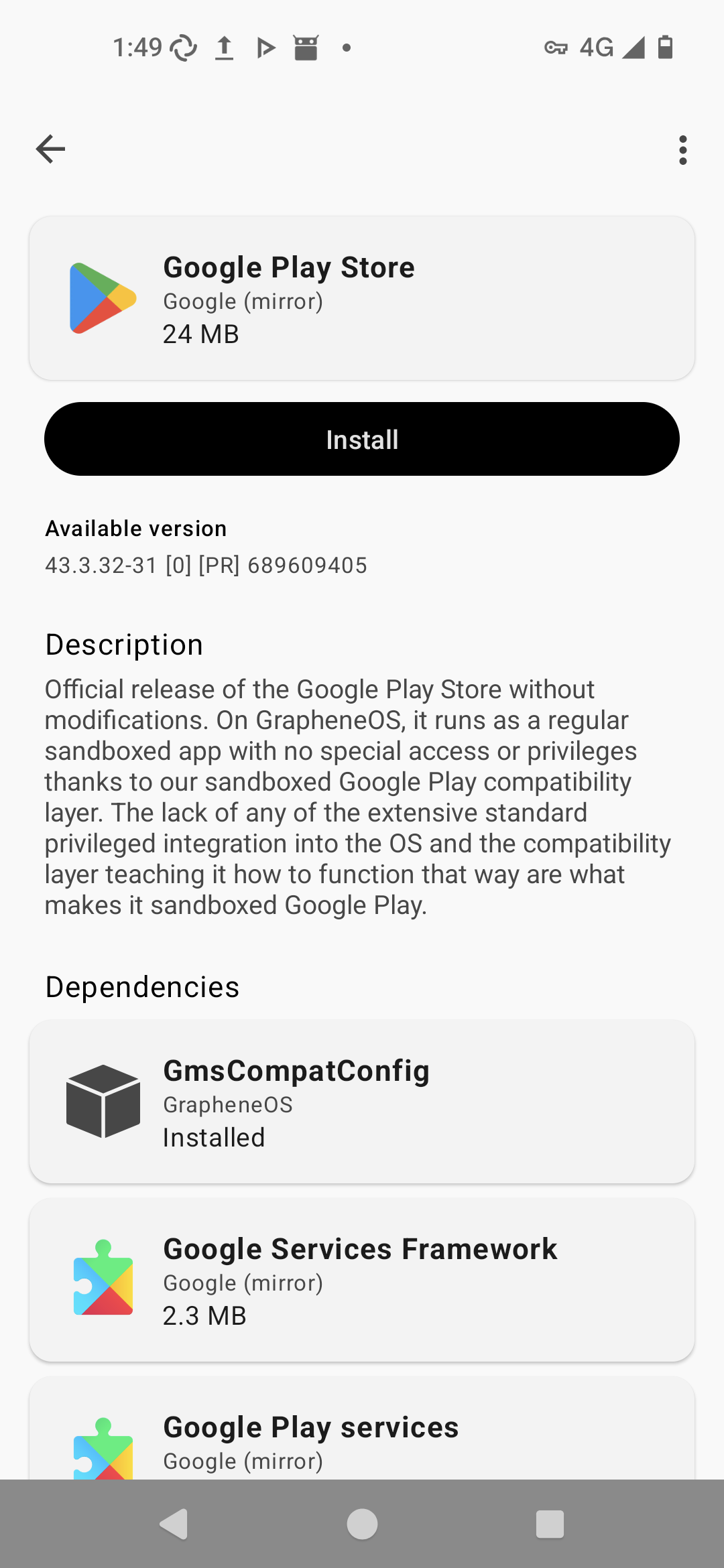
GrapheneOS provides fairly prominent links to a Google Play installer or the relatively obscure Aurora Store. The Aurora Store client app is FOSS but the store is quite literally a proxy for the Google Play Store. The apps in the screenshots on Ausora Store's homepage are mostly apps that use or require Google Play Services. This is all very Google-centric.
If Google Play wasn't an important part of GrapheneOS, it could just not contain a prominent link to the Google Play installer. Or it could contain a link to install a fairly prominent app store that offers an ecosystem outside of Google Play. But it exclusively steers users to the Google Play ecosystem as a part of the default, packaged experience, hence my original reply to the OP.
But it is Google Play-centric. There is an option to install Google Play. There is not an option to install other app stores like F-Droid, unlike some of the other AOSP clones.
Screenshot for you. Google is explicitly linked to for easy setup. F-Droid is not. "There is nothing" is simply disingenuous.
view more: next ›
I worked at a university in the IT area. The influence of the Big 4 was visible, with corporate coloured decisions being made that favoured large companies over internal capabilities.